Commentary: The DOJ isn't enforcing the law. It's protecting the president
Published in Op Eds
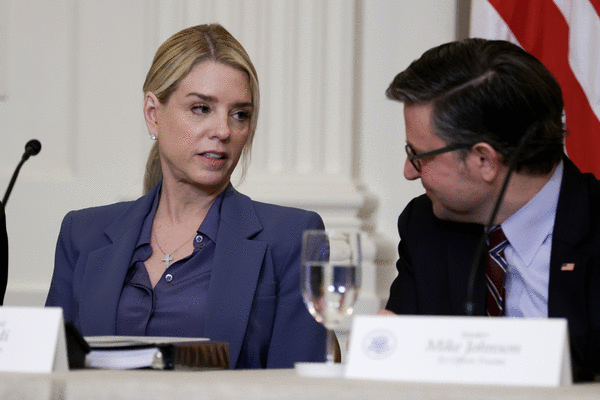
The Department of Justice in President Donald Trump’s second term has sometimes been referred to as the president’s personal law firm. But that characterization is unfair to law firms. Although private lawyers advocate zealously on behalf of their clients, most constrain themselves within the limits of the law and professional ethics.
Under Attorney General Pam Bondi, however, the Justice Department has too often acted less like a law enforcement agency than a political instrument for revenge. Bondi and her underlings have often worked to advance Trump’s interests by effectively making their own rules. The most recent example is the department’s deeply flawed compliance with the Epstein Files Transparency Act. The federal statute required Bondi to disclose all materials relating to the investigation of sex offender Jeffrey Epstein, with only narrowly tailored exceptions designed to protect victims, national security and ongoing criminal investigations.
But instead of diligently complying with this act of Congress, Bondi, Deputy Attorney General Todd Blanche and FBI Director Kash Patel appear to have made protecting Trump their primary mission. The Justice Department blew past the statute’s Dec. 19 deadline, failed to properly redact some private information about victims and survivors, and withheld documents relating to Trump that the law required be disclosed.
The Wall Street Journal reported that Bondi told Trump last May that his name appeared in the files. During the summer, Trump began downplaying their significance, posting on Truth Social that people should “not waste Time and Energy on Jeffrey Epstein, somebody that nobody cares about.”
In September, Patel testified before Congress that there was “no credible information” that Epstein trafficked underage girls to anyone besides himself. Last month, following the long-delayed disclosure of the files, Blanche said that “There was nothing” in the files “that allowed us to prosecute anybody.”
Nothing to see here, folks!
Meanwhile, the New York Times reported that as early as last summer, FBI agents were compiling a spreadsheet and PowerPoint presentation summarizing all of the “derogatory” references to Trump and other prominent men in the files. Among those references was a victim’s statement alleging that Trump sexually assaulted her. But the underlying documents were nowhere to be found in the department’s public database of files. It was only after a reporter noticed the discrepancy last week — and the ensuing public outcry — that the Justice Department finally released a set of FBI summaries of her interviews with investigators.
According to the report, the victim described an occasion in which Trump attempted to force her to perform oral sex on him when she was between the ages of 13 and 15. The accusations have not been corroborated, and Trump has repeatedly denied any wrongdoing in connection with Epstein.
Although unconfirmed allegations like this one are typically withheld from public disclosure to avoid harming a person’s reputation, the Epstein Files Transparency Act specified that “No record shall be withheld, delayed, or redacted on the basis of embarrassment, reputational harm, or political sensitivity, including to any government official, public figure, or foreign dignitary.”
Certainly, when any organization is asked to redact and produce more than 3 million documents in short order, some mistakes will be made. But we are apparently expected to believe that the very documents referencing Trump were simply the ones inadvertently left out. No chance. The idea that a mere oversight caused Justice Department officials to omit the Trump documents from the public database strains credulity.
The botched rollout of the files is emblematic of a Justice Department that serves the president instead of the American people. Last week alone, we saw the department withdraw and then reinstate its baseless legal fight against law firms that refused to enter into agreements with the Trump administration over their associations with certain lawyers and hiring practices. At the same time, a court quashed subpoenas demanding files from the Federal Reserve regarding Chair Jerome Powell, finding that “There is abundant evidence that the subpoenas’ dominant (if not sole) purpose is to harass and pressure Powell either to yield to the president or to resign and make way for a Fed chair who will.”
During testimony before the House Judiciary Committee last month, Bondi seemed less interested in fulfilling her duty to the American people than in performing for her boss. She spoke with open disdain for a separate and coequal branch of government, responding to questions by insulting House members and pointing to the value of the stock market rather than addressing lawmakers’ concerns about Epstein’s victims.
Trump seems to be molding the Justice Department in the image of his mentor, Roy Cohn. Cohn, a former federal prosecutor, served as chief counsel to Senator Joseph McCarthy’s “Red Scare” witch hunts of the 1950s and later represented members of New York’s crime families. A former Trump employee said that Cohn “tutored Trump to ignore the law.”
Trump first hired Cohn to defend himself and his father from a 1973 Department of Justice investigation into allegations of racial discrimination in their apartment rentals. The result was a settlement, but it went unenforced because of what a Politico profile called “Cohn’s shameless, time-buying tactics.” With a life that often mirrored the tactics he taught his pupil, Cohn was indicted four times but never convicted of any crime, though he would eventually be disbarred for “dishonesty, fraud, deceit and misrepresentation.” Cohn once told Penthouse magazine, “I decided long ago to make my own rules.”
As president, Trump made it clear that he expected similar conduct from government lawyers, famously complaining in 2017, when his first attorney general, Jeff Sessions, followed department ethics protocols and recused himself from the Russia investigation, “Where’s my Roy Cohn?” As described by National Public Radio, “The clear implication was that Cohn, the advocate who stopped at nothing, would never have cowered before a few departmental rules or procedural niceties.”
This time around, Trump has learned from his mistakes and assembled a team of Roy Cohns to lead the Justice Department. The banner bearing Trump’s scowling face above the entrance to the DOJ’s headquarters symbolizes its transformation from an institution named for a virtue into one that now places the president’s enemies in a vise.
____
This column reflects the personal views of the author and does not necessarily reflect the opinion of the editorial board or Bloomberg LP and its owners.
Barbara McQuade is a professor at the University of Michigan Law school, a former U.S. attorney and author of the forthcoming book, "The Fix: Saving America from the Corruption of a Mob-Style Government."
©2026 Bloomberg L.P. Visit bloomberg.com/opinion. Distributed by Tribune Content Agency, LLC.


















































Comments