Commentary: The trillion dollar Iran war
Published in Op Eds
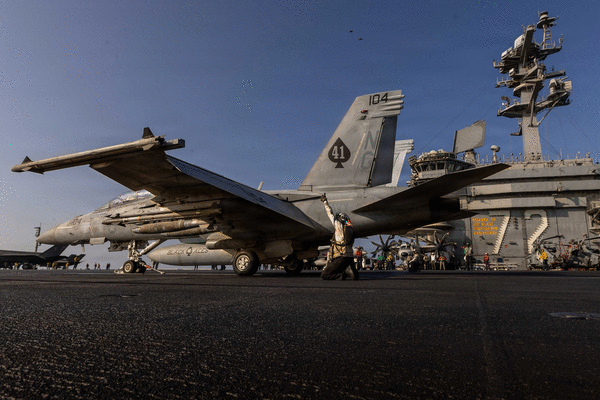
In late 2002, as the U.S. was on the precipice of invading Iraq, the president’s top budget official estimated that the war would cost as little as $50 billion dollars. That conflict ultimately cost American taxpayers more than $3 trillion, and we’re still paying the bill. Fast-forward to 2026 and the U.S. has embarked on another war of choice in the Middle East and the price-tag is once again a mere $50 billion we’re told. Sound familiar?
To use a saying that President George W. Bush famously bungled in the lead-up to the Iraq war: “Fool me once, shame on you. Fool me twice, shame on me.” Before this current crisis truly spins out of control, it's imperative that we fully understand the true costs of this war and don’t get fooled again.
For starters, there are the direct military costs of the war. Those estimates vary widely and increase daily. In just the first days of the conflict cost estimates ranged from $3.7 billion to over $5 billion. During the conflict the U.S. has used hundreds of missiles – including Tomahawks and Patriots – with price tags around $4 million each. The U.S. has also lost incredibly expensive military equipment, including three fighter jets that cost around $100 million each, and more than $2 billion worth of U.S. radar systems in the region.
In private briefings, the Trump administration has conceded that the war could be costing nearly $2 billion per day. That number may increase markedly if the U.S. puts boots on the ground, something Trump hasn’t ruled out. And even without a major land component, the fact that the president keeps expanding U.S. war aims could mean an open-ended conflict with no clear conclusion in sight, which would multiply the ultimate costs enormously.
Even these huge spending levels don’t account for the long-term costs of the war. Linda Billmes – who was one of the first to report that the true costs of the Iraq war were in the trillions of dollars – has recently explained that the true costs of the Iran war could easily surpass $1 trillion when the costs of veterans care and interest payments on the debt we’re accruing are accounted for.
And, that’s just the direct costs to Americans, who will also indirectly be paying for the war as they go about their daily lives. The cost of gas has increased over 60 cents per gallon since the war began. While American families bear this cost immediately, it won’t be long before this trickles down to increasing the costs of just about everything we buy, as inflation is poised to skyrocket. Some economists are sounding the alarm that this could result in inflation staying elevated for years.
All of this ignores the human costs of a war that is actually endangering the American people. At least 13 U.S. troops have already paid the ultimate price in the conflict and more than 100 have been injured, some severely.
As horrific and pointless as this war has been, it’s not too late to stop it in its tracks. The current war will impose a huge cost in dollars. But it will impose an even larger cost in human lives and strategic instability – costs we will be paying for decades. The sooner this conflict can be brought to a close, the sooner we stop piling up the costs and passing them on to generations to come.
We simply cannot afford to double down on another misguided war of choice that will make America a weaker nation and the world a more dangerous place.
____
The Quincy Institute's Ben Freeman and Bill Hartung are authors of the recent book "The Trillion Dollar War Machine: How Runaway Military Spending Drives America into Foreign Wars and Bankrupts Us at Home."
___
©2026 Tribune Content Agency, LLC.


















































Comments