Anita Chabria: Should child rapists be released just because they're old? Maybe
Published in Op Eds

SACRAMENTO, Calif. — Murder is considered the worst crime out there, but for my money, it’s child rapists who are the worst of the worst — especially the serial ones who destroy one life after another.
That’s wholly subjective on my part, but I doubt I’m alone. Which is why I was far from surprised at the outrage that accompanied two recent, successful parole hearings for convicted serial child predators in Sacramento.
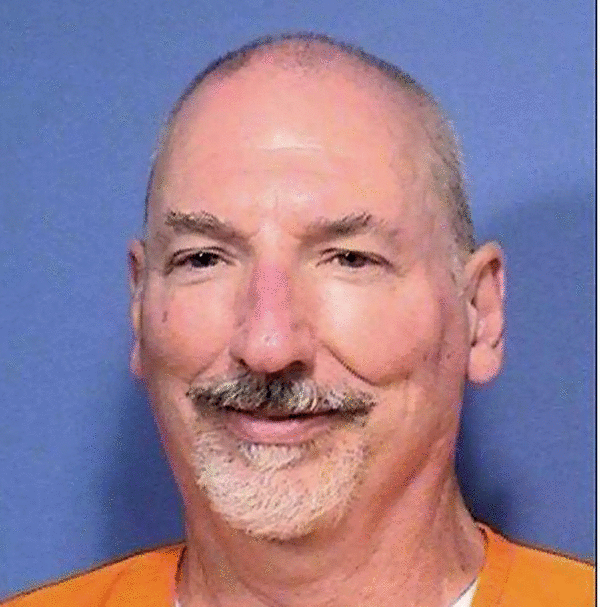
Gregory Lee Vogelsang, 57, and David Funston, 64, both attacked children and were granted parole through California’s elderly parole program — though both remain behind bars for now.
But the fury over the possibility of their freedom has put the state’s controversial elderly parole program under scrutiny — again — and led to a flurry of legislation to add new restrictions. Should sex offenders be excluded? Especially heinous murderers? Everyone under the age of 75?
It’s easy to answer “yes” to all of the above.
“Part of the problem we have is we shouldn’t be making policy decisions based on speculation and on scary rhetoric that’s disconnected from the facts,” Keith Wattley told me. He’s the founder and director of UnCommon Law, a nonprofit that provides legal services and parole advocacy.
“That’s how politicians make people afraid, but it shouldn’t be how we make law,” he said.
And he’s right, as grotesque as these headline-grabbing cases are. In 2024, there were 3,580 elderly parole hearings and 606 people were granted that relief. Most have remained law-abiding. In the 2019-20 year, the most recent recidivism statistics available from CDCR, 221 people were granted elderly parole. Within three years, only four had been convicted of new crimes, and only one of those was a felony for a crime against a person. That tracks with lots of data that shows men generally age out of violent crimes.
But Funston and Vogelsang are the worst of what we fear when we talk about parole, and their cases rightfully make us wonder what the heck the parole board is doing. Though Gov. Gavin Newsom sent both of these decisions back for review, it’s easy to imagine the attack ads should he run for president: Under Newsom’s watch, child rapists walked free.
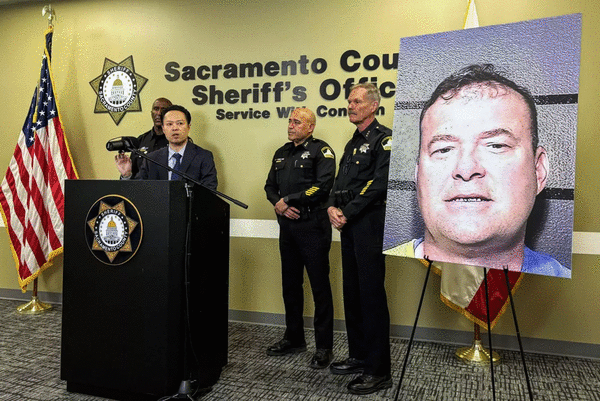
“Elder parole has gone too far,” Thien Ho, the Sacramento district attorney whose office prosecuted both men, told me. “I support the opportunity of people to be rehabilitated. But I think that certain individuals, in my opinion, and in my experience, cannot be rehabilitated.”
Here’s where I’m going to make a lot of folks mad on both sides of this issue. I agree with Ho, but also, I agree with Wattley. I don’t think we can pass laws based on our grimmest view of humanity. Removing hope from the system turns our prisons into dungeons and does not ultimately serve public safety.
But then, neither does releasing child molesters into our communities.
Lost in all the wrath about these two cases is the difficult business of justice that led to the early release law in 2014, and any interest in the hard and nuanced conversation that we need to have around terrible crimes. It’s easy and popular to say no violent criminal should ever be released, but we can’t just lock up everyone with no possibility of ever getting out because the “R” in CDCR stands for “rehabilitation,” and also — we just can’t afford the forever scenario, morally or fiscally.
California tried the throw-away-the-key model in the 1980s and ‘90s and ended up with prisons so overcrowded that the federal courts stepped in. The original elderly parole effort came through a 2014 court decision on overcrowding that gave inmates 60 or older who had served at least 25 years a chance to go before the parole board. A chance — no guaranteed freedom, and usually it takes multiple hearings years apart before the board approves it.
Later, the Legislature expanded elderly parole to inmates 50 or older who had served 20 years, but excluded those sentenced under the “three strikes” law or those who had murdered peace officers.
The reality is California has a lot of old, aging and sick people behind bars — at great expense. As we grapple with the idea of universal health care, there’s one place in California where it already exists — our prisons and jails. We currently pay more than $41,000 in health care costs per inmate per year, according to the Legislative Analyst’s Office.
I’m not going to tell you it’s the best health care, but it’s taxpayer-funded, and includes even long-term dementia care. And yes, we do have incarcerated dementia patients.
“This is about reducing our prison population and our liability to cover housing and health care for an aging prison population, and we have to balance that with the safety of the community and the rights of victims,” state Assemblymember Maggy Krell (D-Sacramento) told me. She’s sponsoring a bill that would create an additional layer of safety around sex crimes by referring these possible parolees to the civil system that evaluates sexually violent predators for confinement in mental facilities after their prison terms.
“Under some circumstances, it is worth considering paroling some of these defendants,” she said, with the kind of thoughtful rationality sure to offend many. “But the cases that you’re seeing right now are completely egregious, and those defendants should not be released.”
Vogelsang was convicted of almost 30 counts of kidnapping and sex crimes, against kids as young as 5. He’s served 27 years of a 355-year sentence.
David Allen Funston was convicted in 1999 of 16 counts of kidnapping and child molestation for kids as young as toddlers. He was sentenced to three consecutive 25-to-life prison sentences. Newsom bounced his first successful parole bid back to the parole board for a review, and on Feb. 18, it affirmed its decision.
But Placer County prosecutors quickly charged him with an old crime that had never been filed due to the Sacramento case, and he remains incarcerated awaiting trial on those charges.
Vogelsang’s case particularly raised a red flag for me. He told the parole board he’s been working successfully for about five years to control his thoughts about children.
“I don’t want to become aroused, but I know it’s always going to be there,” he said during the hearing.
Newsom also sent Vogelsang’s case back for review, and he will go before the board again on March 18. Vogelsang’s testimony was concerning enough that if I had a vote in this, I’d probably ask him to come back again in a few years, but we’ll see what the board does.
I’ll admit my decision would be emotional, and these cases do make me wonder. But Wattley is right that condemning elderly parole based on the monstrous deeds of these child predators is shortsighted. There is likely little to no public safety benefit in raising the overall age for elderly parole, and certainly no fiscal benefit.
“When you’re paying for older, sicker people to be incarcerated, and they don’t pose a risk to public safety, what are we actually getting for that? We’re not getting anything that supports survivors. We’re not getting anything that prevents crime. We’re just spending taxpayer dollars on something that doesn’t correlate with the public safety risk,” Wattley pointed out.
As hard as it is to wrap our minds around, it’s best for public safety to allow even the worst of the worst their chance in front of the parole board. It may even make sense for some who have committed truly terrible crimes decades ago to be released, if there is strong evidence of change and a low risk to public safety. That’s the kind of fair and realistic justice that no one on either side of the issue wants to talk about.
I’m not convinced Vogelsang and Funston have met those bars. But that doesn’t mean we should throw out the bars.
©2026 Los Angeles Times. Visit at latimes.com. Distributed by Tribune Content Agency, LLC.




















































Comments