Commentary: Why the rent-control movement is growing
Published in Op Eds
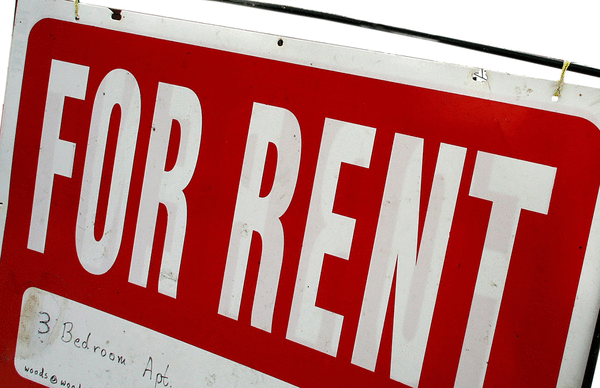
From Maine to New York to Illinois to California, and many places in-between, a national rent-control movement is rising up — and Big Real Estate is running scared. That’s as it should be, because a successful movement would make it much harder for the real estate industry to rent gouge tenants.
Rent regulations have a long history of protecting hard-working people in America. Soon after World War I, elected officials created fair rent commissions and rent control in dozens of U.S. cities. During World War II, the federal government expanded rent control, with states creating their own rent regulations in the 1950s. In the 1970s, President Richard Nixon pushed for temporary rent controls, prompting U.S. cities to create permanent rent regulations.
This was all done to stop Americans from drowning under sky-high rents and to prevent seniors, families and millions of others from falling into homelessness. Rent control urgently helped people by giving them direct relief, unlike the self-serving, trickle-down housing policies pushed by the real estate industry.
So it’s not surprising that a national rent-control movement is growing, right now, in the United States. With unaffordable rents linked to higher mortality rates and increased homelessness, which has resulted in more people dying in the streets, Americans need immediate help.
In Maine and other states, mobile home owners, who have to rent land at a mobile home park, are demanding rent regulations as corporate landlords buy up properties and quickly charge sky-high rent hikes. In Rhode Island, the Providence City Council is considering a new rent-stabilization ordinance because of unfair, excessive rents.
In Illinois, activists are pushing to revoke that state’s rent-control ban and allow local voters to approve rent control. In California, the Santa Barbara City Council just passed a one-year moratorium on rent hikes and the Salinas City Council voted to put the city’s rent stabilization and rental-protection ordinances on the November 2026 ballot.
And New York City’s new mayor, Zohran Mamdani, wants to establish a rent freeze for rent-stabilized units. He has already succeeded in raising nationwide awareness of the need for rent control, inspiring activists across the country to fight for rent regulations.
These are just a few examples of a national rent-control movement gathering steam. But activists and tenants can’t fight their battles separately. Corporate landlords, developers and real estate lobbying groups will spend hundreds of millions of dollars to defeat rent-control movements anywhere in the country. The only way to overcome those millions is to have a unified, people-power rent-control movement.
In addition, activists understand that rent control is just one part of a multi-pronged approach to address the housing affordability and homelessness crises. Politicians must implement what are known as the 3 Ps: protect tenants through rent control and other protections; preserve existing affordable housing, not demolish it to make way for unaffordable luxury housing; and produce new affordable and homeless housing using such concepts as adaptive reuse and prefabricated housing.
In the meantime, Big Real Estate is trying to flood newspapers and news sites with outdated and flawed anti-rent-control arguments, fearing rent regulations will finally rein in their predatory business practices.
But in the Harvard Business Review, experts with the Open Markets Institute clearly explained that rent regulations are a crucial tool to protect Americans against runaway corporate greed. In 2023, a group of 32 top economists wrote a letter to the Biden administration that said rent regulations are desperately needed.
Respected housing experts at the University of Southern California and University of California, Berkeley also released studies that explain that rent control is a tool politicians must utilize to protect their constituents. They also found that Big Real Estate’s arguments against rent control are scantily researched and disingenuous.
Rent regulations will directly, and urgently, help poor and middle-class and working-class Americans who are being forced to pay unfair, excessive rents month after month. Millions of hard-working tenants understand that, and that’s why a national rent-control movement is only growing in the United States.
_____
Patrick Range McDonald is the award-winning advocacy journalist for Housing Is A Human Right, the housing advocacy division of AIDS Healthcare Foundation. This column was produced for Progressive Perspectives, a project of The Progressive magazine, and distributed by Tribune News Service.
_____
©2026 Tribune Content Agency, LLC.





















































Comments