Commentary: Why MAHA must be family first to succeed
Published in Op Eds
A couple weeks ago, Calley Means, the man responsible for securing the MAGA/MAHA alliance between Donald J. Trump and Robert F. Kennedy Jr., took to X to call out The New York Times for describing home cooking as “unpaid labor that tends to fall disproportionately on women.”
This feminist propaganda came from an article titled “We Shouldn’t Want to Eat Like Our Great-Great-Grandparents.” In the print version of the Times, the article was entitled, “Stop Worrying and Learn to Love Industrial Food.” Only the paper’s remaining customers who pay for its nonsense would ever take a headline like this seriously.
It’s difficult to point out all the lies and frankly, stupidity, in this article that tries to defend industrial food as superior to what our great-grandparents would whip up on a random Tuesday afternoon in the kitchen. It claims the bagel you are eating is “affordable, convenient and nutritious” and that even vegetables are part of an “industrial system.”
In an age of obesity, a bagel’s nutrition density could be easily contested. And while vegetables are part of an industrial system that transports fruit to the United States in the dead of winter, no reasonable person would argue that blueberries from Latin America have the same nutritional value as a Twinkie.
Per usual, The New York Times fails to make distinctions or even acknowledge a hierarchy of competing alternatives—such as having a mother in the home full time, which will almost always result in healthier children. And a two-parent home increases the odds that one of those parents – yes, usually the mother – has more time to tend to the needs of children, including their nutritional needs.
A significant amount of research shows that a two-parent nuclear family – consisting of a mother and a father – results in better physical and mental health for children. An abstract from a 2014 study says that “Nearly three decades of research evaluating the impact of family structure on the health and well-being of children demonstrates that children living with their married, biological parents consistently have better physical, emotional, and academic well-being.”
Another report from the Institute of Family Studies based on CDC data found that “Kids living with two married parents were more likely than those from other types of families to be in excellent or very good health, and less likely to suffer from chronic health problems, poor behavior, and severe emotional difficulties.”
Yet The New York Times, as it has for decades, tries to convince its readers that domestic activity, including cooking, is essentially slave labor, unworthy of any woman’s time and energy.
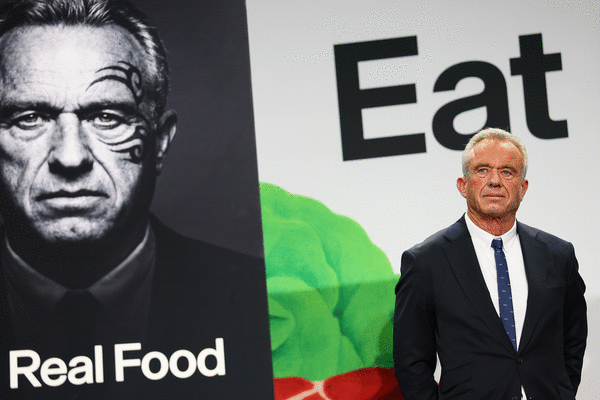
Fortunately, Kennedy’s HHS knows better. From Super Bowl commercials to Instagram posts, city billboards to graphically pleasing websites, the message the department is sending is simple: Eat Real Food. Yes, real, less-processed food does take more time to prepare and cook. But the notion that a woman is more valuable in the workplace than in her home, and that her child’s health isn’t worth the sacrifice, is a lie.
This is the problem with a Left – and a media that supports it – that has increasingly embraced Marxist principles: Everything is reduced to an economic unit of measurement. Sacrifice is reduced to slavery rather than an expression of love. According to today’s feminists, who almost always identify themselves as left of center, the most valuable thing about a woman is her earning potential rather than her potential to carry and deliver the miracle of life.
Parents pass down healthy habits, not only through food choices, but through family traditions, cultural rituals, and spiritual practices like fasting and religious feasts. Conversations and connections happen at the dinner table. Fathers provide for the household, but mothers are the heart of home. Both are needed to nourish and feed a child’s body, mind and soul. Remove either a mother or a father, and a child’s chances of growing into healthy, happy and thriving members of society diminish.
In reclaiming the kitchen as a sanctuary of love and legacy – not drudgery – families are fortified and children inherit healthier bodies and resilient spirits for a stronger, healthier America. This should be the legacy of MAHA.
____
Jennifer Galardi is a Senior Policy Analyst for Restoring American Wellness in Heritage’s DeVos Center.
_____
©2026 Tribune Content Agency, LLC.





















































Comments