Kaitlyn Buss: Jeffrey Epstein case forges a rare, cynical American consensus
Published in Op Eds
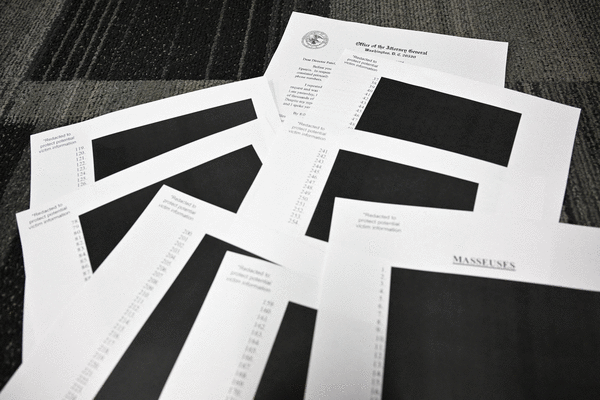
Jeffrey Epstein has become one of the few scandals that unites Americans in cynicism.
The case is about far more than sex crimes. It has crystallized a suspicion many Americans across party lines already carried — there is one set of rules for the powerful and another for everyone else.
With each new release of documents, flight logs and testimony, the public is confronted with not just the depravity of one man, but with the social orbit that surrounded him. We can see how close he was to people who sit at the top of global politics, finance and culture.
Presidents, billionaires, royalty, intelligence officials and cultural elites appear in records tied to Epstein’s world.
Their presence alone does not prove criminal wrongdoing. But the slow drip of revelations has reinforced a perception that power protects itself and that ordinary citizens live under a different standard.
Politically, the impact is reshaping behavior, party loyalty and coalitions on both sides with the potential to be a defining issue in the midterms.
But the deeper problem is the continued erosion of trust in the government and its legitimacy.
Epstein died in federal custody in 2019, awaiting trial on sex trafficking charges. His partner and associate, Ghislaine Maxwell, is serving a 20-year sentence.
Beyond that, there has been little visible accountability tied to the broader network Americans were told — and can ascertain from the Justice Dept. files — existed.
Average Americans watching this saga unfold believe that if it were happening to anyone else, the outcome would likely look different.
That belief lands atop a country that already does not trust its government. Years of high-profile controversies — plea deals, pardons and investigations that feel politicized depending on who is involved — have left Americans skeptical that justice is blind.
Trust in Washington has hovered near historic lows.
Just 17% of Americans now say they trust Washington to do what is right “just about always” or “most of the time,” according to December 2025 Pew Research Center data — one of the lowest readings in the survey’s nearly 70-year history. (That’s far lower than their trust in local news organizations.)
More severely, two-thirds of Americans believe the federal government is intentionally withholding information, according to a recent poll.
Half of Americans are not satisfied with the Trump administration's handling of the release of the Epstein documents, according to a survey released Jan. 19.
But the Epstein files didn’t create this distrust. They expanded the realm of what Americans believe is possible behind closed doors — and deepened a suspicion that elites operate by different rules.
The Epstein story resonates deeply across ideological lines precisely because it confirmed instincts Americans already had about the system and the institutions that uphold it.
If Americans conclude that accountability is optional and that their lives are part of a rigged game, that damage to the public sphere will outlast this single scandal. Whether every allegation is true and the conclusion that justice is rigged is fair is almost irrelevant. The perception that injustice is tolerated is dangerous enough.
One man’s crimes have exposed how fragile Americans believe the promise of equal “justice for all” has become. Repairing that requires more than simply releasing documents.
_____
©2026 www.detroitnews.com. Visit at detroitnews.com. Distributed by Tribune Content Agency, LLC.





















































Comments