Editorial: Warsh looks like a smart choice for the Fed... for now
Published in Op Eds
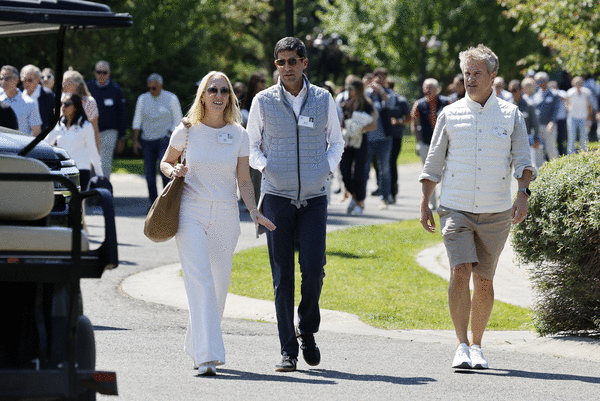
The nomination of Kevin Warsh as next chair of the Federal Reserve is good news. He’s amply qualified for the role, having served as a Fed governor from 2006 to 2011. He has argued throughout for the central bank to narrow its focus to controlling inflation and to rely less on balance-sheet operations, positions for which there are strong arguments. He was the best of the leading contenders.
For now, his thinking on the economy aligns pretty well with the president’s — he wouldn’t have been nominated otherwise. The big questions are how long it will be before they disagree and what happens then.
Warsh’s critics accuse him of inconsistency on the crucial issue: Long seen as an inflation hawk, he’s lately called for lower interest rates, as demanded by the White House, even though inflation remains persistently above target and the economy is at full employment and growing well. What kind of hawk is that? they ask.
The legitimate answer is: a supply-side optimist. In recent commentary, Warsh has emphasized the potential of the AI revolution, lower taxes, and lighter regulation to transform productivity and boost growth. Under these conditions, he says, signs of faster growth shouldn’t be blindly greeted as predictors of excess demand and rising inflation that call for high rates. This echoes a theme that the White House has lately emphasized in its attacks on the Fed: Faster growth is good news, not bad news.
If the economy really does stand at a supply-side turning point, this basic argument makes sense even for an inflation hawk. But, as yet, it’s impossible to know whether the economy is indeed at such a point. For the moment, upside and downside risks to growth and inflation therefore need to be balanced, as Fed Chair Jerome Powell tirelessly says. Warsh’s views are more consistent than his critics charge, but they aren’t entirely prudent.
More specifically, even a supply-side optimist can’t easily explain why the current policy rate, which the Fed left unchanged last week, is unduly “restrictive.” It’s one thing to say that, despite firm growth and persistent higher-than-target inflation, the policy rate shouldn’t be raised — because inflation is subsiding and the effect of tariffs on prices is temporary. It’s a lot harder to claim that the current rate is squeezing financial markets and choking growth, and therefore needs to be cut.
Rarely has the economy been so difficult to read. As Powell noted, measures of consumer sentiment are weak, yet households in the aggregate keep spending freely. On most measures, the labor market remains firm, yet employers like Amazon.com Inc. keep announcing layoffs. Inflation expectations look tolerably well-anchored, yet long-term interest rates (which build in a premium for inflation risk) are up.
Consumers and producers alike are struggling to keep up with the administration’s ever-changing tariffs (actual and threatened). Enormous investment in AI is buoying aggregate demand and might radically improve productivity — while dramatically changing the economy, making forecasts of output, employment, wages and inflation all the more uncertain. On the whole, the stock market is delighted, yet prices of gold and precious metals have surged and the dollar has dropped, signals of growing unease.
Given all this, it’s wise to let the data cast further light before moving again, as Powell explained last week. And there’s simply no case for cutting the policy rate by two full points or more, as the White House has proposed.
It’s heartening that Warsh has often emphasized the benefits of central bank independence — a theme he presumably didn’t press in his conversations with the president. But how willing is the nominee to disagree with the White House if the need arises? Sooner or later, a supply-side optimist who’s also an inflation hawk is going to fall out with a president who wants interest rates close to zero under all circumstances. What then?
_____
The Editorial Board publishes the views of the editors across a range of national and global affairs.
_____
©2026 Bloomberg L.P. Visit bloomberg.com/opinion. Distributed by Tribune Content Agency, LLC.


















































Comments