Commentary: War on drugs never has been, nor will it be, the answer
Published in Op Eds
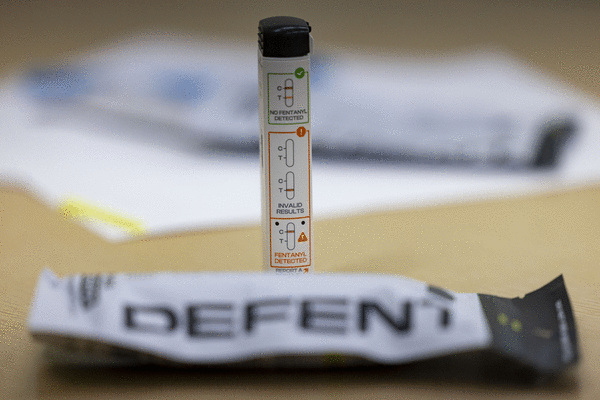
With news of multimillion-dollar lawsuits arising from President Donald Trump administration’s military incursion to apprehend Venezuelan leader Nicolás Maduro, America’s drug problem remains front and center. The White House demonstrated it believes a military campaign against alleged drug trafficking from Venezuela is central to protecting Americans. I won’t decry that effort. Reining in the supply of illegal drugs will always be crucial, but it’s not the principal solution.
In the 1970s, beginning with Richard Nixon’s White House, crushing the supply line was the focus of U.S. strategic policy. But that changed early this decade when it became clear this was an ineffective primary approach — something the Trump administration would do well to acknowledge.
In the ’70s and ’80s, the drug trade was a thriving business with all the hallmarks. Sales were booming. Innovation was a strategic priority with new products emerging. The cartels found unique ways to get the products into the U.S. and to their consumers. Today, the digital-age explosion sees the cartel wholesalers and the local dealer leveraging the internet, smartphones and cashless payment systems to create an entirely digital marketplace. Throughout these different snapshots in time, we’ve seen sectors evolve, all while the so-called war on drugs has been in full force. But the war on drugs is not the key solution.
So what is the path forward if trouncing the supply lines won’t produce results? As a pharmacist-scientist at a prominent institution who has researched new ways to curb opioid addiction, I’ve thought long and hard about the best direction. The reality is that America needs to refocus its energy on driving down the demand. The American street drug trade is a steamrolling business engine. Let’s treat it that way. Suppliers operating in a thriving market will always rise to meet the demand, and they’ll exit the market when it’s no longer profitable to stay in the game. I’m urging my fellow citizens to join me in the call to curb the demand.
The drug problem is fueled by a deadly trend of rising demand. Someone who’s facing that daunting battle is fighting against a very powerful force. Substance use disorders are the result of ever-growing demand for dopamine stimulation in patients’ brains. Sadly, opioid disorders are the standard-bearers for this problem. Millions of American families know all too well the power of that driving force. Maddeningly, the cartels and dealers know just how to capitalize on that overpowering reality of the human condition. They’re harnessing it to drive sales.
With that in mind, consider this a call to action. We need a full commitment from Americans on the street, and our leaders, to help those battling addiction and misuse disorders gain control over the dopamine driving force. When we do that, we’ll regain control over the recently declining death toll by reining in the predominant market force.
Controlling the demand takes a community effort. We need to invest time, energy and money into unique solutions that give people the ability to change the course of their addictions and recover by effectively integrating back into their communities. The budgeting process needs to fund federal and state programs to treat substance abuse.
We need to support efforts to bring effective treatments to patients suffering from daily pain. Plenty of Americans suffer injuries and have surgery every day. Programs to teach patients how to manage their pain and focus on recovering from injuries or surgery are an untapped resource.
For instance, I’m co-leading a group that’s studying a program that teaches patients to treat pain based on answers to questions about their functional abilities. The idea is if patients can stick to over-the-counter drugs such as ibuprofen and acetaminophen to treat their pain, they’ll rely less on opioids. Surgery and injury recovery are significant entry points to the river of despair that becomes opioid use disorders and addiction. As an example, a 2021 study in the Journal of the American Medical Association found nearly 7% of people continue using an opioid one year after surgery when they’d never used them prior to surgery. That’s never the intent when we give patients opioid pain medication. If we can make this commitment, we’ll make an impact far greater than a forceful attack on the supply lines.
We’re at an inflection point. In the last two years, America has seen great strides in causing the opioid death toll to plummet. It’s a source of great pride, and we need to harness it. The reality is that the battle to help our families, friends, co-workers and neighbors win this fight means we need to press forward with this momentum. We need to be vocal and challenge our leaders in Washington, D.C., and at home to prioritize efforts to promote healing and healthy behaviors.
When we do this, we’ll shrink the demand for products and create a business with less profitability. In the end, reining in demand will be more powerful than attacking the supply. The war on drugs is not the principal solution, because it never has been, and it never will be.
____
Sterling Elliott is a faculty member and researcher in the Department of Orthopaedic Surgery at Northwestern University Feinberg School of Medicine in Chicago.
___
©2026 Chicago Tribune. Visit at chicagotribune.com. Distributed by Tribune Content Agency, LLC.

















































Comments