Andreas Kluth: At Davos, the world rebalanced against a bully
Published in Op Eds
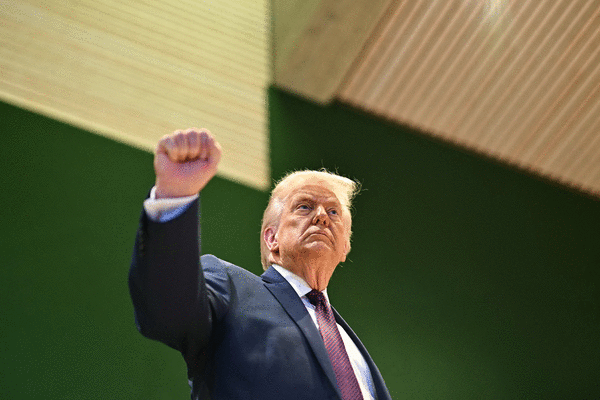
Better late than never: One year into the second presidency of Donald Trump, the world has reached an inflection point, as Canada’s prime minister, Mark Carney, made explicit in his speech at an economic summit in Davos. Having tried and failed to appease Trump’s imperialist bullying, middle powers such as his own country must and will instead “act together, because if we’re not at the table, we’re on the menu.”
Acting together, Carney said, will take the form of “variable geometries.” Countries, whether traditional friends or foes of the United States, may form ad hoc coalitions to pursue specific interests, trade pacts to replace commercial links to the U.S. that Trump has damaged or severed, cooperation in new or existing multilateral forums or even new military alliances.
This reaction to Trumpism is exactly what international-relations theory predicted. In the 1980s, the realist scholar Stephen Walt, nowadays at the Harvard Kennedy School, formulated the “balance of threat” hypothesis of world affairs. It said that states tend to form alliances to counter countries that are simultaneously mighty and hostile.
At the time, Walt’s insight addressed a shortcoming in conventional wisdom, which stipulated that a balance of power was the default tendency in world politics. That theory fit the 19th century, for example. The problem was that it couldn’t explain the Cold War, when one of the superpowers, the United States, attracted rather than repelled many middle and small powers, with no counterbalancing to speak of. The dissonance became even starker after the Cold War, when the U.S. became a hyperpower and still kept adding allies, totaling about 70.
What made the U.S. historically unusual, of course, is that for about eight decades it was a controversial but largely benevolent hegemon of the international system, one that provided global public goods such as open trade, international law and a modicum of order. To countries from Canada to Denmark and South Korea, America looked powerful but protective rather than threatening.
Trump, as you may have noticed, flipped that stance into powerful and menacing. Not only is he fond of what Jake Sullivan and Jon Finer, the top national security advisors to Trump’s predecessor, call “flamboyant violence” — force for show rather than long-term strategic advantage, as in Venezuela recently. Trump also threatens middle powers that are close allies, such as Canada and Danish Greenland, with annexation — even if this week he seemed to tone down his tariff assault against Europe over Greenland.
The enigma of the past year was that this new phenomenon of an aggressive America did not cause a balance of threat. Aside from the autocrats of China and Russia, who either stared Trump down or strung him along, most leaders from Europe to the Middle East and Asia tried to flatter and kowtow to the American president. They’ve gifted him golden crowns, luxury jets and crypto deals; nominated him for a Nobel Peace Prize; or simply fawned as though trying to win an Oscar. The leader of NATO went so far as to call Trump “daddy.”
I asked Walt whether he was surprised that his balance-of-threat theory didn’t kick in for a while. Not really, he told me, because “reacting against the U.S. as a threat is costly,” and the countries that Trump has offended or economically harassed are numerous enough to pose a “collective-action problem.” It’s only now dawning on allies that “accommodation isn’t working” because Trump is a “predatory hegemon,” and “there is no such thing as a lasting deal with a predatory hegemon.”
Now, though, the penny has dropped and the rebalancing has begun. Some countries are forming new security pacts, as Saudi Arabia and Pakistan recently did. The European Union and Mercosur, a South American trade bloc, accelerated talks about a mega-deal after decades of being stuck. India, whose leader used to be chummy with Trump, is warming up ties to China and others. And a whole succession of leaders from countries that are nominally still American allies — Britain, Germany, South Korea — are wooing rather than shunning Beijing to deepen economic cooperation. (1)
Carney’s Canada is a good example. He has been opening commercial and diplomatic doors from Europe to India. He even visited China, after a brief ice age in bilateral relations since 2018 (when Canada arrested a Chinese executive who was wanted in the U.S. and China retaliated by detaining two Canadians). Now Beijing and Ottawa have a “strategic partnership.” The goal, Carney has said, is to wean Canada from its big American neighbor.
The hardest and slowest threat balancing is the military sort, because America’s preponderance in hard power is so overwhelming. “I don’t see a non-U.S. NATO forming an alliance with China,” Walt told me. But as countries in Europe and Asia re-arm, they may start thinking twice about buying their kit from the Americans, and may even consider building their own nuclear arsenals now that the U.S. “umbrella” seems leaky.
America First will sooner or later become America Alone, I predicted about a year ago. The world, after trying in vain to placate its predatory hegemon, now seems to have started the hard work of rebalancing.
____
(1) 1 China, incidentally, just clocked its biggest trade surplus ever, despite Trump’s tariffs, after more than replacing its lost exports to the U.S. with exports to the rest of Asia, Europe and other places.
____
This column reflects the personal views of the author and does not necessarily reflect the opinion of the editorial board or Bloomberg LP and its owners.
Andreas Kluth is a Bloomberg Opinion columnist covering U.S. diplomacy, national security and geopolitics. Previously, he was editor-in-chief of Handelsblatt Global and a writer for the Economist.
©2026 Bloomberg L.P. Visit bloomberg.com/opinion. Distributed by Tribune Content Agency, LLC.



















































Comments