Beth Kowitt: America's à la carte economy is making everyone feel poorer
Published in Op Eds
Over the winter break, I took my family to see the light show at the Bronx Zoo. Here, among the sea lions and penguins, holiday magic does not come cheap. I expected to have to negotiate some extras with my kids (yes to s’mores, no to the bubble wands). But there were the surprise add-ons, too, from the $4 train ride that went twice around the parking lot to the $7 per person for a spin on the carousel.
At the school bus stop the first day back after vacation, a fellow parent lamented about the relentless upselling tactics he’d faced during a family trip to a Great Wolf Lodge water park — for an interactive scavenger game, for a late checkout, for a themed suite. When I brought up the onslaught of drip pricing at work, one colleague said her family had drawn the line at the extra $20 for the human crane at Dave & Buster’s. Another recounted the pressures to pony up for the aerial ropes course at a local rock-climbing center.
Call it the à la carte economy, with an add-on, up-sell or “optimization” around every corner. Companies have gotten smart to the practice of unbundling: break down the cost of a product or service into its component parts, advertise the lower sticker price, and then spin the additional costs to consumers as a perk that offers customization and freedom and choice.
But the ancillary revenue revolution, as some have dubbed it, is exacerbating the deepening sense among many in this country that they can’t keep up. It’s hard to feel like you have made it when there’s always another way to upgrade to more — a carousel or train to ride, a ropes course to scale. And worse, you are very likely getting a close-up view of someone who did. It’s no wonder that lower- and middle-income Americans are feeling far gloomier about the state of the economy than the wealthiest.
“Companies are going to make it pretty clear that you’re missing out. It’s not harmless,” says Neale Mahoney, a professor of economics at Stanford University who has researched added fees and services.
Studies have shown that as ancillary fees increase, the perception of fairness among consumers decreases. This phenomenon is especially stark in the service industry, where trusting the seller is critical because value is more intangible.
But rather than focusing on creating more value or lowering costs, the allure of revenue from drip pricing can “distort the direction of innovation” toward creating new and larger fees, as Neale has pointed out. Sure enough, at 13.9%, profit margins for America’s biggest companies as represented by the members of the benchmark S&P 500 Index, are forecast to be a record this year, according to FactSet.
The great unbundling began in earnest post-9/11 when airlines needed to find ways to increase their revenue after the terrorist attacks decimated their sector. Services and goods that were once included — a meal, a pillow, a checked bag — were now considered extras. Customers at first derided the fees as outrageous, but these costs are now considered just part of flying.
Carriers have since taken the practice to new heights. The consultancy IdeaWorks estimates that in 2016, airlines generated $67.4 billion of revenue, or 9.1% of their total, from ancillary fees. That jumped to a record $157 billion last year, or 15.7%, with one airline bringing in as much as 62% of its revenue from fees.
Other sectors have caught on and are using the airline industry’s strategy to address another kind of crisis: the widening chasm in the U.S. between the haves and have-nots. Three decades ago, the entire middle 40% held a greater share of wealth than the top 1%. Today the reverse is true, with Moody’s Analytics recently estimating that the top 10% of U.S. households now make up about half of all spending.
Those stats have changed what it means to be a mass market brand. The largest number of people no longer closely overlaps with the largest pool of money. But one way that companies have attempted to cater to both is by offering the same base experience and then upselling to those who can afford it. The result: Consumers are having vastly different experiences even within the same spaces.
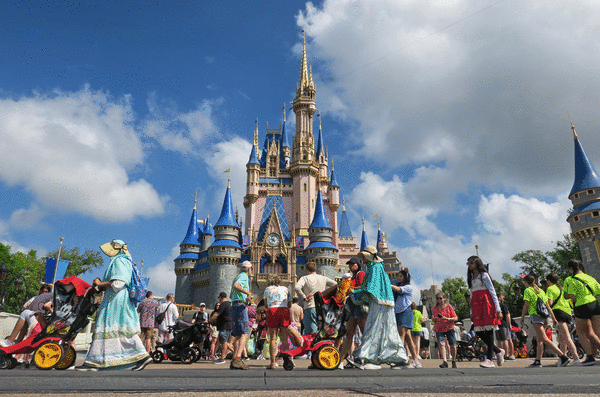
Perhaps nowhere is that more glaring than at Disney World. The Wall Street Journal reported last year that a typical four-day visit to the theme park costs $1,000 more than it did five years ago, adjusted for inflation. Some 80% of those increases come from new extras that were once free, such as shuttles to and from the airport and its “fast pass” feature that let guests pay to avoid waiting in regular lines. In 2024, leaked documents showed that the company made $724 million from skip-the-line products between 2021 and 2024.
These changes might have juiced the company’s profits in the short term, but there are signs they could hurt the company in the long run. As the Journal reported at the time, Disney’s own surveys starting in late 2023 found that the number of guests planning return trips had “ticked sharply down.”
Consumers understand that companies have a right to make a profit, and they are most accepting of ancillary fees when it’s explained how extra charges are helping to keep a base price low. That doesn’t seem to be what’s happening.
Yes, companies have higher input costs (tariffs, inflation, etc.), but profit margins for America’s biggest enterprises have never been wider. If companies aren’t careful, it’s not that consumers won’t just cough up the cash for the upgrade; they won’t show up at all.
_____
This column reflects the personal views of the author and does not necessarily reflect the opinion of the editorial board or Bloomberg LP and its owners.
Beth Kowitt is a Bloomberg Opinion columnist covering corporate America. She was previously a senior writer and editor at Fortune Magazine.
_____
©2026 Bloomberg L.P. Visit bloomberg.com/opinion. Distributed by Tribune Content Agency, LLC.


















































Comments