Lara Williams: America is missing the real problem in the Arctic
Published in Op Eds
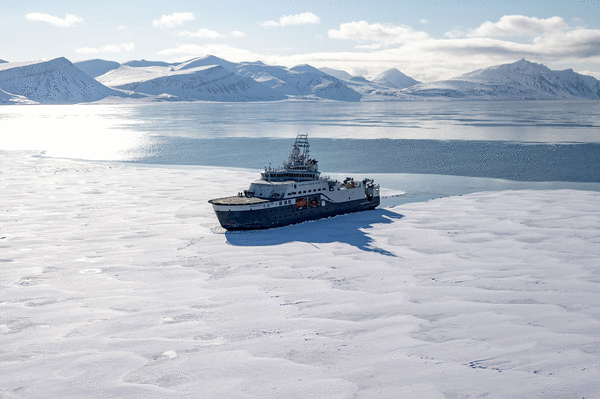
President Donald Trump’s greedy stare at Greenland, with its mineral riches and strategic location, has put the world on high alert about what’s going on in the Arctic. Unfortunately, this obsession with the region’s geopolitics comes as the critical monitoring of its geography and climate is getting harder and harder.
Constructing a detailed overview of the Arctic has always been difficult because of its vast size, often impossible working conditions and the heterogeneity of its landscapes. But Russia’s invasion of Ukraine, and the subsequent severing of international ties with its polar researchers, created a huge blind spot. President Donald Trump’s administration is making things worse.
The 2025 Arctic Report Card, a peer-reviewed update, has sounded the alarm about the robustness of the systems observing the area. This is a disaster in the making. We need a clear picture of what is now the world’s fastest-warming region. Any worrying local trends could turn into unstoppable global forces with implications for everyone.
Science in general is under attack by Trump’s government, with grants impeded, publications delayed and blatant misinformation published by the White House. The so-called Department of Government Efficiency fired swaths of scientists from important bodies including the National Oceanic and Atmospheric Administration and the Environmental Protection Agency.
Even after a year of slash-and-burn, Trump is not done. His proposed budget would cut scientific funding by 22%, with earth-science spending halved. Although Congress is pushing back on planned cuts, the damage has been done with months of uncertainty leading to canceled grants and staff shortages.
At the U.S. National Snow and Ice Data Center, for one, funding has been lost for basic services including elements of sea ice monitoring.
This is bad for all research. But the Arctic is acutely vulnerable. Of the 31 observing systems used to inform the yearly Arctic Report Card, 23 are either primarily supported by U.S. federal agencies or jointly backed by them alongside international partners. Some eight out of 10 assessed datasets used for analysis are also created by U.S. agencies.
Estimates of tundra greenness — a key indicator of warming — are one example of the cost of all this. They’re already constrained by the limited field data available to validate satellite observations. That’ll be made worse as one critical dataset won’t be updated in future because of NASA cuts.
Having fewer people on the ground will also make it more difficult when certain datasets are replaced, as with MODIS, which provides crucial daily information about the atmosphere, ocean and surface features. Such changeovers introduce inconsistencies in the data that require staff time and expertise to fix. Similar stories can be told across the spectrum of Arctic indicators.
While there are alternative European-funded datasets, scientific consensus is built from the kind of repetition and validation from multiple sources that allow a fuller picture to emerge. So a blow to U.S. science is a blow to our entire knowledge of the Arctic. As Sandy Starkweather, executive director for the U.S. Arctic Observing Network, explained to me: “We simply cannot observe tomorrow what we failed to observe today.”
Data gaps will erode the precision of forecasting models, and the ability to track changes in vital ecosystems. This will make it tougher to create early-warning systems, give the best shipping forecasts and even manage fisheries.
From a polar perspective, the U.S. turn against rationality is taking place while there’s an effective patch over our right eye. After Russia’s 2022 invasion of Ukraine, scientific relations with the country were paused. The International Network for Terrestrial Research and Monitoring in the Arctic put 21 Russian research stations on hold. Many studies are on hiatus, while data from a huge area is inaccessible or possibly not being collected.
Western scientists have adapted by using satellite data. That’s hardly ideal. The information can be spotty, interrupted by cloud cover and limited daylight. In a perfect world, data from research stations validates observations from above. Studying the permafrost can’t be done without field measurements.
The maddening thing is that the attacks on science come just as technology advances promise to help us collect more and better data from the region than ever before. The UK’s Advanced Research and Invention Agency is funding the development of new sensing systems to help fill gaps in polar observations. One project in Greenland is creating an autonomous mobile observatory powered by the sun, to be deployed on remote parts of the island’s ice sheet.
But these projects need money and permission to deploy. If the U.S. continues on its reckless path, its science will fall behind and exciting research will go unfunded. Unless there is a breakthrough with the bellicose Russians, we’ll remain blind to events on that country’s sea ice and permafrost.
Much has been made by covetous Americans of Greenland’s “natural assets,” the relatively small reserves of critical minerals, but the territory’s greatest asset is its massive ice sheet. It covers 1,710,000 square kilometers (660,000 sq mi), and is an average of 1.6km thick. If all the ice melted, sea levels would rise by more than 7 meters, seeing off major cities and some entire countries. Venice, most of the Netherlands and the Bahamas would be lost to the sea.
Unfortunately, Greenland is melting ever more rapidly, which would surely be the priority if Trump’s administration cared about genuine global “security.” What happens in the Arctic, does not stay in the Arctic. Without the funding of long-term observations and posts detecting emerging changes, we may find that future catastrophes are unstoppable.
_____
This column reflects the personal views of the author and does not necessarily reflect the opinion of the editorial board or Bloomberg LP and its owners.
Lara Williams is a Bloomberg Opinion columnist covering climate change.
_____
©2026 Bloomberg L.P. Visit bloomberg.com/opinion. Distributed by Tribune Content Agency, LLC.




















































Comments