Commentary: Foreign policy is not a board game
Published in Op Eds
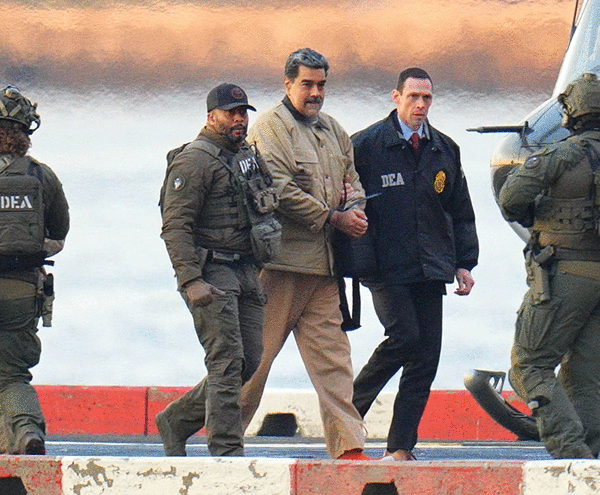
Given the administration’s actions for the past month, from shooting small boats near the shores of Venezuela, to seizing oil tankers, to acknowledging that there was a U.S. covert action underway there, the military intervention to remove Venezuelan president Nicholas Maduro should come as no surprise.
But while some in Washington are celebrating this as a “victory,” in the long-term it could be disastrous for elites in the U.S. and Venezuela, not to mention the people of both nations.
There is no recent evidence that U.S. sponsored regime change can succeed, yet President Donald Trump has said the U.S. will “run” the country until an acceptable transition government can be assembled.
Iraq is the most recent case. Administration officials said deposing Saddam Hussein and winning the war would be a “cake walk,” and suggested it would be “cheap” – only $50 to $100 billion. In the end it cost at least 20 times that, and it brought to power a sectarian regime that even its own armed forces didn’t fully trust, which made it easier for ISIS to sweep in and capture large parts of the country in 2014.
Even more important, Congress and the public should resist efforts by Secretary of State Marco Rubio and Trump to go further, whether attacking Colombia or using the Venezuelan intervention as a first step towards trying to foster regime change in Cuba.
Foreign policy is not a board game where one victory leads smoothly into the next. Real life is messy and unpredictable, and war even more so, as our experiences in Iraq and Afghanistan amply demonstrate. The “easy” wars there ended up running up $8 trillion in taxpayer obligations, causing the deaths of hundreds of thousands of refugees for their respective reasons, and inflicting physical and psychological wounds on huge numbers of veterans, including hundreds of thousands suffering from PTSD and Traumatic Brain Injuries. Meanwhile, staff processing veteran’s benefits and staffing VA medical clinics are being cut.
President Dwight D. Eisenhower, who coined the term military-industrial complex at the end of his term, began it with a speech to the American Society of Newspaper Editors formally entitled “The Chance for Peace,” but later dubbed his “Cross of iron” speech, in which he said the following:
“Every gun that is made, every warship launched, every rocket fired signifies, in the final sense, a theft from those who hunger and are not fed, those who are cold and are not clothed. This world in arms is not spending money alone. It is spending the sweat of its laborers, the genius of its scientists, the hopes of its children.”
The question now is, what do we want to spend our money and labor on that will actually make us safer and more prosperous? War in Latin America is not high on that list. In fact, it is likely to have the opposite effect, bringing on the consequences Eisenhower warned of over 70 years ago.
Eisenhower also had astute observations about the best way to make America strong. It did not involve piling up more weapons or fighting more wars. It involved cultivating a healthy, well educated, well motivated, and united citizenry as the foundation of our security.
The current policies emanating from Washington are undermining those pillars of security. War in Latin America could leave them in tatters, undermining our safety and security for decades to come. It’s time to speak out in favor of a new course before we pay that awful price.
____
William D. Hartung is a senior research fellow at the Quincy Institute for Responsible Statecraft.
_____
©2026 Tribune Content Agency, LLC.


















































Comments