Commentary: The Postal Service can't deliver without financial reforms
Published in Op Eds
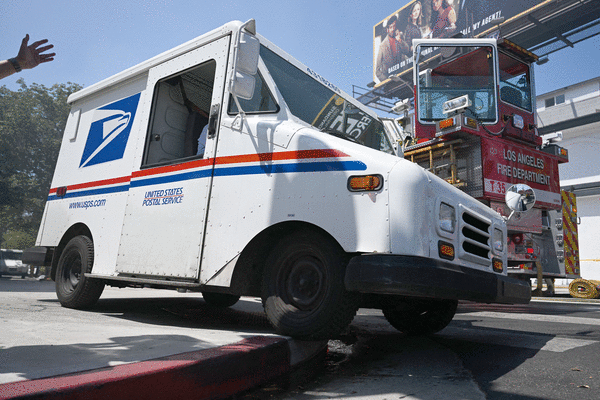
The United States Postal Service has reached a pivotal moment. Challenged by technological disruptions and constrained by outdated regulations, it is in the midst of a major restructuring plan to modernize operations, achieve service excellence and survive financially.
But to enable its transformation, the Postal Service urgently needs legislative and regulatory reforms to ensure access to critical liquidity and to undo costly mandates over which it has no control. Time is of the essence.
The complications started more than half a decade ago. The Postal Reorganization Act of 1970 made the service an independent agency that would work like a private business, with a dual mandate of delivering mail to every address and being financially self-sustaining. But it’s now clear that the Postal Service cannot fulfill this mission using its historical business model.
Since 2007, the service has accumulated more than $100 billion in recurring losses that decapitalized the organization and were funded primarily by deferring capital expenditures, not paying mandated amortizations of pension deficits, and borrowing.
These losses were not simply the result of declining mail volumes because of the internet; they also stemmed from congressional mandates that prevented the USPS from working like a business as originally intended, and which have accounted for the majority of its losses.
After Louis DeJoy became postmaster general in 2020, he led the formulation of the Delivering for America (DFA) plan, a balanced strategy with three key elements: self-help initiatives consisting of cost reductions and revenue growth; external reforms; and strategic pricing. Since taking over as postmaster general in July 2025, David Steiner has reaffirmed support for the DFA and acted decisively to keep its momentum.
To achieve its mission, the Postal Service must fundamentally restructure its nationwide network into a cost-effective, integrated mail and package logistics system. Its package business must contribute sufficient cash flow to cover operating costs, invest in infrastructure (including $20 billion of deferred capital expenditures), and meet its other obligations. The transformation is already well underway, even as the Postal Service continues to handle about 350 million pieces of mail and packages daily.
The 2022 Postal Service Reform Act provided important relief by ending the unusual requirement to pre-fund retiree health benefits and integrating Medicare into the Postal Service’s healthcare program. But further legislative reforms are needed. In fiscal 2025, more than 70% of its losses were from factors outside its control.
Financial Flexibility. Adequate liquidity is critical for any organization to survive. The Postal Service does not have access to traditional credit or capital markets; its only line of credit has been with the Federal Financing Bank. In 1991, Congress set a debt limit of $15 billion, and that capacity is exhausted. In today's dollars, this limit would top $30 billion. Until the Postal Service becomes profitable, it urgently needs access to contingent financing to ensure the uninterrupted implementation of the restructuring plan.
Retirement Plans Reforms. The service’s pension and retiree health benefits funds are underfunded, through no fault of its own. Current law mandates that the funds be invested solely in Treasury debt. According to the USPS inspector general, if the funds had been invested in a traditional portfolio, they would have had an $800 billion surplus instead of a $100 billion deficit at the end of 2022. Notably, Postal Service pension funds were 70% funded at the end of 2025 while the rest of the federal workforce’s were only 34% funded in 2024.
Two pension reforms are needed. One, when the Postal Service transformed into an independent agency in 1970, the responsibility for funding the pensions of employees who had worked for the old Post Office Department was unfairly apportioned, as pointed out in a recent report by the inspector general. Fixing this would end the annual payment mandated by the Office of Personnel Management (OPM) to reduce the pension fund deficit associated with those employees. Critically, if done in the current fiscal year, it would enable the resulting $95 billion surplus to be immediately transferred to the retiree health benefits fund, extending the life of that depleting fund from about five years to over 25.
Two, the Postal Service should be allowed to invest its retirement assets in a traditional portfolio like other independent agencies, such as Amtrak and the Tennessee Valley Authority. In any event, the Postal Service should not have to amortize its pension deficits, as mandated by the OPM, so long as it is funded at a greater percentage than the rest of the federal workforce. These reforms would eliminate what was a $5.3 billion amortization expense in 2025.
Workers' Compensation Management. Unlike private-sector companies, the Postal Service is restricted in managing its workers' compensation program. According to the inspector general, potential annual savings could have reached $700 million in 2024. The inability to manage this program contributed to workers’ compensation liabilities of $17.4 billion, a balance that fluctuates with interest rates and actuarial changes, which resulted in a $1 billion charge in 2025.
Regulatory and Pricing Flexibility. The current regulatory framework was set up when the service had a profitable mailing monopoly. The Postal Service needs more pricing and operating flexibility and the elimination of price caps. The US currently has one of the lowest stamp prices in the world. Further, the Postal Regulatory Commission (PRC) requirement that a part of revenue derived from price increases be diverted to pay for the amortization of pension deficits is inconsistent with the mandate to be self-sustaining. This requirement was $1.5 billion in 2025, and it is estimated to total $12 billion over the next four years.
The Postal Service is a national necessity, connecting every corner of the country — binding rural, urban and in-between. Its survival should not be a partisan issue. The reforms needed are not radical but common sense, and they require strong leadership from the White House and Congress, and realistic regulation from the Postal Regulatory Commission.
____
This column reflects the personal views of the author and does not necessarily reflect the opinion of the editorial board or Bloomberg LP and its owners.
Roman Martinez IV served as chairman of the board of the United States Postal Service from 2022-2024 and as a governor until December 2025. He was previously a managing director at Lehman Brothers until 2003.
©2025 Bloomberg L.P. Visit bloomberg.com/opinion. Distributed by Tribune Content Agency, LLC.





















































Comments