Editorial: A bigger European Union must be a better one, too
Published in Op Eds
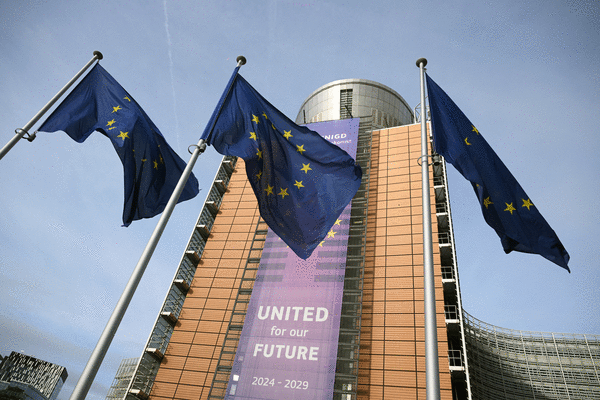
Does the European Union — 27 states, 450 million people, politically fractious even in the best of times — need to expand even more? The answer, in the European way, is a qualified and equivocal yes.
Nine countries are officially in line to join the bloc, and EU officials have recently hinted some may be added by 2030. The European Commission’s latest progress report exposes the gap between ambition and readiness. Tiny Montenegro has quietly done much of the hard work required for accession; Albania, Moldova and Ukraine are far behind. Others are unlikely to join anytime soon.
If handled well, enlargement can enhance Europe’s security and credibility as a democratic bloc. It could prove particularly helpful at the moment, as Russia’s aggression, America’s inward turn and China’s expanding footprint have made regional integration more of a strategic imperative. The likely alternative is a union ringed by fragile, easily coerced states whose instability could spill across Europe’s borders.
Economically, too, the logic of expansion is sound. A previous round of entrants in 2004 lifted the new members’ gross domestic product per capita from 59% of the EU average to 81% by 2022; living standards rose sharply, alongside huge improvements in infrastructure, services and life expectancy. Existing members gained a larger market, smoother supply chains, more regional stability and hence greater prosperity: Income per person is about 10% higher than it would’ve been.
But such gains aren’t automatic, and any additional enlargement must be handled with prudence. Adding small countries such as Montenegro and Albania is a low-cost, high-leverage option. It should bolster a vulnerable region, strengthen border and migration management, and reward genuine reform efforts. The benefits of such additions are likely to significantly outweigh the risks.
Ukraine’s bid demands a subtler calculation. Its size, industrial capacity and military resilience could one day make it a strategic asset. Yet a live conflict, vast reconstruction needs, governance problems and political sensitivities all complicate the case. Here the EU needs a more flexible approach that prioritizes deepening ties under existing agreements for matters such as trade, energy, and customs and regulatory alignment, while laying the groundwork for full membership down the road.
Two further principles should guide the enlargement process.
One is that the EU should be mindful of how it wields leverage over aspiring members. It has long insisted on judicial independence, transparency, rule of law and other good-governance benchmarks as prerequisites to accession. But leaving candidates in a perpetual waiting room erodes the bloc’s credibility and potentially cedes leverage to outside powers. The EU should offer better interim rewards for progress — such as earlier market access, sectoral integration and deeper participation in EU programs — while imposing clear penalties for backsliding.
Next, the EU must reform itself if it wants to stay governable. It should allow for more key decisions (in foreign policy, sanctions and other areas) to be made through qualified majority voting, rather than requiring unanimity among members. It also needs to strengthen its single market: Removing friction in cross-border capital markets, banking, energy and other areas should be paired with reforms to reduce red tape. This isn’t just about enlargement: Without such changes, even the current union will struggle to remain functional.
Europe’s founding purpose was to bind nations together in peace, prosperity and democracy. The EU can help renew that mission by pragmatically embracing more countries on its periphery. It might also save itself in the process.
____
The Editorial Board publishes the views of the editors across a range of national and global affairs.
©2025 Bloomberg L.P. Visit bloomberg.com/opinion. Distributed by Tribune Content Agency, LLC.





















































Comments