Michael Hiltzik: Here's how Trump gets away with using questionable numbers
Published in Op Eds
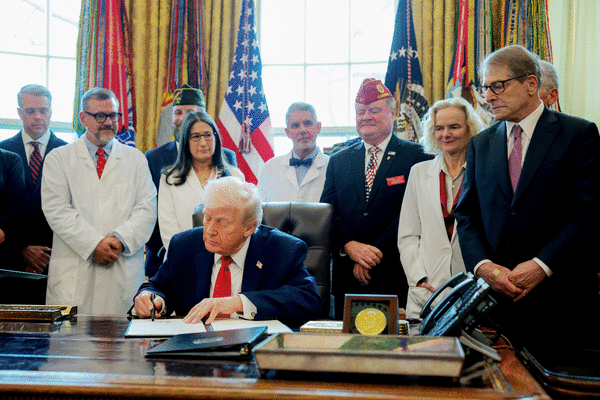
Much attention has been focused on Donald Trump's use of words — that is, his peculiar style of oratory. But more attention should be paid to another feature of his discourse: his use of numbers.
Trump doesn't use numbers the way most of us do, as "things that can be added, subtracted, multiplied, and divided," as Columbia University statistician Andrew Gelman put it. Rather, he uses them as rhetorical objects.
That habit was vividly on display during Trump's televised speech Wednesday night. He claimed that President Joe Biden's immigration policies had admitted "11,888 murderers." That his own tariffs and trade deals had brought in "$18 trillion of investment" from abroad. That deals he negotiated with drug companies and foreign countries had "slashed prices on drugs and pharmaceuticals by as much as 400, 500 and even 600 percent."
I asked the White House for its sources for these figures, but didn't receive a reply.
The exploitation of big or vague statistics to make a partisan point isn't novel. It was perfected in the 1950s by Sen. Joseph McCarthy, whose claim about the number of communists in the State Department shifted from 57 to 205 to 81 to 207 in speeches to varied audiences.
McCarthy didn't actually have a "list" of reds, as he claimed — his goal was to communicate that there were lots of them, the specific number unimportant.
I reported recently on implausible statistics coming from the Trump administration about healthcare, mortgages and inflation. But there are many more cases to draw our attention. Therefore, it's proper to examine the underlying political strategy, such as it is.
First, some examples: In his recent interview with Politico, Trump asserted that "We save 25,000 people every time we knock out a boat." (Politico's interviewer, Dasha Burns, didn't press Trump to explain his math; the White House didn't respond to my request for validation.)
On Trump's 100th day in office, Atty. Gen. Pam Bondi declared that day, April 29, National Fentanyl Awareness Day. She announced that since Trump's inauguration "we've seized over 22 million fentanyl-laced pills, saving over 119 million lives." That works out to nearly 1 in every 3 Americans. Alerted to the absurdity of the claim, she revised it — to having saved 258 million lives. That would mean 75% of the entire U.S. population rescued from fentanyl-driven oblivion.
Bondi derived her figures from a calculation by the Drug Enforcement Administration, a unit of her agency, that 22 million pills was the equivalent of 119 million fatal doses. But as Ryan Marino of Case Western Reserve University told Poynter.org, her original claim assumed that every pill would be shared by five users, and that all would have died of an overdose — if not for the administration's intervention.
Bondi's audience was "the distressingly large percentage of the public that is incapable of the most rudimentary statistical reasoning," by whom "Bondi intended that her message be taken as a literal statement of fact," writes Paul Campos of the University of Colorado Law School. Among her goals was "to undermine the very concept of some sort of reliable public discourse, especially one emanating from purportedly authoritative government sources."
Innumeracy is not exclusively an American issue. The inability to comprehend the significance of big numbers is a human affliction. No one is especially enamored of arithmetic, except perhaps mathematicians (and, also, me).
Large magnitudes tax our imagination. "Big numbers befuddle us, and our lack of comprehension compromises our ability to judge information about government budgets, scientific findings, the economy and other topics that convey meaning with abstract figures, like millions, billions and trillions," the Wall Street Journal observed in 2017. "Yet humongous numbers pepper the news, and as citizens, we are asked to make sense of the material."
Metrics to aid comprehension abound. Would it help, for example, to know that one million seconds is about 11 and a half days, one billion seconds is 3,200 years, and one trillion seconds is about 32,000 years?
Gelman divides innumeracy into two categories. The first is "standard-issue innumeracy," which he identifies as "claims that could in theory be correct but whose plausibility disintegrates after any serious engagement with reality ... These are numbers that don't make a lot of sense, but they kinda sound good."
Gelman's examples include a claim offered in the book "Freakonomics" that "beautiful parents are 36% more likely to have girl babies," derived from a tortuous calculation by a British statistician.
My own favorite case involved the claim by a couple of documentary producers in 2005 that the porn movie "Deep Throat," having grossed $600 million in its time, was the most profitable picture ever made. My calculations established that for this to be true, "Deep Throat" would have had to sell tickets to enough customers to populate the entire United States one and a half times over.
Gelman's second category is "hard-core innumeracy," or "quantitative statements that don't even require a moment's reflection to recognize as absolutely ridiculous." The features of this affliction are "providing numbers that are orders of magnitude away from anything reasonable" and "exercising political or social authority, the power to say things that don't make sense without getting called on it."
That's the pigeonhole where one finds Trump's 25,000-lives-saved trope. It also houses Trump's claims about immigrant murderers, trillions in tariff-driven foreign investments and drug prices and Bondi's fentanyl claim.
Let's try to deconstruct some of these statistics.
Start with his "11,888 murderers" among the illegal immigrants admitted under Biden. Trump has used this figure, or similar claims, at least since his 2024 presidential campaign. As it happens, Trump's figure shifted over time — in two posts on his Truth Social platform on the same day, he used 13,000 and 14,000. The closest thing to a source for the figure is a letter provided by the Department of Homeland Security to Rep. Tony Gonzales (R-Texas) in September 2024. The letter stated that 13,099 "noncitizens" convicted of homicide were "non-detained" by the agency.
But neither the idea that all of these murderers are roaming the country in freedom nor that they were admitted under Biden is true. DHS says only that it is not the detaining agency — they're likely to be in the custody of state or other federal agencies. Moreover, the figure in the letter covers decades of immigrant admissions, including during Trump's first term.
"The data goes back decades; it includes individuals who entered the country over the past 40 years or more, the vast majority of whose custody determination was made long before this Administration," DHS stated in a follow-up announcement. "It also includes many who are under the jurisdiction or currently incarcerated by federal, state or local law enforcement partners."
As for Trump's claim that more than 50% of these murderers had killed more than one person, its source is unknown.
Trump's assertion that he has secured "$18 trillion of investment into the United States" from abroad through his tariffs and trade deals is murky, but still implausible. The White House website claims only $9.6 trillion in "total U.S. and foreign investments" announced during his current term. A Bloomberg analysis pared that figure back to $7 trillion, including "amorphous pledges" from overseas, not concrete commitments.
How much money has come specifically from tariffs? The administration itself announced Tuesday that it has collected $200 billion from "tariff enforcement" since Trump's inauguration. That's a lot, but it shouldn't be forgotten that for the most part, tariffs are paid by U.S. consumers through higher prices for affected goods.
Trump in November promised to issue $2,000 in "dividend checks" to all Americans other than "high-income people," to be funded from tariff revenues. Trump didn't specify where the income cutoff would be, but the budget hawks at the Committee for a Responsible Federal Budget calculated that if the same standard as that governing the pandemic-era economic impact payments was used, the cost would be about $600 billion, swamping tariff income.
It's almost tempting to call all these assertions "whoppers," but that hardly does justice to the sheer audacity of Trump's number-mongering. Yet, again, his goal is not to provide numbers to be added, subtracted, multiplied and divided, but to shower his audience with numbers big enough to make their eyes glaze over.
As Gelman observes, the problem with this approach as policy "is not just the innumeracy, it's the blithe disregard for it, the idea that being off by multiple orders of magnitude ... just doesn't matter." The Trump tradition is to dismiss hard information as "fake news" or "alternative facts," and hope that voters will just go along.
Stay tuned, because Trump's numbers are likely to get ever more preposterous. But actual math can be a harsh mistress, and it may not be long before the absurdity of Trump's version becomes obvious to everyone.
____
©2025 Los Angeles Times. Visit at latimes.com. Distributed by Tribune Content Agency, LLC.





















































Comments