Commentary: The depressing truth about depression research
Published in Op Eds
Depression Awareness Month (October) began in the 1990s to increase public recognition of one of the most common mental health disorders. Nearly four decades have passed, and we still have a lot to learn.
Scientists do not yet fully understand the brain mechanisms behind human depression. Perhaps that’s because they’ve been studying the wrong brains.
Depression is complex. It includes major depressive disorder, bipolar disorder, seasonal affective disorder, postpartum depression and premenstrual dysphoric disorder. Each has different causes and treatments.
Depression is also extremely common. Depressive disorders are the leading cause of disability worldwide. About 332 million people experience depression globally, with nearly 21 million U.S. adults affected.
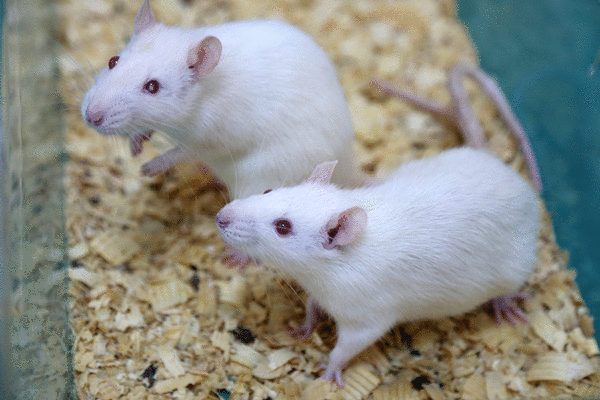
Despite its prevalence among humans, research on depression has predominantly relied on studying other animals. It’s a counterintuitive practice that diverts resources from human-relevant studies and hinders scientific understanding of this condition and potential treatments, all while subjecting animals to pointless cruelty.
Depressive disorders are characterized, in part, by feelings of sadness, hopelessness and despair. These symptoms are subjective, with identification largely relying on patients’ self-reporting. While other animals experience a full range of emotions—and those used in experiments certainly feel overwhelming fear, despair, depression and more—they can’t self-report their feelings as humans can.
Still, experimenters try to replicate and measure these feelings in animals by putting them in increasingly cruel situations. They subject animals to painful electric shocks, restraints, starvation, sleep deprivation, isolation and other agonies in attempts to induce depression. All cause immense suffering, and all fail to truly replicate human depressive symptoms.
Take, for example, the forced swim test. Experimenters put mice, rats and other animals in inescapable containers filled with water. They watch as the panicked animals try to escape by climbing or diving underwater in search of an exit, mostly paddling furiously to keep their heads above water. Eventually, the animals will stop swimming and float.
It was once believed that floating meant an animal had “given up.” Experimenters used the amount of time an animal spent swimming or struggling to escape as a misguided metric to gauge that individual’s level of “despair.” But most experts now agree that this interpretation is simply inaccurate. Animals may float for a variety of reasons, influenced by various factors, none of which is directly comparable to human depression or despair.
In 2021, a fellow researcher and I published a study showing that the use of the forced swim test by the world’s top 15 pharmaceutical companies did not produce any drugs approved for treating human depression. Many leading companies, including Johnson & Johnson, Pfizer and Bayer, have, in turn, abandoned the misguided test.
Even so, the forced swim test is still one of the most commonly used behavioral tests in depression research, and experiments on animals remain a standard in the field. Scientific advancement suffers as a result.
Humans and other animals have significant physiological differences, making data translation between the two difficult and unreliable. No single animal-based method can replicate all aspects of human conditions, and human behaviors that represent hallmarks of depressive disorders cannot be accurately produced or assessed in experiments on animals.
Thankfully, there are methods that do work—and forward-thinking researchers are already using them.
State-of-the-art, non-animal methods can better study human depression and aid in developing treatments, helping people get the support they need and deserve while sparing countless animals unnecessary tests.
Three-dimensional in vitro cultures of human brain cells that can replicate the cellular organization and signaling of brain tissue, organoids that can mimic complex interactions between different parts of the brain and brain imaging techniques that can study human psychiatric conditions directly in individuals with lived experience are just a few examples of viable, animal-free research methods.
The National Institutes of Health recently announced a major paradigm shift toward prioritizing human-based research. The agency should start by ending animal use for research on depressive disorders and other neuropsychiatric conditions and instead invest in abundantly valuable animal-free methods.
By doing so, we will finally move closer to finding treatments for the millions who suffer.
_____
Emily R. Trunnell, Ph.D., is a neuroscientist and the director of Science Advancement and Outreach for People for the Ethical Treatment of Animals, 1536 16th St. N.W., Washington, DC 20036; PETA.org.
_____
©2025 Tribune Content Agency, LLC.





















































Comments