Juan Pablo Spinetto: Latin America's motorcycle boom has hidden costs
Published in Op Eds
It had rained that June morning in Mexico City, leaving the pavement slick.
Isaac was speeding near the airport when his motorcycle apparently hit a damaged stretch of wet asphalt, skidding out of control and sliding toward a passing tanker truck. The driver braked hard but couldn’t stop in time, crushing the bike — and Isaac — under its front wheels. The victim was carrying his mother, Blanca Estela, as a passenger: She was thrown to the side and luckily survived — yet had to watch as her son was killed by the giant vehicle.
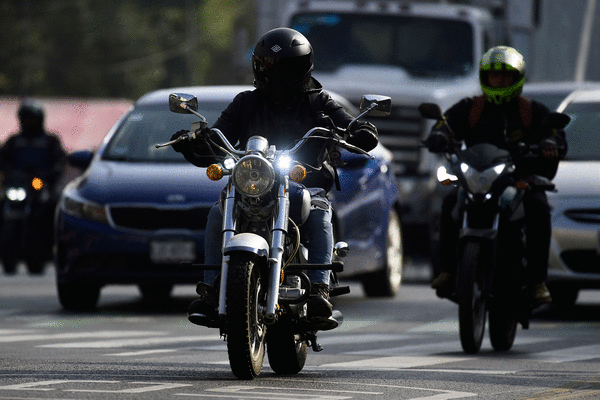
Heartbreaking accidents like this are becoming alarmingly common across Latin America, where traffic crashes are already the leading cause of death among young people, especially men. A surge in motorcycle sales is fueling a sharp increase in road fatalities across the region’s crowded urban centers, erasing the safety gains seen at the start of the last decade.
Rio de Janeiro reached a record number of traffic fatalities last year, nearly 70% of them motorcyclists. In Mexico City, rider deaths almost tripled to 261 in 2024 from 91 in 2018. Regional figures are patchy, but one partial estimate shows motorcycle fatalities in Ibero-America jumping almost 175% between 2013 and 2022. In countries like Colombia or Chile, the death toll doubled.
Traffic crashes are not unique to Latin America. Every year, more than a million people die and up to 50 million are injured in road accidents worldwide. But with some of the planet’s most densely populated cities and a motorcycle boom showing no sign of slowing, the region faces a mounting public health and road-safety crisis.
The surge in two-wheeled vehicles is fueled by the courier economy, particularly food-delivery apps that rely on motorbikes to navigate some of the world’s most gridlocked cities. Easy access to credit, tax benefits, low operating costs and greater flexibility compared with public transportation have also encouraged demand. The pandemic, with its lockdowns and social-distancing requirements, gave the trend an additional boost. Perhaps more symbolic, owning a motorcycle is seen in the region as a sign of upward social mobility, particularly among lower-income workers. Brazil and Mexico also have growing motorcycle industries, explaining why their governments tacitly encourage their use.
The downside is an ever more chaotic traffic ecosystem. Cars, motorcycles and other mobility options fight for space in cities with inadequate public-transport networks. Spend an evening in Mexico City’s rush hour — as I often must — and your stress levels will spike, thanks not only to the swarm of motorcycles but also to the crumbling roads and reckless drivers. Poor training, inadequate signaling and lax policing of traffic rules all add to the dangerous mix replicated across the region.
“Unfortunately, some of the improvements that occurred in the previous decade are being lost. The serious problem is the increase in private motorization,” Carlos Bellas Lamas, a senior transport specialist at the World Bank based in Brasilia, told me. “Any policy that encourages the population to use motorcycles is a mistake that will be marked by a high price in healthcare and accident costs.”
Addressing the problem requires urgent action from both local and national authorities. With enough political will, there are many tested policies — from investments in driver education to improved public transport infrastructure and more accurate statistics — that can reduce accidents. Still, policymakers typically face diverging options: They don’t want to pay the political costs of policing a popular trend even if their own governments are left to bear its heavy costs.
Beyond the human burden on families like Isaac’s, traffic accidents take a significant economic toll. Brazil ranks fifth in the world with nearly 35,000 traffic-related deaths annually and has significantly worse indicators even compared with some regional peers. According to a recent report by the World Bank co-authored by Bellas Lamas, the total cost of traffic crashes in Latin America’s largest economy — including medical expenses, production losses and property damages — exceeds $61 billion per year, or 3.8% of the country’s GDP. The growing number of accidents also strains health systems: in the first half of 2025, Rio’s public hospitals treated an average of 80 motorcycle accident victims per day.
A first step is to give this crisis the visibility it deserves. Unlike crime — which carries clear political repercussions — road accidents often draw limited public attention because meaningful fixes demand unpopular policies.
Above all, road safety cannot remain only a government responsibility. In congested megalopolises like Mexico City and others, where a driving license can be obtained with little or no on-road experience, the need to educate motorists in basic traffic rules is urgent. It must become a collective goal, given the heavy price that families and communities pay every day.
____
This column reflects the personal views of the author and does not necessarily reflect the opinion of the editorial board or Bloomberg LP and its owners.
JP Spinetto is a Bloomberg Opinion columnist covering Latin American business, economic affairs and politics. He was previously Bloomberg News’ managing editor for economics and government in the region.
©2025 Bloomberg L.P. Visit bloomberg.com/opinion. Distributed by Tribune Content Agency, LLC.





















































Comments