Editorial: Suddenly, Florida's future is at stake
Published in Op Eds
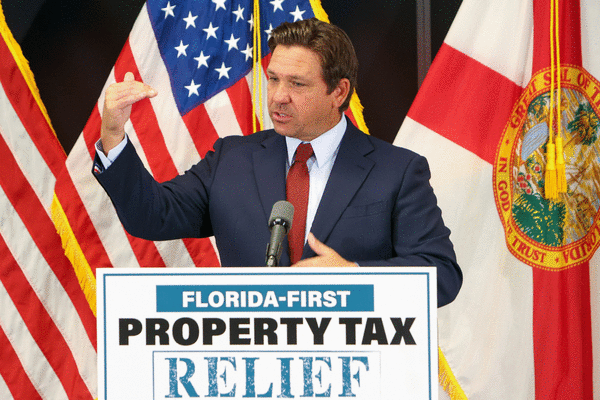
The drastic demolition of cities and counties sought by the Legislature is the most irresponsible enactment by Tallahassee since 1861, when an elected convention made Florida the third state to secede from the Union.
How did that turn out?
Then, as now, the people gambling recklessly with Florida’s future had not thought out the consequences — and didn’t much care.
This time is different. Voters have the final say on Nov. 3. The tax scheme will be on the ballot as Amendment 3 under the politically loaded title “Save Our Homes from Excessive Property Taxes.”
It requires 60% approval to pass.
It does not deserve anyone’s vote.
Giving voters the final say does not excuse the irresponsibility of lawmakers who should have killed it but didn’t. A total of 105 of them voted to place it on the ballot while only 35 did the right thing and voted no.
Extreme haste and ignorance
The anti-tax amendment (HJR 1-F), sloppily approved just two days after Gov. Ron DeSantis dumped it on their desks, deserves defeat for many reasons, which will air in great detail before voting begins.
The process itself — done in haste amid stupefying ignorance — is reason enough for any responsible citizen to vote “no” and to hold its perpetrators accountable.
Lawmakers did not seem to care how a much larger homestead exemption for homeowners would hurt the roughly one-third of residents who must rent. Many are unable to afford a home, and their landlords will necessarily pass along their higher tax bills, as they do now.
The core of Amendment 3 would exempt up to $150,000 of a home’s taxable value from non-school property taxes next year and up to $250,000 in years following.
Florida’s exemption is already generous — $25,000 off the taxable assessment for all owner-occupied homes and up to $26,411 more (against non-school taxes only) against a higher portion of value.
A grave threat to small businesses
Legislators did not seem to care how small businesses would cope with a shifted tax burden in a persistently inflationary economy.
Nor do they seem to care how local governments will pay for libraries, parks, public health and other amenities under a provision limiting use of property tax revenue to public safety, education, infrastructure and a few more core functions. Even if billions in local tax revenue disappear, local needs will remain.
They did not seem to care how cities and counties could support police, fire and other emergency services on a sharply reduced tax base, or about those local governments that can’t raise tax rates under existing constitutional ceilings.
“The Revenue Estimating Conference has not reviewed the proposed amendment,” said a pitifully superficial Senate staff analysis that acknowledged “a negative indeterminate impact.” Translation: Many billions.
The Legislature amended DeSantis’ scheme to exempt schools, but that only made a deplorable idea marginally less terrible.
There is no reason, other than his ambition to run for president again, for the lame-duck governor to promote such a radical idea and give the Legislature so little time to consider it.
Even Florida TaxWatch, a group often reluctant to attack the status quo, criticized the extreme haste and argued that this question should be left to a Taxation and Budget Reform Commission to be appointed next year under a constitutional provision.
“The hurried evaluation and adoption of this proposal, which became public less than a week ago, is unnecessary,” TaxWatch said.
A history of bad tax ideas
It wouldn’t be the first time Florida crippled its revenue sources for suspicious motives.
The 1924 amendment that still prohibits a personal income tax was promoted secretly by the Florida Bankers Association and openly by Gov. Cary Hardee, a banker himself, to attract wealthy people to Florida. The state’s hyperinflated real estate market collapsed a year later.
The first homestead exemption, at $5,000, erased much of the local tax base. As intended, it left Florida broke and led to the first sales tax in 1949, proposed and signed by Gov. Fuller Warren, who had promised voters to veto any such thing.
Power, not money
The overarching impulse is the contempt that DeSantis and his collaborators bear toward local government. Former Republican Sen. Jeff Brandes of St. Petersburg hit it on the head in a column for the Florida Trident.
“Power, not taxes, is what this debate is really about,” Brandes wrote. “Florida is debating a fundamental redesign of how local government is financed.”
Under what’s proposed, he warned, local officials will have to go to Tallahassee “to keep deputies on patrol, firefighters in stations, and ambulances on the road.”
The irony, he said, “should give conservatives pause. A proposal intended to shrink government could ultimately centralize it.”
The governor becomes everyone’s mayor.
And an arrogant Legislature that couldn’t spare more than two days to think such a major change through becomes everyone’s remote city council.
_____
©2026 South Florida Sun Sentinel. Visit at sun-sentinel.com. Distributed by Tribune Content Agency, LLC.




















































Comments