Editorial: A CBS credibility crisis. That's the way it is
Published in Op Eds
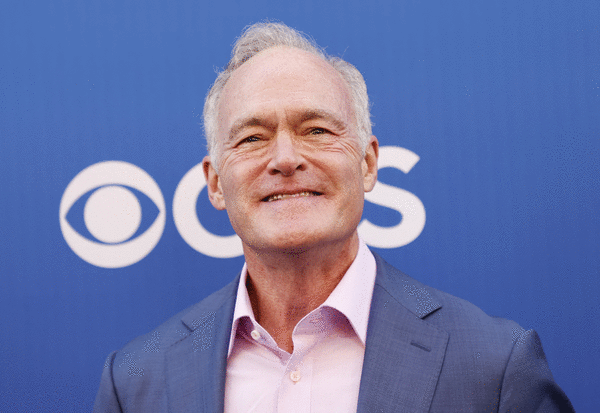
CBS News correspondent Scott Pelley probably knew that what he was about to say to his bosses would get him fired from its marquee broadcast, “60 Minutes.”
What he said afterward implied why he might have forced their hand.
Pelley charged the new management, under Bari Weiss, with conduct that would disgrace any self-respecting news organization, disparage its staff’s integrity and force people with uncompromising principles to leave.
Pelley said that “new management has instructed me to inject falsehoods and bias into a politically sensitive story. I’ve been told to include assertions that are unverified. To date, in every case, I have managed to ignore these instructions or refuse them.”
Also, equally unethical, he said, “Recently, politicians have been invited to choose correspondents for interviews on the broadcast. Giving politicians control over ’60 Minutes’ interviews is not how this is done.”
‘Internal repercussions’
Separately, Cecelia Vega, one of two other “60 Minutes” correspondents whose dismissals upset Pelley, released a statement that she and her producers “have experienced efforts to insert political bias into our stories” and that producer teams have self-censored proposed stories “out of fear of the internal repercussions.”
With the elimination of the consistently credible CBS Radio after nearly a century and the evisceration of “60 Minutes,” America has sustained an irreplaceable loss, but mainstream media critics, led by President Donald Trump, must be delighted.
A defanged “60 Minutes” is great news for corporate thieves and corrupt politicians.
The network’s fame and reputation owed not to its corporate management, but to fearless journalists whose names became household words: most prominently Edward R. Murrow, Walter Cronkite, Mike Wallace and others.
The highest compliment that could be paid to a journalist is to be compared to any of them.
It was Murrow in 1954 who took on the reckless Red-baiting senator, Joe McCarthy, a man whom even President Eisenhower feared.
Murrow’s “See It Now” documentary was the beginning of the end for the demagogue from Wisconsin.
To be confronted by Mike Wallace was the deepest dread of countless malefactors in public and corporate life. Wallace was one of two original “60 Minutes” reporters when the program debuted in 1968.
‘Uncle Walter’ Cronkite
Cronkite’s 19 years as anchor of “CBS Evening News” became the gold standard of television journalism. He was called “the most trusted man in America” and was referred to as “Uncle Walter,” a tribute to his credibility.
When Cronkite returned from Vietnam after the Tet Offensive in 1968 and told the nation what President Johnson’s subordinates dared not admit to him — that the war was a hopeless stalemate — LBJ reportedly remarked, “If I’ve lost Cronkite, I’ve lost Middle America.”
And now, the nation has lost CBS. That is a tragedy, at a time when Americans need trustworthy information more than ever.
An alternative U.S. history without the heroic work of Murrow, Cronkite and Wallace would likely be dystopian. It is hard to comprehend, so significant were their achievements. To a very real extent, their accomplishments were America’s.
It is equally difficult to imagine the network’s reputation being rehabilitated under its corporate overseer, Paramount Global, which paid $16 million to Trump’s foundation to settle his spurious lawsuit over how “60 Minutes” had edited his interviews to fit the available air time.
Foretelling Pelley’s accusation, the payoff effectively sublimated the news judgment of CBS to the whim of a politician who craves to dominate everything he can and destroy what he can’t.
We hope, as everyone should, that Pelley finds a forum where he continues to speak truth to power.
It has been an American tradition, after all, since July 4, 1776.
_____
©2026 South Florida Sun Sentinel. Visit at sun-sentinel.com. Distributed by Tribune Content Agency, LLC.



















































Comments