Ronald Brownstein: What Democrats will do with all that power
Published in Op Eds
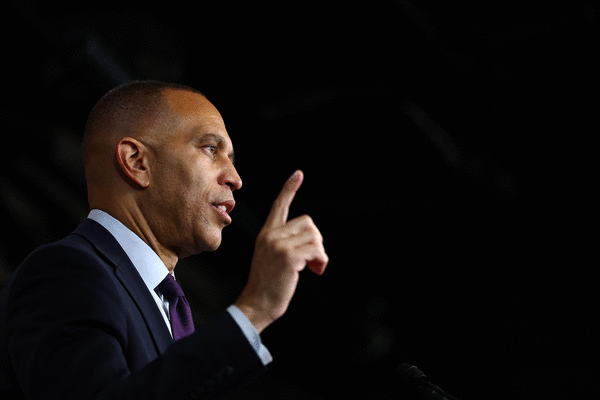
Incoming House Speaker Hakeem Jeffries has offered an important signal that he believes he can unite Democrats behind a more ambitious agenda than many anticipated. Recently, he’s surprised many in the party by endorsing policies to significantly expand Medicare’s eligibility and coverage — a possibility that goes far beyond his pledge during the campaign to reverse President Donald Trump’s cuts to Medicaid and the Affordable Care Act.
This idea stops short of the left’s push for Medicare for All. But the proposal to extend eligibility for federal health coverage to potentially millions more people would still constitute the most expansive — and expensive — permanent addition to America’s social safety net since the ACA itself.
Though Trump is likely to veto any such “Medicare for More” plan even if Democrats pass it through both chambers, Jeffries’ comments show a leader determined to transcend the ideological firefights that raged in so many of this year’s Democratic primaries.
The Democrats’ sweeping gains this month have strengthened both poles of the party’s ideological spectrum. Through the spring and summer, the dominant narrative in the party was the rise of leftist challengers winning primaries in safe Democratic seats. In the House, those candidates are flowing into the Congressional Progressive Caucus, which will increase its numbers by about half a dozen members to around 105 in all.
But in November, the candidates who built the new majority were almost entirely centrists. About three dozen Democrats who captured Republican-held districts have joined either the centrist New Democratic Coalition, which revolves mostly around suburban and white-collar districts, or the Blue Dog Coalition, which tends more toward rural areas. This torrent of new representatives has swelled the New Democratic Coalition to at least 142 members and the Blue Dogs to about two dozen.
Economists often talk about a K-shaped economy where the middle has hollowed out between high- and low-income consumers; these results have left Jeffries contending with a K-shaped Democratic caucus polarized between progressives and centrists, with fewer conventional mainstream liberals in between.
Given that distribution, Democrats will likely find it easiest next year to coalesce around measures that directly respond to Trump’s excesses and missteps: reversing his Medicaid and ACA cuts, reining in his tariff authority, challenging the Iran war, banning stock trading for public officials, and imposing more accountability on Immigration and Customs Enforcement agents. Promoting more home construction, protecting voting rights, combating higher drug prices, and raising the minimum wage will also likely find broad agreement between left and center.
But Jeffries’ embrace of such a transformational Medicare proposal suggests he believes he can unite House Democrats to take bigger swings.
Jeffries endorsed three sweeping policies that have been championed most prominently by Senator Bernie Sanders of Vermont as a first step toward a Medicare for All system: lowering the age of Medicare eligibility to 55; expanding Medicare’s benefits to include vision, dental and hearing; and providing federal health care to all young people through age 26.
Those are not small nibbles: Estimates during Joe Biden’s presidency (the most recent available) projected that the expanded Medicare benefits would cost about $360 billion over 10 years, and lowering eligibility just to age 60 would cost around $500 billion over the same period. Considering medical inflation (and the broader eligibility net Jeffries discussed), the 10-year price tag for these ideas could easily exceed $1 trillion — though Democrats could cover that bill by rescinding parts of Trump’s 2025 tax cut ( whose 10-year cost is estimated at nearly $4.5 trillion).
Notably, the centrist Democratic groups did not recoil in alarm from Jeffries’ Medicare proposal, though if the idea advances, they would likely seek ways to limit its cost (perhaps by sequencing the additional benefits before the eligibility expansions). House progressives were elated by his remarks and want to push further. Their wish list includes other big-ticket items, including a universal childcare program and funding an increase in Social Security benefits by repealing the $184,500 cap on earnings subject to the payroll tax. Those ideas would likely face more resistance from moderates: Even if they accept a costly Medicare expansion, many of the newly elected centrists will likely remain cautious about advancing too much other new spending, much less voting for a big payroll tax increase on affluent suburbanites that the president would surely veto.
Conflict between the Democrats’ two camps may be unavoidable. But Jeffries’ surprising commitment to Medicare expansion indicates he has not resigned himself solely to pursuing least-common-denominator agreements between them. That same instinct may prompt bigger-than-expected proposals from House Democrats in other areas, including reforming the Supreme Court, regulating artificial intelligence, pursuing a constitutional amendment to limit dark money in elections and restricting partisan gerrymandering.
Jeffries’ ambitious Medicare ideas are the tell. He is betting that even in a K-shaped caucus, enough progressives and centrists will agree that failing to go big — whether Trump signs their legislation or not — would spell trouble in 2028.
____
This column reflects the personal views of the author and does not necessarily reflect the opinion of the editorial board or Bloomberg LP and its owners.
Ronald Brownstein is a Bloomberg Opinion columnist covering politics and policy. He is a CNN analyst and the author or editor of seven books.
©2026 Bloomberg L.P. Visit bloomberg.com/opinion. Distributed by Tribune Content Agency, LLC.







































Comments