Commentary: Scrap nukes before our luck runs out
Published in Op Eds
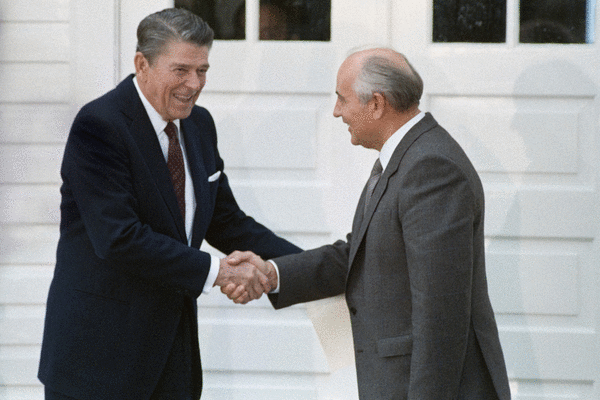
In October 1986, at a two-day summit in the Icelandic capital of Reykjavik, President Ronald Reagan and Soviet leader Mikhail Gorbachev nearly struck an agreement calling for the elimination of nuclear weapons. The recent film “The Brink of War” revisits that extraordinary moment, showing two adversaries who recognized that nuclear war is unwinnable and that deterrence — relying on the threat of nuclear retaliation — was a perilous gamble with humanity’s future.
Today, that gamble is far more dangerous, and Congress has not meaningfully examined it.
For eight decades, nuclear deterrence has served as the foundation of U.S. security policy. It is often described as sober, realistic and time‑tested. But deterrence is not a law of nature. It is a theory built on assumptions about human behavior, technology and geopolitics that no longer match the world we live in.
Experts increasingly argue that the post-Cold War period, often perceived as stable, was actually an anomaly in which unusually strong buffers masked a brittle deterrence system that produced multiple near‑misses. Those buffers are gone, and today’s destabilizing technologies make the risks even greater. The near‑misses were warnings that the system was vulnerable even under ideal conditions.
Artificial intelligence, autonomous weapons, cyber intrusions, hypersonic missiles and weaponized satellites have transformed conflict escalation and decision-making.These technologies compress warning time and decision windows to minutes, not hours, increasing the risks of miscalculation.
The geopolitical landscape has also become increasingly unstable. Five of the world's nine nuclear-armed states have engaged in warfare over the past year and a half. Two of them, the U.S. and Russia, have made direct threats to use nuclear weapons.
While nuclear weapons have not been used in war since 1945, we must examine whether deterrence alone explains this outcome. Former Defense Secretary Robert McNamara identified a different reason: “We lucked out.”
Meanwhile, the Government Accountability Office has repeatedly warned that cyber vulnerabilities in nuclear‑related systems remain insufficiently addressed. And the U.S. is now advancing a nuclear modernization effort that will lock in current assumptions for decades, without reviewing whether those assumptions remain sound.
Moreover, the expiration of New START in February 2026 left the U.S. and Russia without legally binding limits on deployed strategic nuclear forces. Without verification, miscalculation becomes more likely and unconstrained arsenal expansion more plausible.
Despite all this, Congress has not held hearings that directly examine the risks and assumptions of nuclear deterrence or the viability of alternatives in decades. The Armed Services and Foreign Affairs committees conduct annual reviews of nuclear programs, but these hearings rarely question the underlying strategy. Nor do they examine false alarms, near‑misses, technological vulnerabilities or the ways AI and cyber warfare could undermine deterrence.
That makes it essential to understand why past efforts to reduce nuclear danger have failed — and what lessons they offer today.
The agreement at Reykjavik was prevented in large part by Reagan’s insistence that his Strategic Defense Initiative (“Star Wars,” as it was known) remain unconstrained, a position many observers believe blocked what could have been the most far-reaching nuclear disarmament agreement in history. In retrospect, that outcome is particularly striking because the comprehensive missile shield Reagan envisioned was never demonstrated to be feasible, and its most ambitious goals were widely regarded as unworkable.
Today, a similar belief persists that missile defense technology will save us. President Donald Trump’s proposed Golden Dome missile defense system offers false security while accelerating arms production.
But a newly reconstituted Congress offers fresh hope for change. A growing number of lawmakers are openly questioning deterrence and calling for a safer long‑term strategy. H.Res.317 in the House and S.Res.323 in the Senate outline a comprehensive nuclear arms control and disarmament agenda.
It may be more naive to believe deterrence will work forever than to believe disarmament is possible. No one is suggesting that eliminating nuclear weapons will be easy. But can we believe deterrence can keep us safe forever in a world defined by AI‑driven warfare, cyber vulnerabilities and multipolar instability?
Reagan and Gorbachev understood something we have forgotten: Deterrence is not a destination. It is a temporary condition — one that becomes more fragile as technology accelerates and crises multiply. Reykjavik showed that courage and imagination have the power to change the course of history. Congress should seize that clarity now — before our margin for error disappears.
____
Danny Hall is the lead Capitol Hill representative and faith community outreach coordinator of Back from the Brink: Bringing Communities Together to Abolish Nuclear Weapons. This column was produced for Progressive Perspectives, a project of The Progressive magazine, and distributed by Tribune News Service.
_____
©2026 Tribune Content Agency, LLC.

















































Comments