Ronald Brownstein: Medicaid will be 2027's first defining political fight
Published in Op Eds
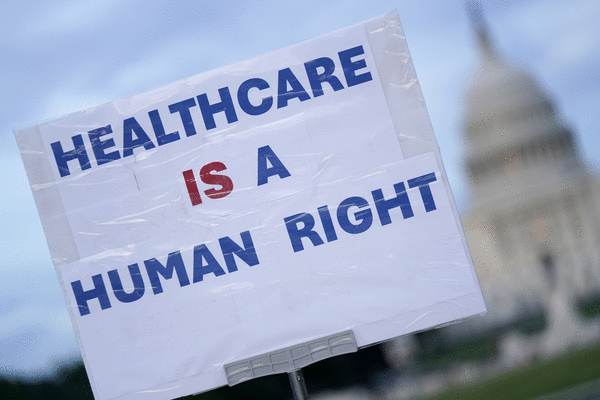
November’s big Democratic wins in state races could empower the party to close the largest remaining gap in America’s healthcare safety net: Medicaid, the joint state-federal program providing healthcare for low-income Americans. Ten states have long refused to expand it, and Democrats have new power in several of them, including Texas, Georgia and Wisconsin.
In these states, the clash over expansion is likely to be 2027’s defining political struggle — one with profound consequences for hundreds of thousands of Americans. In Texas alone, the state with the nation’s highest rate of uninsured people, expanding Medicaid would provide coverage to an astronomical 1.1 million people.
The battle over expanding Medicaid has been simmering for nearly 15 years. President Barack Obama’s Affordable Care Act essentially required states to expand eligibility for Medicaid to low-income adults earning up to 138% of the federal poverty level, now about $45,000 for a family of four. In 2012, the Supreme Court ruled that Washington could only incent, not require, the states to expand Medicaid.
Blue states rushed to sign up anyway, but many red states initially balked. Gradually, though, even most of the red states joined, either through state legislative action or ballot initiatives. Forty states have now expanded the program — providing insurance to an additional 20 million people.
Expanding Medicaid has been enormously popular in the states that have done so. It reduces uncompensated care for hospitals and doctors, improves health outcomes and benefits a population both parties claim to venerate: low-income working people. States that have expanded have slashed their uninsurance rate to about half the level of the states that have not.
Expansion is a relative bargain for states because the federal government covers more of the cost for the new enrollees. The best estimate, for instance, is that under expansion, Texas would receive $9 billion in new federal funds annually, for only $1 billion of its own money. “It’s a healthcare benefit, but it’s also an economic benefit to these states to have this influx of federal money,” says Larry Levitt, executive vice president for policy at KFF, a healthcare think tank.
But 10 states have resolutely refused to expand eligibility. Both KFF and the Urban Institute have estimated that if those states joined the program, it would reduce the number of uninsured nationwide by about 2.4 million.
Heading into this election, Republicans controlled the governorship and state legislature in all the non-expansion states, except Kansas and Wisconsin, where GOP-majority legislatures have repeatedly blocked expansion proposals from Democratic governors. But Democrats this month won the governorship and both state legislative chambers in Wisconsin, as well as the governorship and state House in Texas and Georgia.
In Wisconsin, Democratic Gov.-elect David Crowley and the Democratic legislative majorities are exploring several options to expand coverage. Robert Kraig, executive director of Wisconsin Citizen Action, says he’s optimistic Democrats will coalesce behind one of them. “They think they have to pass things that people feel in their lives … and they can have much more of an impact here than they can on grocery prices or gas prices,” he says.
In Georgia, incoming Gov. Keisha Lance Bottoms has called Medicaid expansion her top priority. With a solid Democratic majority in the state House, and Republicans clinging to a narrow two-seat state Senate advantage, local observers believe she’s well-positioned to muscle it through.
Texas will be the main event. Newly elected Democratic Gov. Gina Hinojosa has also tagged expansion as a top priority, and she too now has a secure state House majority. However, Texas Republicans maintain a solid 19-12 state Senate majority.
But the case for expansion is especially compelling in Texas, where the state healthcare system, particularly in rural areas, is straining under the pressure of treating so many uninsured patients. Democratic State Representative John Bucy, a leading expansion advocate, says the upcoming fight will pivot on rural Republican senators who recognize that expansion would benefit their communities but have feared endorsing it while GOP leaders opposed “Obamacare.”
“Republican senators could not do what is best for their district,” Bucy told me. But now, “they get a fresh start, too.”
Even in the states where Democrats didn’t break unified GOP control, they gained enough state legislative seats in South Carolina, Mississippi, Alabama, Florida and Kansas (where they also hold the governorship) to possibly generate new momentum, says Anthony Wright, executive director of Families USA, a consumer group that focuses on healthcare access.
“Medicaid expansion would be a dramatic material benefit to literally hundreds of thousands of constituents that no other policy could match,” Wright told me. “It would be a huge way to deliver real, tangible results for voters who are looking for change.”
One hurdle for Democrats: The GOP’s “One Big Beautiful Bill” focused its unprecedented Medicaid cuts on the expansion states. That will complicate the finances for Democrats trying to expand now. While state-level Democrats jockey with local Republicans over expansion, congressional Democrats will tussle with Trump and congressional Republicans over repealing those cuts — which they have pledged to do in their first 100 days.
In both Washington and state capitals, bolstering Medicaid will offer Democrats their best early opportunity to deliver on their pledge to relieve economically squeezed voters — and test whether Republicans will reconsider the policy choices that landed their party in intensive care.
____
This column reflects the personal views of the author and does not necessarily reflect the opinion of the editorial board or Bloomberg LP and its owners.
Ronald Brownstein is a Bloomberg Opinion columnist covering politics and policy. He is a CNN analyst and the author or editor of seven books.
©2026 Bloomberg L.P. Visit bloomberg.com/opinion. Distributed by Tribune Content Agency, LLC.
















































Comments