Commentary: Farmers deserve data sovereignty
Published in Op Eds
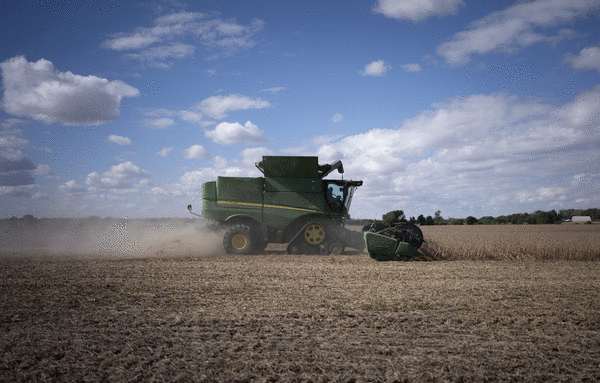
Farmers are getting squeezed so hard these days that, if they were oranges, we might soon be stuck with only the rinds.
Kidding aside, farmers today are caught between two kinds of unfair markets. On the purchasing side, President Donald Trump’s wayward war in Iran is causing the costs of fertilizer and diesel to sharply rise. Then, when it’s time to sell, increasing corporate consolidation lowers prices for farmers—prices that are often below what it costs them to grow, care and harvest their products.
And now there is an additional reason that farmers are feeling the pinch: Big Tech companies pushing for the use of artificial intelligence in farming and agriculture research.
The fight against data centers, it turns out, is only one dimension of the national debate concerning AI. Another is the question: Who owns all that data being stored in those giant concrete buildings gobbling up our land and driving up our utility bills?
Earlier this year, I was asked by a member of the Colorado House of Representatives to speak at a hearing for a state bill known as the Agricultural Data Ownership and Market Competition Act. For farmers who generate data while using certain technologies, this bill would have granted the right to retain ownership of that data and the chance to sell it to service providers. Speaking in favor, I discussed how farmers with control over their data could make markets more competitive by helping them negotiate terms with manufacturing dealers and corporations.
While that bill did not pass, it did highlight the need for farmer data sovereignty to push back against corporate power and create more just markets.
Farmers generate all kinds of information about their land, crops and animals. Records from past years show change over time, perhaps over generations. Firms covet this information, which they can use to tailor products to sell to the farmers.
While others may use AI bots to conduct research, create images or brainstorm recipes for leftover ingredients, farmers use it in ways that affect their actual livelihood. In an industry with tight margins, some tout AI’s potential to help farmers reduce waste and improve yields, while others note that the technology may assist with early disease detection to save crops.
But, as in other areas, AI also comes with unknown risks. Farmers using AI may receive potentially disastrous information on what to do with their operations, especially if AI models hallucinate, or if some pertinent data is missing. Companies, depending on their contracts with farmers, or lack thereof, could shirk responsibility and leave producers in the lurch. Others warn that adopting AI could lead to further farm consolidation.
It is only fair that the farmers who produce this data be able to decide what to do with it. But Congress has failed to secure any such protections. The recently introduced Senate bill, S.4627, known as the FARM AI Act of 2026, proposes ways to increase access to AI among farmers by expanding U.S. Department of Agriculture research grants, funding rural workforce training for precision agriculture and creating an AI Agriculture Advisor within the USDA.
What it doesn’t do is provide details about who owns and controls farmer data.
The situation at the state level is more promising. For instance, in April of this year, Nebraska passed LB 525, known as the Agricultural Data Privacy Act. This legislation grants farmers rights over how to control and potentially sell the data they produce. While tech companies may process it, they are barred from selling the information that farmers generate about their operations.
Similar legislation has been introduced in Iowa. House File 8407, or the Agricultural Data and Market Competition Act, mandates that farmers maintain “full ownership rights” over both raw and transformed data, including the right to copyright and sell it.
AI, for better or worse, is increasingly becoming part of our daily lives and is therefore worth a lot of money. For struggling farmers, it could be a much-needed revenue source. It’s up to us, and our legislators, to recognize this fact instead of taking farmers for granted and squeezing them more.
____
Anthony Pahnke (anthonypahnke.com) is vice president of Family Farm Defenders and professor of international relations at San Francisco State University in San Francisco. This column was produced for Progressive Perspectives, a project of The Progressive magazine, and distributed by Tribune News Service.
_____
©2026 Tribune Content Agency, LLC.
















































Comments