Commentary: Will Donald Trump's meeting with Vladimir Putin and Xi Jinping yield real results?
Published in Op Eds
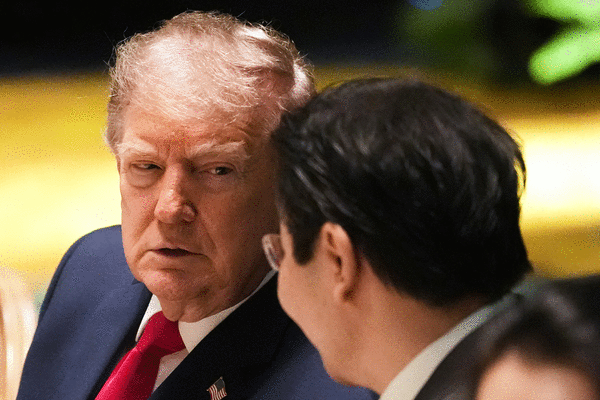
After getting walloped in the midterms, President Donald Trump will spend the bulk of his time this week in Asia, away from the glare and constant punditry about whether the Republican Party is moving away from his brand of politics. Still, the president’s overseas trip will hardly be a vacation.
Trump will visit the Philippines, then head to Shenzhen, China, for a meeting of the Asia-Pacific Economic Cooperation grouping.
The most consequential leg of the journey is his session with Chinese President Xi Jinping and Russian President Vladimir Putin, a trilateral summit that foreign policy commentators have described as a modern-day version of Yalta, the famous 1945 sit-down between President Franklin D. Roosevelt, British Prime Minister Winston Churchill and Soviet dictator Josef Stalin that decided how Europe would be drawn following World War II.
The comparison is not that unreasonable; the world is not only in flux right now, but two of the three leaders (Trump and Putin) are fighting wars of choice that have proved to be anything but short.
The Chinese are marketing this get-together as an opportunity of “groundbreaking significance” meant to achieve peace in a tumultuous world.
In reality, it will produce little in the way of substance. Barring some unexpected meeting of the minds, the most we’re likely to see are a few photos of the three men shaking hands and a bland joint statement. All the problems bubbling between the United States, Russia and China will continue to bubble afterward. And sure enough, Trump’s critics back in Washington will knock him for groveling in front of two dictators and not extracting anything in return.
Why the pessimism? Because Trump, Xi and Putin come into this summit with vastly different interests, goals and expectations. Nobody is carving up the world, a la Yalta 1945, because there’s no agreement on how to do it or whether it should even be done.
What are Trump’s aims? Beyond moving on from a terrible midterm blowout, White House officials have talked up the summit as a chance for the three nuclear-armed states to make progress on limiting nuclear proliferation. A grand denuclearization agreement is something Trump has brought up frequently going back to his first term, when he teased the possibility of striking a three-way accord that could eventually turn the world nuclear-free.
That ambition has gotten only more difficult as Russia and the United States modernize their nuclear arsenals and China tries to catch up with Washington and Moscow. According to the Pentagon, China could have 1,000 nuclear warheads by 2030, still about one-fifth of what the U.S. and Russia possess, but it’s a number that’s exponentially higher than what Beijing had a decade earlier.
Xi’s position has been consistent throughout this buildup: He won’t engage in nuclear reduction negotiations until Beijing has parity. That means China’s arsenal either matches those of the United States or Russia or the latter two bring their own stockpiles closer to Beijing’s level — something Trump and Putin have no intention of doing. Chinese perspective hasn’t changed.
Without major changes in U.S. nuclear policy, Trump is probably using up whatever political capital he has left in his effort to convince Xi to cut or even cap China’s nuclear capability. His time would be better spent exploring the kinds of nuclear transparency and de-confliction arrangements Washington and Moscow solidified during the Cold War, which served the interests of both.
Putin’s objectives are more systemic, bordering on the spiritual. Unlike Trump, who as best we can tell is coming into this meeting focused on a few issues, the Russian strongman will leverage the three-way leaders’ dialogue as more grist for his attempt to do what Stalin succeeded in doing more than 80 years ago: establish a new balance of power arrangement in Europe that puts a large swath of Eastern Europe under Moscow’s tutelage.
Like all of Russia’s prior leaders since time immemorial, Putin wants a buffer zone for security reasons and neighbors that take his orders. Ukraine’s status is obviously integral to this vision. So is stopping NATO from expanding closer to Russian borders and pushing the organization into moving its troops and military infrastructure out of the post-Soviet space, a demand Putin spelled out in his Ukraine peace proposal last week. Putin won’t get any of these concessions this week, if ever.
For Xi, the summit is about being the good host and protecting China’s core prerogatives. He will remind Trump for the umpteenth time that Taiwan is at the core of China’s grand strategy and that, ultimately, Beijing expects the island’s reunification with the mainland.
If Trump floats nuclear weapons negotiations, Xi will remind his American guest that Washington has thousands upon thousands more nuclear arms under its control than China does, which is an elongated way of saying “no thanks.”
Xi will also try to keep the war in Ukraine out of the discussions. First, the last thing Beijing wants to do is bring attention to its own enabling of the war, which includes the export of dual-use goods sourced from China finding their way into the hands of the Russian military. And second, Xi has a positive, useful relationship with Putin he wants to sustain.
None of this is to suggest that Trump’s upcoming meeting with Xi and Putin is a bad idea. After all, great power politics require durable communication channels at the very top. Finding or at least exploring mutually acceptable ways of solving problems is far preferable to shutting down dialogue just because some of the participants at the table happen to have a different interpretation of how international politics should work.
Just don’t expect any major headlines coming out of it.
____
Daniel DePetris is a fellow at Defense Priorities and a foreign affairs columnist for the Tribune.
___
©2026 Chicago Tribune. Visit at chicagotribune.com. Distributed by Tribune Content Agency, LLC.













































Comments