Commentary: Efforts to silence voices for Palestinian lives have failed
Published in Op Eds
On Oct. 21, the American Israel Public Affairs Committee announced that, after the midterms, it will no longer endorse candidates for public office or contribute directly to their campaigns. The change comes as candidates are increasingly rejecting AIPAC’s support; the lobby group retains enormous financial reserves, but associating with it has become a political liability.
A few weeks prior, Gillette Stadium owner Robert Kraft pressured singer Ed Sheeran to drop rapper Macklemore as his opening act for a multi-venue tour, after Macklemore proclaimed “Free Palestine” while onstage at his concert. Four other performers, including Sheeran’s backing band, withdrew from the tour in protest. Country star Zach Bryan subsequently appeared on Gillette’s stage, defiantly wearing a “Free Palestine” T-shirt before a record crowd of more than 73,000. And Macklemore announced an international tour for Palestine that quickly sold out.
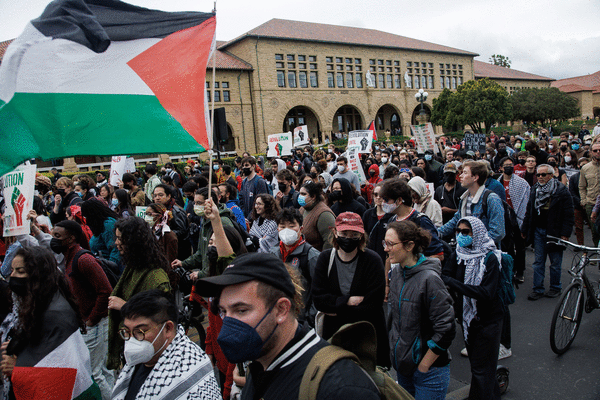
This pushback is not an isolated phenomenon. Across the country, efforts by supporters of Israel to silence voices for Palestinian lives have failed. Nowhere is this shift clearer than in the crackdown on campus activism over the past three years.
In October 2023, the Anti-Defamation League and Louis D. Brandeis Center urged nearly 200 universities to investigate chapters of Students for Justice in Palestine for allegedly providing material support to terrorism. In 2024, more than 3,200 people were arrested on campuses, and an American Civil Liberties Union and Amnesty International USA investigation published in September found that colleges punished these students far more harshly than other protesters.
Meanwhile, the federal government cut funding to universities until they signed agreements reshaping their curricula, discipline and protest rules. Columbia agreed to pay more than $200 million in a settlement to resolve federal investigations for allegedly violating anti-discrimination laws by allowing dissent. Mahmoud Khalil, a Columbia student with permanent U.S. residency status, was arrested for taking part in protests for Palestinian lives and spent 104 days in detention, missing the birth of his son. Another Columbia student activist, Mohsen Mahdawi, was arrested at his citizenship interview and locked up for more than two weeks.
In some ways, these efforts succeeded. Campus protests fell by more than 64% between spring and fall 2024, and the ACLU-Amnesty report describes how fear made the movement for Palestinian lives less visible. Students now weigh whether a protest could cost them their degree, visa or home.
But the suppression also pushed the struggle beyond campus and ignited a national debate over free speech. Scholars of nonviolent resistance call this backfire: repression meant to silence a cause that instead draws more attention to it, prompting a response.
Civil rights advocates took the institutions behind this suppression to court, forcing them to put their justifications on the record. The proceedings exposed the government’s insidious motives, including the revelation of a State Department memo conceding it had no evidence against one detained student beyond an op-ed she co-wrote. A New York judge overturned Columbia’s sanctions against 22 students as arbitrary and capricious.
In a lawsuit on which I serve as co-counsel, brought against the University of North Carolina at Chapel Hill, a federal judge lifted campus bans against encampment participants after finding that the bans likely amounted to unlawful viewpoint discrimination. The Stanford Daily, backed by more than 50 student news organizations, won its challenge to the government’s weaponization of immigration law against student speech. And in September 2025, a federal judge in Boston found the secretaries of State and Homeland Security unconstitutionally set out to chill speech by targeting noncitizens for deportation.
While the crackdowns diminished campus organizing, the broader movement has continued to grow. This year, the Chicago Council on Global Affairs recently found that the core demand of the movement for Palestinian lives has gained popularity: Most Americans now say U.S. military aid to Israel should be either decreased (21%) or stopped altogether (35%).
AIPAC’s money will keep indirectly reaching candidates, and universities and federal officials retain the power to punish dissent. But when authorities rely on intimidation and coercion to silence a movement, they do not defeat a cause. What began as localized campus protests for Palestinian lives is now a debate about national public opinion. A stadium owner can decide who takes his field. He cannot decide what the crowd leaves talking about.
_____
Reem Subei is a senior staff attorney for Muslim Advocates, a national civil rights organization. This column was produced for Progressive Perspectives, a project of The Progressive magazine, and distributed by Tribune News Service.
_____
©2026 Tribune Content Agency, LLC.













































Comments