Commentary: Iranians need the rule of law, not just a peace deal
Published in Op Eds
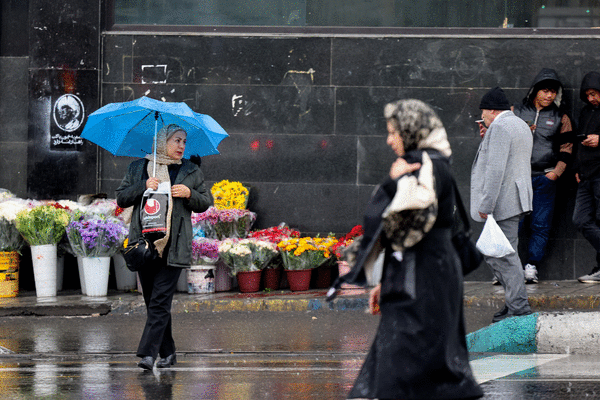
America’s midterm elections brought celebration to many voters, particularly Democrats hoping for a change in the country’s direction. Thousands of miles away, another government was equally eager to celebrate: the Islamic Republic of Iran.
“Americans said no to war, and we endorse this message,” Mohammad Bagher Qalibaf, Iran’s parliament speaker and chief negotiator, posted on X. Mohsen Rezaei, a former Revolutionary Guard commander and secretary of the Supreme National Security Council, warned that any base used in a new attack, “from West Asia to Europe,” would be “a legitimate target.” “No safe haven,” he added. After more than eight months of war, Iran’s rulers claim victory over Washington and now present an American election as further proof.
The triumphalism is revealing. To the government, what matters is the survival of power, not the citizens who pay its price. For ordinary Iranians, nothing has changed. They remain trapped between repression at home and uncertainty abroad.
Kilometer-long lines and fuel shortages have hit Tehran and other cities, and in September the government doubled the price of every liter beyond a monthly allowance of 110. The rial passed 2.5 million to the dollar in late September, from about 1.5 million in January.
Iranian media report shortages of about 90 essential or lifesaving medicines, and the Mehr news agency said the price of popular pain reliever paracetamol rose at 375% in a year. The cost of insulin is up sixfold. War, sanctions and a U.S. naval blockade squeeze everything else.
And the executions continue. The Human Rights Activists News Agency documented at least 2,003 executions between October 2025 and October 2026, a 29% increase. Behind every execution is a life extinguished and a family devastated.
This is the cruel paradox of Iran’s moment: An authoritarian government commands the country’s principal instruments of power, while international leaders voice concern without always showing the capacity, or the willingness, to protect Iranians.
So what happens now? The question is no longer whether Iran is approaching another historic turning point. It is whether any transformation can produce something more enduring than a change in who wields power. The answer begins with the rule of law.
A lesson from Chicago: In 1940, the U.S. Supreme Court made a ruling in a Chicago case rooted in racial restrictions on housing — Hansberry v. Lee. A Black family had bought a home in a white neighborhood covered by a covenant designed to exclude Black residents, and neighbors sued to enforce it. As William Hubbard writes in “Civil Procedure: An Integrated Approach,” such covenants were “commonplace — and they were legal.”
The Supreme Court did not strike down racially restrictive covenants. It ruled on due process: whether res judicata could bind the family to the judgment in an earlier class action in which its interests had not been adequately represented. Eight years later, in Shelley v. Kraemer, it held that judicial enforcement of such covenants violated the equal protection clause of the 14th Amendment.
These decisions did not eliminate racial discrimination. But they showed that deeply entrenched injustice can be challenged when individuals have access to independent courts. The Hansberry family did not possess the political influence of those seeking to exclude them. What they possessed was the ability to carry their case to an institution capable of placing constitutional limits on power. They won no revolution. Procedure, as Hubbard teaches, is power: They won the right to be heard, and their young daughter Lorraine would later turn the family’s ordeal into “A Raisin in the Sun.”
In the American tradition, judges guard their judicial dignity, which is not conferred by a robe or a title but earned through independence and fidelity to the law. The legacy they leave in history matters deeply to them.
The rule of law does not promise a society without injustice. It promises that injustice can be contested through institutions whose authority comes from law rather than political loyalty.
Could an Iranian family confronting state-sponsored injustice expect the same protection? For many defendants facing political or national security charges, the answer is profoundly troubling.
The Islamic Republic’s judiciary has repeatedly faced allegations of denying defendants basic fair-trial guarantees, including meaningful access to counsel, impartial adjudication and protection against coerced confessions. Revolutionary Courts, which hear many political and security cases, are a focus of international criticism.
Independence matters most when the punishment is death. Even under Iran’s own Islamic Penal Code, punishment must rest on lawful procedures. An execution after a fundamentally unfair trial is the irreversible exercise of state power without the protections that give judicial authority its legitimacy.
Over these hardships hangs the prospect of renewed war. Iranians face a painful question: whether to fear a new war more than a daily life that grows more restricted.
The Revolutionary Guard exercises extensive influence over Iran’s security apparatus, political institutions and economy, and severe restrictions make opposition organizing inside Iran extraordinarily difficult. Abroad, Reza Pahlavi remains among the prominent opposition figures seeking international attention. But neither prominent leaders nor the calculations of foreign governments should obscure the people whose lives are at stake.
Accountability, due process and judicial independence are not aspirations to be addressed after a geopolitical settlement. They are essential to any durable political order.
Iranian citizens deserve courts where a young protester is treated as a rights-bearing individual rather than an enemy of the state; where judges answer to law rather than political commanders; and where a family can challenge injustice without fearing that seeking justice will invite further punishment.
The question is not simply whether there will be another war or another agreement. It is whether an Iranian citizen will one day be able to stand before an independent judge, challenge an abuse of power and expect the protection of the law. Peace that secures a government while leaving its people defenseless is not justice.
____
Pegah Banihashemi, a native of Iran, is a legal scholar and journalist in Chicago whose work focuses on human rights, constitutional and international law, and Middle East politics.
___
©2026 Chicago Tribune. Visit at chicagotribune.com. Distributed by Tribune Content Agency, LLC.
















































Comments