Commentary: There's nothing special about factory jobs
Published in Op Eds
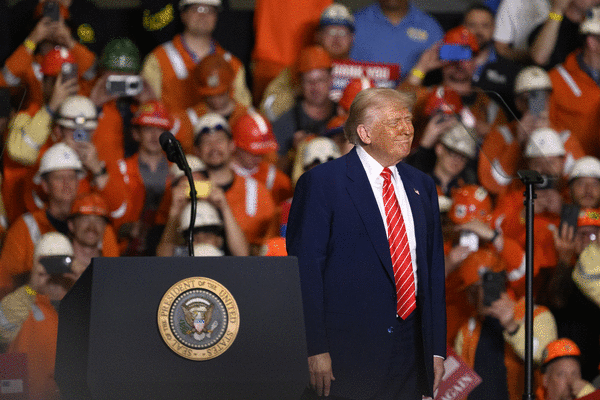
If there’s one thing on which American politicians can agree, it’s that U.S. factory jobs are special. And with midterm elections approaching, the number of people working in manufacturing has become the scoreboard for President Donald Trump’s trade and industrial policies: Democrats point to 35,000 jobs lost since Trump took office in January 2025, while Republicans highlight a rebound of almost 60,000 since last December’s low.
Beneath both claims lie three assumptions: that all U.S. factory jobs are “good jobs,” that they’re attainable for anyone with a high-school degree, and that they’re the kind of jobs Americans want. New research punctures them all.
A September study from the Federal Reserve Bank of Cleveland compares manufacturing wages with those of similar workers (same age, education, etc.) in other industries. It finds that the premium U.S. manufacturers paid in the 1980s had turned negative by the early 1990s and, save a blip around 2015, has stayed there. Workers with a high-school diploma or less have faced an even bigger penalty since the late 1980s, excluding only an aberrational pandemic surge. Only college-educated factory workers consistently come out ahead versus their non-manufacturing peers.
The study’s findings are consistent with previous research showing that the long-standing “manufacturing wage premium” has essentially disappeared. For well over a decade, in fact, average hourly earnings for blue-collar (aka “production and nonsupervisory”) workers in manufacturing were significantly less than the same workers in the services sector.
The Cleveland Fed report also deflates the assumption that factory work is much the same today as it was decades ago, when a sole breadwinner with a high-school diploma could count on lifetime job security to support his family and retire comfortably. That may have been true in the early 1980s, when the manufacturing wage premium was positive and almost 80% of industrial workers lacked any college education. By June 2025, however, the U.S. manufacturing workforce had become far more educated: Employees with at least some college outnumbered those without it by a 60.6% to 39.4% margin, and the share of workers with a college degree or higher rose from 10% to roughly 35%.
Research from the Economic Innovation Group, meanwhile, shows that recent gains in U.S. manufacturing jobs — driven by order backlogs and the AI boom, not tariffs — have been concentrated in the advanced, higher-skill aerospace and electrical equipment industries, while most lower-skill industries keep shedding workers, consistent with longer term trends. Separate EIG research further shows that a significant number of U.S. “manufacturing workers” are actually performing higher-skill services — R&D, marketing, human resources, sales, etc. — for “factoryless” producers with offshore facilities or large onshore manufacturers with diverse operations both in-house and outsourced. These aren’t your uncle’s manufacturing jobs.
These realities help to explain why the third assumption — that American workers are itching to fill factory jobs — is also misguided. Start with what people say: A 2024 Cato Institute survey found that, while about 80% of respondents said the U.S. would be better off with more manufacturing jobs, just 25% said they’d personally be better off working in a factory. Cato’s March survey, meanwhile, found that respondents would — assuming equal pay and education requirements — prefer a job in the skilled trades or at an e-commerce warehouse over one at a factory.
Even this level of interest is probably exaggerated, as Americans’ “revealed preferences” indicate: The main driver of the decline in U.S. manufacturing employment since 1960, according to the study from the Cleveland Fed, is “the lack of younger workers entering the industry,” not a lack of available work. Today, the U.S. manufacturing sector has more than 500,000 job openings — well above pre-pandemic levels — and employers have long cited “attracting and retaining a quality workforce” as a key challenge. Yet, as Bloomberg’s Brooke Sutherland has noted, there are roughly half a million unemployed Americans who last worked in manufacturing, thus suggesting mismatched skills and wage expectations or unappealing work.
None of this means that all American factory work is bad, or that unemployed American manufacturing workers haven’t struggled. But the reality of modern U.S. factory work argues strongly against treating a simple increase in “manufacturing jobs” as goal for national policy or a measure of policy success.
For starters, research shows that all nations tend to lose manufacturing jobs as they develop, regardless of their trade and industrial policies. Jobs get automated, systems get streamlined, and wealthier consumers devote more spending to services instead of goods. (One only needs so many outfits and appliances.) All three have certainly occurred in the U.S.: long-term manufacturing employment declines are almost mirror images of labor productivity gains and track U.S. factories’ embrace of robots. But the loss has also occurred in China, which supposedly stole all the U.S.’s factory jobs yet had 18 million fewer manufacturing workers in 2022 than at its 2013 peak.
A headcount target also invites the wrong policies — ones that can pull finite workers toward whatever jobs are most labor-intensive (and usually the lowest-paying and the easiest to automate) and away from advanced, globalized manufacturers that pay well. Research shows, in fact, that across-the-board tariffs could modestly boost overall U.S. manufacturing employment in the long run (and after a painful adjustment period), but the levies would do so primarily by increasing basic and lower-skill industries while shrinking higher-skilled ones. At the same time, tariffs burden U.S. consumers, including the very ones these policies are intended to support. Male-dominated, blue-collar service occupations — many of them good-paying — today outnumber manufacturing production workers by more than 4-to-1. Tariffs on goods only hurt services workers, helping to explain why the levies poll so poorly among today’s working class.
Counting factory jobs reveals only how many Americans work in factories. It says nothing about whether these workers, or the nation overall, are actually better off. America’s politics should adjust accordingly.
____
This column reflects the personal views of the author and does not necessarily reflect the opinion of the editorial board or Bloomberg LP and its owners.
Scott Lincicome is an economist with the Cato Institute. He specializes in domestic policy and international trade.
©2026 Bloomberg L.P. Visit bloomberg.com/opinion. Distributed by Tribune Content Agency, LLC.


















































Comments