Editorial: 'Like giving whiskey and car keys to teenage boys'
Published in Op Eds
The federal government managed to become even more fiscally inept during the past fiscal year, running a deficit of $2 trillion, according to the Congressional Budget Office. That’s a $218 billion increase from the previous 12 months.
The sea of red ink comes as revenues have risen. Tax collections were up 3 percent in fiscal 2026, coming in at $5.4 trillion, “driven by larger collections of individual income and payroll taxes,” the CBO reported. For perspective, federal spending in fiscal 2019 — less than a decade ago — was $4.4 trillion, with revenues of $3.5 trillion.
In other words, revenues are exceedingly healthy despite Democratic mewling about tax cuts starving Washington. Meanwhile, the nation would have posted a $1 trillion surplus during the past fiscal year had spending remained steady over the past seven years.
All this further confirms humorist P.J. O’Rourke’s observation decades ago that, “Giving money and power to government is like giving whiskey and car keys to teenage boys.” Our elected officials have a bipartisan spending addiction that only worsens with time. Interest payments on the debt now exceed $1.1 trillion annually. Panicked over the potential fallout, federal politicians continue to ignore reality about entitlement programs. We’re on autopilot toward the cliff.
“Clearly, we can’t keep going like we have,” observed Maya MacGuineas, president of the Committee for a Responsible Federal Budget. “Our fiscal path has been running backward for far too long; it’s time to start working on the path forward.” The committee advocates for Congress to keep deficits at about 3% of GDP — half of our current level.
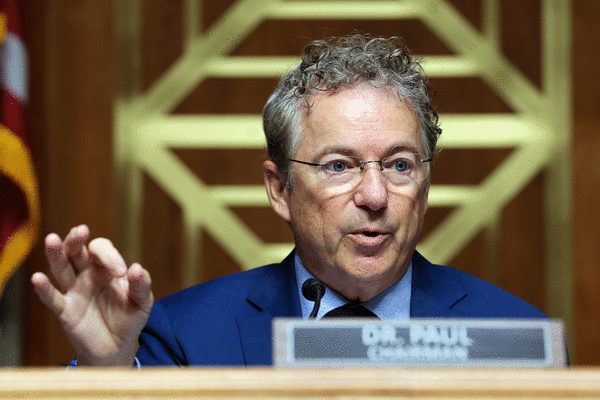
Yet even that modest goal seems to be a white flag rather than a path toward true fiscal sanity. Taking baby steps may be better than remaining wheelchair bound, but a more radical approach is likely the only way to force Washington to change course. Enter Sen. Rand Paul and his Six Penny Plan to balance the budget in five years.
Paul has endorsed a version of this proposal each year since 2018. Every year that critics dismissed the idea has made our current predicament worse, and the debt now stands at $40 trillion. Under the current version, Congress would cut “six cents off every dollar projected to be spent over the next five fiscal years,” his news release says. After that, spending could increase alongside revenues.
“At more than $40 trillion, the national debt now costs every household nearly $300,000 and adds $7 billion a day, with interest payments larger than the defense budget,” Paul argues. He added that, “Neither party has shown the spine to finish the job, but $40 trillion ought to be the moment they finally do.”
The nation continues to turn a deaf ear to Paul at its own peril.
_____
©2026 Las Vegas Review-Journal. Visit reviewjournal.com.. Distributed by Tribune Content Agency, LLC.













































Comments