Michael Hiltzik: A new round of stories asks us to feel sorry for families living paycheck-to-paycheck on $500,000 a year
Published in Op Eds
Ben Franklin was wrong. The certain things in life aren't only death and taxes, but death, taxes and news articles about how wealthy families are living "paycheck-to-paycheck."
We're undergoing a new round of this coverage, triggered this time by a survey from Goldman Sachs titled "New Economics of Retirement: Making Every Dollar Saved Work Harder." Candidly, the "new economics of retirement" described in the survey resemble the same old economics of retirement — families trying to save for college and generally make ends meet find it hard to put money aside in retirement accounts today, just as it always was.
The eye-opening bullet point in this survey, however, is that households with income of $500,000 and more feel as strapped as those at the lowest reaches of the income ladder, say with income of $50,000 to $100,000.
That latter segment encompasses the median household, with income of about $84,000 in 2024. The highest segment encompasses the proverbial 1%, who average about $700,000 in annual inflow.
The survey begat headlines in the media, especially in finance-oriented publications like Fortune and Barron's, that figuratively wrung their hands over the travails of the upper crust.
I've pointed out in the past that articles like these are a genre of financial reporting all its own. "The idea seems to be that wealth doesn't buy happiness or even, really, wealth, so we shouldn't judge these people too harshly," I wrote in 2017. Spates of them appear every couple of years, often inspired by surveys of financial contentment like Goldman's. Very little about them has changed over time, except perhaps for the threshold of unhappiness, which has tended to rise with inflation.
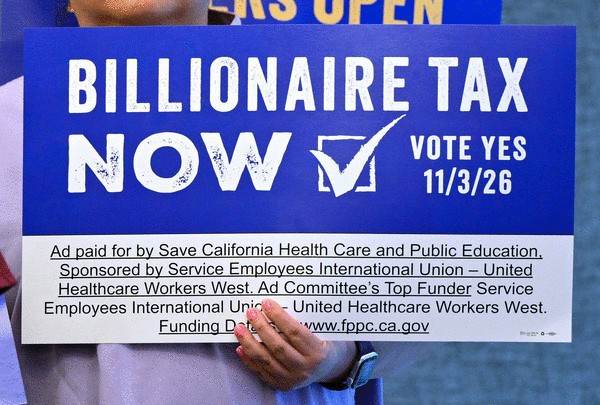
But they're particularly piquant at this moment, when plutocratic influences on our government, economy and politics have come under heightened scrutiny. A key driver of the discussion has been the billionaire tax on the California ballot for next month's election. The leading character in the political brouhaha over the tax is Sergey Brin, the co-founder of Google and one of the richest men in the world, who has lobbed more than $100 million into the opposition campaign from an out-of-state perch.
Some coverage of the Goldman Sachs survey implies that since low-income and high-income families experience similar levels of unease about their finances, they're all in the same boat. That's not exactly what the survey found, however.
Goldman Sachs discovered a U-shaped phenomenon among segments of household income. As one might expect, it found that lower-income households struggle to fund their retirement because their resources are consumed by child-care expenses, staples such as food and gas and housing.
Curiously, households with income between $100,000 and $300,000 reported the most contentment with their ability to save for retirement — their "earnings appear sufficient to cover the essentials, service debt, and still leave room to build toward the future," according to the report.
Things turn darker for those with $300,000 or more. Goldman Sachs notes judiciously that "their reported insecurity is not about covering the essentials but about ... more complex financial lives [and] higher lifestyle expectations."
The bank acknowledges that the source of strain is entirely distinct among these cohorts. "For one, it may be the strain of making ends meet. For the other, it may be the strain of one's lifestyle and the expectations that often outpace a rising income."
To dive deeper into what we can say about wealth and penury in today's America, let's examine the standard features of the articles about the supposedly financially strapped rich—whom economist Greg Kaplan, then of Princeton, and colleagues termed the "wealthy hand-to-mouth" in a 2014 paper.
Several such articles appeared in March 2017, after personal finance writer Sam Dogen published a piece on his Financial Samurai website titled "Scraping By on $500,000 a Year: Why It's So Hard for High Income Earners to Escape the Rat Race."
Dogen wrote of an ostensibly genuine but unidentified couple living in New York City with two kids on combined incomes of $500,000. After their annual expenses, he wrote, they were left with $7,300.
As not a few commentators observed (myself included), that paltry sum was what remained after expenditures on what middle-class families, say those living on $70,000 to $150,000, might see as unattainable luxuries. Those included funding their 401(k) accounts with the then-maximum $36,000, mortgage payments of $5,000 a month on a $1.5-million three-bedroom apartment, child care ($42,000), three vacations a year ($18,000), car payments on a BMW and Toyota Land Cruiser ($9,600) and food for four including "date nights" every two weeks ($23,000).
I noted then that two cars in New York City were non-necessities by any measure. Date nights every other week would plainly drive up child-care costs and render average couples with two toddlers at home prostrate with envy.
Dogen also listed $18,000 for charity, including donations to the couples' universities, and $10,000 on "miscellaneous (something always comes up)," meaning that their actual leftover cash wasn't $7,300 but $17,300. Things like 401(k) contributions shouldn't even count as spending, since they still have that money — they've just put it aside for the moment.
For this couple, like those featured in other such explorations, most of this spending is on items that result from choices, not necessities. Redoing the math, the truth emerges that they had $155,000 available, from which they could pay for their retirement funds, child care, cars, vacations, charitable contributions and miscellaneous expenses.
(At the time, Dogen defended his calculations as reasonable for a couple living in New York and responsible spending for a family helping their children get ahead).
Another round of such reporting erupted in 2020 when Joe Biden, then the Democratic candidate for president, said he would raise taxes only on the rich, whom he defined as those collecting $400,000 a year or more. Market Watch responded with the headline, "Joe Biden defines income of $400,000 as 'wealthy,' but here's why it's barely scraping by for some."
Dogen weighed in again, with a piece cited by CNBC and others. His family of four ended the year with only $34 in hand for "miscellaneous" expenses. Along the way, however, they salted away $39,000 in their 401(k) plans and $18,000 in college savings and spent $81,000 on a $1.6-million mortgage and $37,200 on day care.
A new element in some recent stories is the assertion that the wealthy are so financially straitened they're cutting back. Last year, Fortune reported that "more than seven in 10 of these high earners are now being forced to shop at discount grocery chains to save cash" — as if at gunpoint?
The source of the claim was a survey by Clarify Capital, a small-business lender, which in effect defined "high earners" as anyone with $100,000 or more in income. Today, however, that encompasses solidly middle-class, even working-class, households, not the $500,000+ cadre. The sample was 750 persons.
What's usually undefined in these analyses is living "paycheck-to-paycheck." Obviously, a family that is left with pennies after paying for food, shelter, healthcare and utilities, sees it differently from a family that spends on all those things and also on retirement and college funds, luxury cars, vacation travel and date nights.
Kaplan and his co-authors made an important distinction between the "wealthy hand-to-mouth" who hold little or no liquid wealth (such as ready cash) "but do have significant amounts of illiquid assets on their balance sheet," and the "poor hand-to-mouth" who hold little or no liquid wealth and no illiquid wealth.
Both groups spend down all the liquid wealth they receive. But the first group has plenty of wealth in places such as retirement accounts, which they're reluctant to spend because of the transaction costs of accessing it. To an outsider, both groups may be equally strapped when they've spent down their cash, but the first group is still rich.
There's no question that rising prices are being felt these days by both groups. A $1.4-million 30-year mortgage costs more than $6,600 a month to pay down when rates are at 4%, as they were not a very long time ago; when rates are at 7.5%, about where they are now, a loan of only about $950,000 would require about the same monthly payment and a $1.4-million mortgage would cost nearly $9,800 a month.
A wealthy hand-to-mouth family might well be able to cover the latter by dipping into their illiquid reserves (and they'd have more liquid income, too). The same numbers might prompt a middle-class or working-class family to put a home purchase on hold, for the foreseeable future. That's the sort of distinction that gets glossed over when we fret about rich families living "paycheck to paycheck." And it's the reality today.
©2026 Los Angeles Times. Visit latimes.com. Distributed by Tribune Content Agency, LLC. ©2026 Los Angeles Times. Visit at latimes.com. Distributed by Tribune Content Agency, LLC.

















































Comments