Commentary: Democratic socialism is as American as apple pie. Eugene Debs showed it
Published in Op Eds
The way Republican politicians tell it, democratic socialists are un-American — “incompatible with American values,” in the words of a recent U.S. House resolution. The resolution’s author, Colorado Rep. Jeff Crank, celebrated the September vote, claiming that it “showed who stands for freedom, and others who stand with socialism.”
And President Donald Trump? Over the summer, he called democratic socialists “godless communists” who will “attack all religions but, in particular, Christianity.”
It’s a shame they never met a guy named Eugene V. Debs.
Debs, who died 100 years ago this month, is as close to a patron saint of democratic socialism as Americans have ever had. The Democratic Socialists of America, which is set to grow its congressional representation after the midterms and whose 130,000 members are part of the largest socialist group in U.S. history, is a direct descendent of Debs’ Socialist Party of America. After Zohran Mamdani won the New York City mayoral election last year, his first words were a Debs quote: “I can see the dawn of a better day for humanity.” U.S. Sen. Bernie Sanders lists Debs as his political hero, along with the Rev. Martin Luther King Jr.
So who was Debs? He co-founded the Socialist Party in 1901, ran for president five times and twice won about a million votes — the second time from prison for speaking out against World War I. But his real genius, as I show in my new biography, “ American Socialist: The Life and Legacy of Eugene V. Debs,” is that he made people realize that to be an American and a socialist was the most natural thing in the world.
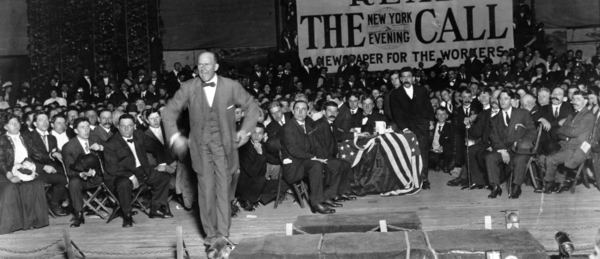
In Debs’ heyday, Socialists held 1,200 elected offices across the U.S., including 80 mayorships. The largest socialist newspaper, Kansas’ Appeal to Reason, rivaled mainstream papers’ reach. Socialists led major unions. Election year or not, Debs barnstormed the country, speaking at crowded railroad stations and bunting-adorned auditoriums, his arms whipping around like a tornado on the plains, everywhere urging ordinary Americans to do what the rebels of the Revolutionary War and the abolitionists of the Civil War had done, this time with ballots and strikes rather than muskets.
“I like the Fourth of July,” he told a Chicago crowd one piping-hot Independence Day. “It breathes a spirit of revolution.”
Debs was born in Indiana in 1855 and toiled on the railroads during America’s Gilded Age. The workplaces of that era were not graced by liberty. Take the mines that pockmarked Colorado, not far from Rep. Crank’s district today. Miners were forced to sign “yellow dog” contracts that barred them from joining unions. Their strikes regularly turned deadly when mine owners dispatched rifle-toting private guards to quell the protests. That felt like an assault on the Declaration of Independence to them. And to Debs.
Debs declared himself a socialist on New Year’s Day 1897. “We have been cursed by the reign of gold long enough,” he said, adding: “Property has become sacred and human life has been reduced to a valueless commodity.”
He would soon remark: “What is socialism? Merely Christianity in action.”
That doesn’t sound like a “godless,” America-hating socialist to me.
Debs’ Jesus was the lowly carpenter’s son who sided with the poor. His America was Thomas Paine’s America, fighting monarchist Britain, and Frederick Douglass’ America, fighting the Southern slavocracy.
Only now, in the Gilded Age, it was the robber barons who threatened American democracy. Debs’ goal was a “cooperative commonwealth,” as he called it, in which workers would have a democratic say in their workplaces, corporate tycoons wouldn’t control politics, and economic plenty would be used to guarantee everyone a steady job, ample leisure time and a decent standard of living.
Debs’ movement racked up its biggest victories in Midwestern cities, Western mining towns and villages on the Great Plains. Milwaukee became as renowned for its Socialist mayors as its beer. And don’t tell Homeland Security Secretary Markwayne Mullin — who recently claimed democratic socialists undermine the “ foundation of this country” — but his home state of Oklahoma boasted the country’s strongest socialist party in Debs’ day.
Galvanized by Debs and the dedication of its rank and file — the party peaked at around 120,000 members — the Socialist Party built a democratic insurgency for a time. It backed women’s suffrage before either of the two major parties and championed many of the pro-labor reforms later passed during the New Deal. And though thoroughly American, Debs’ Socialists didn’t forget workers outside U.S. borders, rallying their countrymen to support the Mexican Revolution.
Debs died on Oct. 20, 1926. By that point, his party was a shell of itself, hollowed out by government repression — Debs himself was jailed for almost three years for opposing WWI — and ruinous factional splits. But his spirit lived on. A. Philip Randolph, whom Debs befriended when Randolph was a young socialist, headed the 1963 March on Washington. King’s “spiritual mentor,” as King called him, revered Debs, and King, a democratic socialist himself, was known to quote Debs in his speeches.
Today, the Democratic Socialists of America have taken up Debs’ mantle. New York City DSA’s Claire Valdez is poised to enter Congress after running a campaign declaring: “We will usher in a golden age for organized labor to battle back the new gilded age.” Valdez’s platform would surely have made Debs smile, with sweeping policies to halt union-busting, “end corporate dominance” and ensure every worker the “freedom to live a good life.”
As Debs put it during one of his presidential runs, the Socialist Party is the “only party that believes that the people have capacity for industrial as well as political government; the only party that proposes to make this in fact a government of and by and for the people.”
Sounds pretty American to me.
____
Shawn Gude is an Iowa native, former editor of the magazine Jacobin and the author of “American Socialist: The Life and Legacy of Eugene V. Debs.”
___
©2026 Chicago Tribune. Visit at chicagotribune.com. Distributed by Tribune Content Agency, LLC.


















































Comments