Editorial: Democrats need an agenda, not theatrics
Published in Op Eds
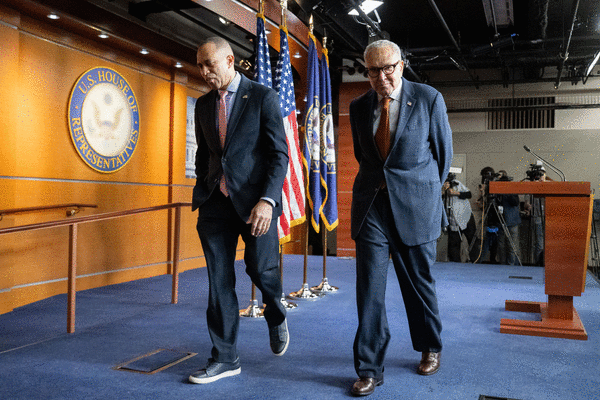
With a month to go until midterm elections, Democrats find themselves in better shape than expected. Odds are, they’ll win the House and perhaps a slim majority in the Senate. Exactly what they’ll do with that power, though, remains a mystery.
On the campaign trail, most of the party’s congressional candidates have been long on rhetoric and short on policy. In lieu of an agenda, many are promising partisan warfare: more investigations of the president, expansive impeachment proceedings, subpoenas for documents and witnesses, aggressive oversight hearings, and more.
All of which is fine as far as it goes. But the party must remember that voters have many worries on their minds, that the president’s cooperation will still be needed to pass bills — and that the country is facing real challenges that need real solutions.
For starters, a lot of must-pass legislation is coming down the pike that will require cross-party cooperation, including a surface-transportation bill, a farm bill, a debt-ceiling extension, a defense reauthorization and the 12 standard appropriations bills needed to keep the lights on. Democrats should fight for their priorities, but they should avoid shutting down the government or otherwise engaging in theatrics.
Next, they should seek bipartisan victories where possible. Permitting reform offers an obvious one: A bill recently introduced in the Senate would mitigate the endless delays and expenses that currently plague federally linked construction projects. Passing it would slash costs, speed timelines, accelerate the green transition and help lay the groundwork for growth. It should be a no-brainer.
A bigger problem is the country’s looming fiscal crisis. With bond yields rising, Social Security nearing insolvency and deficits at $2 trillion, serious budgetary reform is urgently needed. The place to start is a bipartisan fiscal commission empowered to review both taxes and spending, with the goal of stabilizing public debt and reducing deficits to 3% of gross domestic product by decade’s end. A deal to gradually boost the full retirement age for pensions while raising the payroll tax cap for high earners would be a useful first step.
Such a compromise is more feasible than one might think. Historically, deficit reduction bills have tended to work when the government is divided, voters are concerned, a crisis is in view and a serious penalty looms without action — all conditions currently on the table. But the key is good-faith negotiation: Both parties need to share the pain. Democrats should heed rising public concern on the topic and simply get started.
Should there be an unlikely outbreak of bipartisan equanimity, other opportunities for progress abound. Build on last year’s housing bill to expand supply and reduce prices and rents. Reform immigration law to rationalize enforcement and lure more highly skilled workers. Repeal the Jones Act to slash energy and shipping costs. Improve price transparency in healthcare, including through “site neutral” reimbursement rates. Ideally, dismantle the president’s destructive tariff regime, which has needlessly slowed growth and raised prices for voters of both parties.
For now, suffice it to say that the country has a lot of problems to fix, and there are plenty of opportunities for progress, if lawmakers are willing to compromise. There’s rarely been a better time to put pragmatism over partisanship.
_____
The Editorial Board publishes the views of the editors across a range of national and global affairs.
_____
©2026 Bloomberg L.P. Visit bloomberg.com/opinion. Distributed by Tribune Content Agency, LLC.
















































Comments