Mihir Sharma: Why Europe just can't quit the US
Published in Op Eds
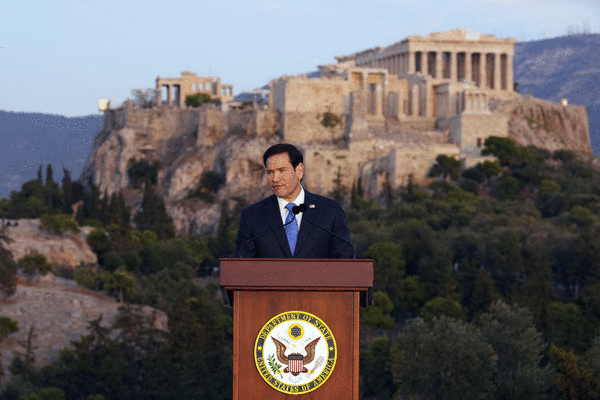
Last week, U.S. Secretary of State Marco Rubio, standing in front of the Parthenon, declared that the Trump administration sought to partner with Europe in defending the “distinct character” of Western civilization. It was meant, perhaps, as an exhortation.
But to Europe, it sounded like a threat. The U.S., said Rubio, had chosen “the unapologetic pursuit of national power.” The implication was that European nations had not and thus resigned themselves “to a future of atrophy and servitude and decline.” Yet few on the continent will think that a partnership with the U.S. defined by the kind of the obedience Rubio and his boss expect would be much better than servitude.
Donald Trump’s White House has not concealed its desire to control Europe’s choices. The national security strategy it released at the end of last year identified “cultivating resistance to Europe’s current trajectory within European nations” as a priority.
The administration has also shown that, if it decides to push these countries in a direction other than the one their citizens might choose for themselves, it has the levers to do so.
Trump pulled one of them earlier this month, when he threatened to withhold fossil-fuel exports unless Europe released some of its strategic diesel reserves. On this occasion, the president’s concern was that high prices at the pump might cost him the midterms. But when such threats prove effective, they tend to be used again and again.
Europe’s leaders have, since President Vladimir Putin’s 2022 invasion of Ukraine, tried to break free of Russian gas. Now they must confront the fact that this effort has just increased their dependence on a Washington that talks about intervention in their politics with the same hunger as the Kremlin.
In recent years, Europe’s leaders have spoken often about their search for strategic autonomy. But in every field that matters to European independence — defense, tech, energy — the continent has become more reliant on the U.S. over the past decade, not less.
Consider Europe’s much-discussed rearmament. Perhaps, a decade from now, its military-industrial complex will have been revived. What we know for sure, however, is that the value of proposed sales of U.S. equipment to European NATO members, as recorded under official programs, was only 28% of those countries’ spending on military equipment between 2019 and 2021; between 2022 and 2024, that proportion rose to more than half.
European militaries are particularly dependent on the U.S. for so-called strategic enablers — the systems, such as those for transport, command and control and communication, that are essential for modern war-fighting. Public recognition that this couldn’t be allowed to continue came last month, when European Commission President Ursula von der Leyen used her annual policy address to announce a proposal for a new “European instrument for strategic enablers.”
Then there’s tech, where everyone knows the continent is a laggard. Mario Draghi’s 2024 report on European competitiveness pointed out that, if you exclude the technology sector, European Union productivity growth over the past 20 years was the same as that of the U.S. Over the same period, American tech has become more essential for European growth, security and survival — 41% of EU enterprises are, according to official statistics, “highly dependent” on cloud services, 70% of which are controlled by U.S. companies.
That’s left Europe’s politics increasingly febrile and open to manipulation. Leaders talk often about Russian infiltration into the continent’s information economy, but Elon Musk and other U.S. tech billionaires are allowed to shape it far more openly. The British prime minister might complain that Moscow tried to interfere in the 2016 Brexit referendum; yet in the years since, it’s the U.S. vice president who has intervened in support of pro-Russian right-wingers in Hungary and Romania, and openly backed the AfD in Germany.
This week, the EU announced an agreement with Beijing that it hoped would give its car industry some breathing space. It’s just the latest example of the massive time and effort the bloc has devoted to planning countermeasures against China and Russia. Perhaps some of that energy should go to figuring out what to do about the U.S. Europe doesn’t need America to tell it how to defend its civilization. It needs to find a way to ensure Washington doesn’t get to decide what that civilization should be.
____
This column reflects the personal views of the author and does not necessarily reflect the opinion of the editorial board or Bloomberg LP and its owners.
Mihir Sharma is a Bloomberg Opinion columnist. A senior fellow at the Observer Research Foundation in New Delhi, he is author of “Restart: The Last Chance for the Indian Economy.”
©2026 Bloomberg L.P. Visit bloomberg.com/opinion. Distributed by Tribune Content Agency, LLC.















































Comments