Ronald Brownstein: Trump is showing again why presidents lose power so fast
Published in Op Eds
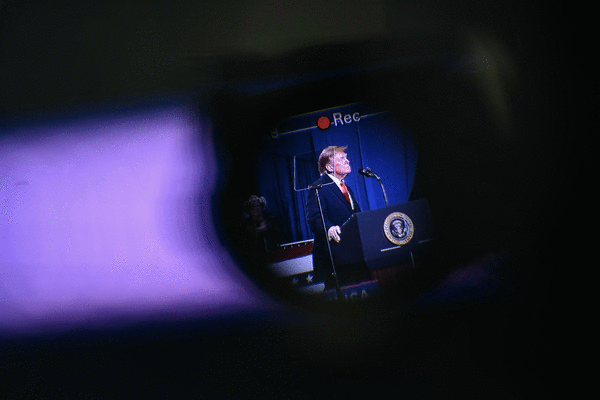
Trying to lower expectations for Republicans on Nov. 3, Vice President JD Vance has recently stressed that it has become almost impossible for the president’s party to maintain unified control of the House and Senate through a midterm election. He’s right about that trend. But he’s wrong to ignore the role that President Donald Trump — and his Oval Office predecessors — have played in making it a self-fulfilling prophecy. There’s a lesson in that for future presidents.
The last five times a president went into a midterm election with unified control of government, voters have revoked it. That list includes Joe Biden in 2022, Trump in 2018, Barack Obama in 2010, George W. Bush (1) in 2006, and Bill Clinton in 1994. This streak seems virtually certain to continue next month with Republicans on track to lose the House and maybe the Senate. That will extend a dismal record, raising to six the number of consecutive times a president has gone into a midterm with unified control and lost it. (Before the current era, the record was four.)
As Vance’s comments suggest, the two parties now consider the rapid loss of unified control to be unavoidable. The paradox is that conviction has encouraged them to behave in ways that make the loss of control more likely. Rather than carefully building support with an agenda that aims to steadily broaden their coalition, each side has chosen to cram its agenda into a front-loaded, party-line legislative blitz during a new president’s first two years.
The Trump administration has taken this approach to an extreme. Trump has treated the places and people outside his coalition not as skeptics to convert, but as enemies to subdue. His frantic second-term policy sprint has included an array of deeply partisan initiatives almost universally opposed by Democrats and independents: inflation-fueling tariffs, a reckless Iran war, militarized mass deportation and tumultuous cutbacks in federal spending and regulation.
To be sure, the front-loading strategy has produced some legislative achievements undeniably prized by each party, including the Affordable Care Act under Obama and big tax cuts under the Republican presidents. But inevitably, these major overhauls have alienated swing voters and enraged the other party, making big midterm losses, and the surrender of control, inevitable. Especially after their redistricting gambit, Republicans “had everything going for them in 2026 to break that pattern — except their own president,” says Princeton University sociologist Paul Starr, author of American Contradiction, a history of US politics since the 1950s. “Of course, since they have refused to speak out against his war, tariffs, corruption and narcissism, they have nobody to blame but themselves.”
The modern parties have forgotten an important historical truth: From the Abraham Lincoln-era Republicans to Democrats under the leadership of Franklin Delano Roosevelt and later John F. Kennedy and Lyndon Baines Johnson, the electoral coalitions that most changed America managed to preserve unified control over a sustained period.
It’s true that these coalitions usually announced their arrival with thunderous opening achievements. Roosevelt’s propulsive first “100 days” in 1933 created the template for dynamic presidential leadership.
But critically, these coalitions all held unified power long enough to both cement and supplement their initial breakthroughs. Republicans didn’t conceive and ratify the towering constitutional amendments ending slavery and establishing equal protection for all Americans until Lincoln’s second term (including after his assassination). Many of Roosevelt’s most lasting achievements — including Social Security and the Wagner Act safeguarding the right to unionize — came during the “Second New Deal,” after he enlarged his congressional majorities in his first midterm. Johnson passed the pillars of his Great Society agenda — crowned by Medicare, Medicaid and the Voting Rights Act — only after winning a landslide reelection in 1964 that swept in overwhelming Democratic congressional majorities.
Presidents at times have left a powerful mark with more fleeting control, as Woodrow Wilson did when expanding government after 1912 and Ronald Reagan did when limiting it 70 years later. But to durably reshape American life, nothing compares to the presidents and parties that found ways to sustain, and even enlarge, their coalition over time. Both the Lincoln-era Republicans and FDR-era Democrats held unified control of the White House and Congress for 14 consecutive years; under JFK and LBJ, Democrats did it for eight.
That seems unimaginable today. Since 1968, no party has managed more than four consecutive years of unified control. That volatility is in part due to voters’ frustration with a slowdown in the growth of living standards, and partly due to the demographic and geographic polarization that has produced persistently narrow congressional margins. But presidents have repeatedly accelerated the trend through ideological overreach.
Though unified control has proved increasingly difficult to sustain, there are good odds the next president in 2029 will arrive with it. Every new president since Bill Clinton in 1993 has entered office with majorities in both the House and Senate. In fact, by my calculation, only six times since the formation of the modern party system in 1828 have voters not provided a new president with control of both congressional chambers. (Richard Nixon, Ronald Reagan and George H.W. Bush were three of them.)
So the next president will have a clear choice. He or she can accept the fatalism openly voiced by Vance and quietly internalized by most other Washington power players and repeat the immediate go-for-broke approach of recent presidents. Or Trump’s successor could pursue a more incremental strategy designed to broaden support and nurture the extended hold on power that the most consequential presidents have achieved.
____
(1) Bush gets an asterisk because he entered office in 2001 with unified control, lost it that spring when a Republican senator quit the party and shifted the majority to Democrats, and then won it back in the 2002 midterm.
____
This column reflects the personal views of the author and does not necessarily reflect the opinion of the editorial board or Bloomberg LP and its owners.
Ronald Brownstein is a Bloomberg Opinion columnist covering politics and policy. He is a CNN analyst and the author or editor of seven books.
©2026 Bloomberg L.P. Visit bloomberg.com/opinion. Distributed by Tribune Content Agency, LLC.


















































Comments