Commentary: Pumpkin patches shouldn't come with a health warning
Published in Op Eds
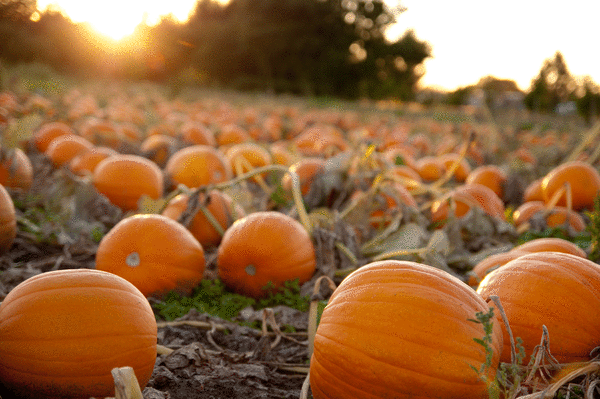
Every autumn, families flock to pumpkin patches and fall fairs in search of hayrides, corn mazes and seasonal fun. But tucked among the gourds and festive displays, many attractions also feature petting zoos and other hands-on animal encounters that pose serious risks to both visitors and animals. As pumpkin patch season gets underway, parents should think twice before allowing their children to participate in these activities.
Public health experts have repeatedly linked petting zoos to outbreaks of dangerous diseases. Animals commonly found in these exhibits, including goats, sheep and calves, can carry E. coli and other harmful pathogens that spread easily to humans. Over the years, numerous children have become seriously ill after visiting petting zoos and animal exhibits across North America. Symptoms of E. coli infection can include severe stomach cramps, vomiting, fever and bloody diarrhea. In some cases, infections can lead to kidney failure and even death.
According to the Centers for Disease Control and Prevention, every year in the United States, an estimated 450,000 illnesses, 5,000 hospitalizations and 70 deaths are linked to contact with animals or their environments. Animal exhibits, petting zoos and agricultural fairs are among the settings where these illnesses occur. Countless more cases surely go unreported.
Recent incidents show the danger is far from theoretical. In August, North Carolina officials issued a public health warning after four goats used in a petting zoo tested positive for rabies. Last year in Arizona, health officials investigated an outbreak linked to a state-fair petting zoo that reportedly sickened nearly 200 visitors. One young patient received multiple blood transfusions and underwent dialysis. Three children contracted E. coli after visiting a Minnesota pumpkin patch petting zoo. One spent a month recovering from a potentially deadly form of kidney disease that caused her kidneys to shut down and required surgery and near-constant dialysis.
Operators tout hand-washing stations as the solution, but hand washing is not a magic shield against disease. Young children often touch their faces, suck their thumbs, handle pacifiers or carry sippy cups that can become contaminated. Bacteria can linger on clothing, shoes, strollers and surrounding surfaces. Researchers have also noted that harmful pathogens can spread through dust and particles in animal environments, creating risks that extend beyond direct contact with the animals themselves. Even diligent parents who follow the rules cannot eliminate the danger entirely.
Yet the health risks to humans tell only part of the story. Petting zoos are also inherently stressful for the animals forced to endure them. Imagine spending hour after hour surrounded by a revolving stream of strangers who grab, hug, chase, poke and crowd you without your consent. Children are often excited, noisy and unpredictable, but even the gentlest interactions can be overwhelming when repeated hundreds of times a day.
Penned animals cannot avoid unwanted contact. A goat seeking solitude, a sheep wanting to rest or a rabbit frightened by rough handling typically has nowhere to escape. The result can be chronic stress, exhaustion, fear and illness.
Autumn outings should be about making happy memories, not ending up in the ER. Petting zoos are not innocuous. Their festive atmosphere conceals health hazards for visitors and stressful circumstances for animals. This fall, families should leave these displays behind and choose attractions that are safe, compassionate and truly worthy of the season.
_____
Jennifer O’Connor is a senior writer with the PETA Foundation, 501 Front St., Norfolk, VA 23510; www.PETA.org.
_____
©2026 Tribune Content Agency, LLC.
















































Comments