Andreas Kluth: Trump's legacy at halftime -- Weakness through war
Published in Op Eds
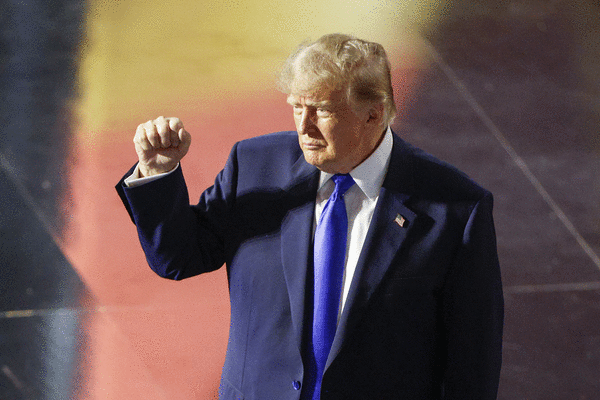
With the congressional midterm elections nigh and the midpoint of Donald Trump’s second presidency not far behind, it’s time to ask: How does Trump’s foreign policy measure up so far? And where is it likely to go once he’s a lame duck?
Even people you’d expect to be in the know have been off by 180 degrees in their predictions. I recall an op-ed by JD Vance in 2023, before he became Trump’s vice president. “Trump’s best foreign policy,” Vance was convinced, will be “not starting any wars.”
Here we are a couple of years later, mired in what seems to be an unwinnable war of choice launched by Trump in the Middle East — a special military operation, if that is the term, which Trump asked neither Congress nor the United Nations to approve; which has sabotaged the world economy and the livelihood of ordinary Americans; and which vaguely resembles the “forever wars” that he once campaigned against.
That attack on Iran, moreover, followed several other acts of war in all but name (since, again, Trump never consulted Congress before ordering any of them). He’s bombed countries from Yemen to Nigeria. Even more controversially, and certainly illegally, he keeps blowing up civilian boats in the Caribbean and eastern Pacific (on suspicion, but without proof, that they may be carrying drugs); that death toll now exceeds 230.
Also illegally, but at least successfully, he infiltrated one country in Latin America, Venezuela, to extract its leader, while constantly threatening to do something similar to another, Cuba. And while we’re on the list of threats, he’s also intimidated several of America’s closest allies, suggesting he might annex Canada and take Danish Greenland by force.
And all the while — even as he casually muses whether to “annihilate” an entire nation — he still demands recognition as a great, Nobel-deserving “peacemaker.” He certainly hasn’t made peace in Ukraine, where Russia continues to wage a genocidal war that Trump once promised he would settle in a single day.
Nor has he achieved peace, as opposed to tense ceasefires, elsewhere. The massive Israeli destruction of the Gaza Strip may have stopped for now, thanks to Trump’s pressure. But neither the rebuilding of Gaza nor the permanent pacification of the underlying conflict, which Trump’s so-called Board of Peace promised, have come any closer or become any more plausible.
And these examples are only the beginning of a long ledger that allows only two conclusions. First, Trump has lived down to the expectations of his most pessimistic skeptics by sowing chaos and wrecking the international order that the U.S. sponsored and built after World War II.
Second, he has broken every promise he gave or implied to his base by delivering more or less the opposite. In that way, and that way alone, Trump has been consistent.
Start with that empty slogan (plagiarized from Ronald Reagan) that Trump brandished so liberally during his campaign: “Peace Through Strength.” What he has delivered instead is weakness through war. Worse, what he may leave his successors as a legacy is yet more war as a result of that weakness.
His war in Iran has weakened America in a geopolitical sense — by undermining its credibility — but also in a direct and measurable military sense, as top brass in the Pentagon have warned. By waging the conflict, the U.S. has burned through many of its ammunitions, especially the high-cost missiles it uses defensively (to shoot down incoming ordnance) or offensively (to hit remote targets without sending pilots on dangerous bombing runs).
The resulting shortages, which will take years to replenish, mean that fewer American weapons are now available to friends in dire need, such as Ukraine, or formal allies, such as those in NATO or East Asia, which need to deter Russia, North Korea and China.
This scarcity in the former “arsenal of democracy” has of course come to the attention of America’s adversaries in Moscow, Beijing and Pyongyang. As these regimes eye their potential prey, from the Baltics to Taiwan and South Korea, they may be tempted to discount the risk of American intervention. The primary casualty is deterrence. That is how American weakness could in time lead to new wars.
But are these autocracies even adversaries any longer? The way Trump fetes their leaders, they may instead feel like America’s new besties. In stark contrast, he likes to humiliate the leaders of America’s traditional allies — for instance by lining them up before (and slightly beneath) his desk in the Oval Office for a good talking to.
His contempt for the nominal allies goes beyond the symbolic. He has waged on-again, off-again trade war against virtually all of them, even as he has TACOed toward China. (TACO, short for “Trump Always Chickens Out,” is a financial markets term that was coined last year and stuck because it fits.) If anyone has achieved peace through strength, it’s Beijing, after it showed Trump that it can choke the U.S. with its control over critical minerals.
Meanwhile America’s allies, if that is still the word, have reacted exactly as the “balance-of-threat” theory in international relations predicted. After first trying to flatter Trump into moderation, they have started forming alternative partnerships to protect themselves against arbitrary and “predatory” American bullying.
The unofficial leader of this movement is Mark Carney, the prime minister of Canada. Earlier this year, he called out the “rupture” in world relations caused by the U.S. president, whom he didn’t name in his speech because he didn’t have to. He has since said that he’s even prepared for scenarios in which America attacks Canada militarily.
Like leaders of other middle powers from India to Japan, Carney has been traveling the globe to find new partners to trade, transact and perhaps ally with. And, like his counterparts in Europe, he’s taking a skeptical second look at Canadian plans to buy American fighter jets, satellites and other weapons.
He’s even gone to the European Parliament in Strasbourg to begin the process of making Canada the European Union’s first “associate member.” In effect, he’s exploring how to switch continents. The EU, for its part, suddenly lunged forward to seal a trade pact with the South American countries in Mercosur after those talks had stalled for two decades.
Individually, too, partner nations in Europe, Asia and elsewhere are distancing themselves from the U.S. in ways overt or subtle. No viable alternative exists as yet to the U.S. dollar in the global economy, but everybody is looking for one. The Dutch central bank has started moving its gold reserves out of the U.S.; the German one began doing that years ago, and the French bank already completed the process.
America’s partners in the Middle East have drawn the same conclusion, with even more urgency. Several thought that hosting American military bases might make them safer. That illusion ended abruptly when Iran pummeled their cities and the American bases, causing much more damage that the Pentagon has divulged.
They too are now building alternative alliances that exclude the U.S., such as the pact recently formed by Saudi Arabia, Pakistan and Turkey. This is remarkable. Just last year, Saudi Arabia had on paper become a “major non-NATO ally” of the U.S., as Pakistan already is, while Turkey is a full NATO member.(1) But they no longer believe that Washington can or will defend them, so they want new brothers-in-arms.
In this way, too, Trump has made America permanently weaker. Alone among recent presidents, he never understood that allies were not, at least not primarily, a burden but a forward line of defense and force multiplier that projected American might globally. Alliances are the strategic advantage that China lacked but America had. Perhaps not much longer.
Trump’s contempt for alliances, combined with the second-order effects of his attack on Iran, will have even more dire consequences in the longer term. One is nuclear proliferation.
Allies from South Korea to Poland no longer find America’s nuclear “umbrella” remotely credible — that is, they no longer believe that the U.S. would retaliate in kind against a nuclear strike against them or that Washington would protect them from nuclear blackmail. As a result, capitals from Seoul to Ankara and Riyadh to Berlin are thinking about building their own nukes.
Trump’s war against Iran, which was at least initially fought in the name of preventing Tehran from developing nuclear weapons, paradoxically reinforces the trend. After all, Iran did not have nukes and got attacked, whereas North Korea already has its arsenal (and is adding to it as fast as it can) and seems to be safe and even cocky.
And so Trump, lacking strategy, has created a mess that resembles the reverse of every goal he once set. He promised a foreign policy that would work for ordinary Americans. Instead, they’ve spent about $100 billion more at the pump than they would have without the Iran war. Because oil prices went up unnecessarily, other prices rose too, and the Federal Reserve had to raise interest rates last month to control inflation — the opposite of what Trump had in mind.
American voters are often said not to care much about world affairs. But as they approach the midterm elections, their opinions seem clear. Most oppose the war in Iran, and vast majorities disapprove of Trump’s foreign policy overall. By the looks of it, Trump — his Republicans, that is — may lose the House and maybe the Senate as well. Then what?
A Congress that no longer acts as a rubber-stamp parliament can certainly make life difficult for the president. Democrats could control committees and could subpoena, or even impeach, the cartoonishly incompetent secretary of defense, for example. They could even withhold funds for the war machine. And they could put teeth into the War Powers Resolution that might, in theory, force Trump to end his wars.
That prospect, plus the trend of other world leaders being fed up with Trump’s antics, leads Ravi Agrawal, the editor in chief of Foreign Policy, to conclude that Trump “has peaked” and that “his coercive capacity, so potent last year, seems lessened from overuse.”
If so, that Trump peak would really be a trough, since world affairs would stand to improve. Alas, that seems too optimistic. As commander-in-chief, Trump will retain vast powers in foreign policy for two more years, and he will not react to signs of his waning influence gracefully.
The most frightening text in international affairs today is testimony recently entered into the congressional record by a large group of neurologists and psychiatrists, including conservatives and liberals, Republicans and Democrats.
In it, these medical professionals cite a long list of observations about the president, from “sudden changes of course in strategic matters, both national and international” to “severely impaired judgment and impulse control, reflected in reckless threats of violence.” Their conclusion is that Trump “presents a clear and present danger to our country and to the world.”
The bad news is that Trump has spent the first half of his second term squandering America’s power and leaving the U.S. weaker rather than stronger, and the world more violent rather than peaceful. The worse news is that nothing suggests he will get any less dangerous in his remaining term.
_____
(1) The difference is that major non-NATO allies do not have a formal security guarantee from the US, whereas NATO allies do pledge to consider an attack on one an attack on all.
_____
This column reflects the personal views of the author and does not necessarily reflect the opinion of the editorial board or Bloomberg LP and its owners.
Andreas Kluth is a Bloomberg Opinion columnist covering U.S. diplomacy, national security and geopolitics. Previously, he was editor-in-chief of Handelsblatt Global and a writer for the Economist.
_____
©2026 Bloomberg L.P. Visit bloomberg.com/opinion. Distributed by Tribune Content Agency, LLC.














































Comments