Michael Hiltzik: The Arizona-Nevada-California water war is heating up, and all three states will end up parched
Published in Op Eds
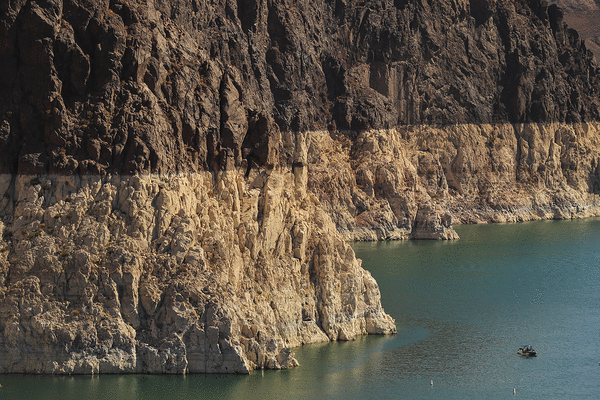
No one interested in pondering what looks like an intractably difficult conflict need turn their attention to Iran or Israel. We have one much closer to home. It's the riddle of how to divide up the ever-dwindling supply of water from the Colorado River.
Seven Western states depend on that water impounded by Hoover Dam at Lake Mead, with Arizona, Nevada and California — the downstream basin states" — facing harsh steep supply cutbacks through 2028 and even harsher cuts over the following eight years under a scheme set forth by the U.S. Interior Department. So it's not surprising that the fight has begotten a new cycle of litigation in federal court.
Nevada sued to block the plan in late August. Last week, Arizona moved to join Nevada's lawsuit. But it warned that its fight isn't only with the federal government, but with Nevada too: Arizona's interests in the case are "unique," it told the court, and it can't entrust them to "another State that has sued to protect its own unique, state-specific interests."
California hasn't expressed an interest in joining the lawsuit, as my colleague Ian James has reported. But as the largest consumer of water from the Colorado River, it's not going to escape the fray.
Here's the basic fact underlying the conflict. These three states are heavily dependent on water from the Colorado River, and there simply isn't enough there. Already, the reservoirs Lake Mead and Lake Powell are at their lowest levels since they first began filling. As they fall further, Hoover and Glen Canyon dams could lose their capacity to provide water and power downstream and even become vulnerable to physical damage.
The government got the three lower basin states to agree to reductions over the next two years. Through 2028, California is to cut its use of Colorado River water by about 12%, Arizona by 31% and Nevada by 28%.
After that, the spigot will only tighten. The total allotments to the three downstream states could be cut by as much as 40% through 2036, menacing their economies and communities.
The root of the conflict is the Colorado River Compact, negotiated in 1922 among the seven states of the Colorado watershed under the supervision of the then-Secretary of Commerce, Herbert Hoover.
This interstate treaty dictated how the waters of the Colorado would be allocated to the seven states, with the lower three guaranteed at least 7.5 million acre-feet annually, measured as an average of 75 million acre-feet over rolling 10-year time spans. Absent that guarantee, Hoover Dam could not have been built. (An acre-foot is 325,851 gallons, or about enough to supply one to three single-family households for a year.)
The guarantee derived from a calculation by Hoover's engineering deputy, Arthur Powell Davis, that so much water flowed down the river that there would always be enough to meet every state's needs. This calculation is often described as a "blunder" or "mistake." It was nothing of the kind; it was a lie.
Hoover and Davis connived at an estimate that would meet the guarantee. Davis estimated that the river's annual flow averaged out to 16.4 million acre-feet a year, based on gauge data from 1899 through 1921. But he surely understood that this was an incautiously brief period of measurement, for the river's annual flow was wildly variable, ranging from about 9.1 million to 25 million acre-feet during the 20-year sampling.
In truth, the river was incapable of meeting the guarantee. The sample period proved to be among the wettest in the river's known history, so Powell's estimate was way out of line. Indeed, since the dam's completion in 1935, the river's 10-year flow has reached or exceeded the 16.4 million acre-feet annual average only four times — and never since 1978.
From the start, Arizona played a dog-in-the-manger role in efforts to allocate the water. The state initially refused to ratify the 1922 compact at all, provoking the other states to rewrite the document so it would go into effect with the approval of only six states rather than seven. (Arizona didn't ratify the compact until 1944.)
In 1934, Arizona Gov. Benjamin Baker Moeur attempted to block the construction of Parker Dam, which was designed to divert California's share of the river water into the new Los Angeles Aqueduct, by dispatching the state's National Guard to the dam site. The Times' editors mischievously assigned the story to one of their war correspondents, Chester G. Hanson, who chronicled the maneuvers of the "Arizona Navy," consisting of a single ferryboat, the Julia B.
The foray promptly descended to a Gilbert & Sullivan level of absurdity when the ferryboat got itself beached on a sandbar and had to be dragged free by workers on the California side of the river. Interior Secretary Harold Ickes ended the skirmish by imposing a truce and persuading Congress to designate the dam as a federal project.
In 1952, Arizona sued in federal court to invalidate the 1922 apportionment. The case would be the third to reach the Supreme Court with the title Arizona vs. California. It would also go down in history as one of the longest and most complex cases in the court's history, staggering to a conclusion only in 1963.
The 5-3 decision seemed superficially to be a win for Arizona, for it deprived California of 20% of its apportionment. But it was a Pyrrhic victory, for the court also ruled that the sole authority to determine apportionment belonged to the federal government, via the secretary of the Interior. The decision elicited a blistering dissent from William O. Douglas, who objected to granting the federal government "a power and command over water rights in the 17 western states that it never has had." But that's where we are today.
In the years since the dam's completion the stakes of a settlement on the river have increased unrelentingly. California was always the most voracious consumer; its population grew from about 6.2 million in 1935 to about 34.5 million at the close of the 20th century, with much of that growth dependent on water supplied by the Colorado. But it was also the chief driver of the dam project, which had originally been conceived to protect Imperial Valley growers from river-borne floodwaters.
Phoenix's population has also surged, from about 215,000 in 1940 to 5.2 million today. That has made the state far more dependent on the river than was anticipated in the 1920s and 1930s, and especially since the completion in 1993 of the Central Arizona Project, a 336-mile system of aqueducts and reservoirs that initially was seen as a boon to Arizona agriculture. As things turned out, the project was more important for residential growth, which more than doubled in the Phoenix area to more than 5.2 million since the project went online.
Nevada, too, became addicted to the Colorado. The state was apportioned a bare 300,000 acre-feet a year in 1928, when Las Vegas was merely a dusty outpost miles from the Hoover Dam construction site. Thanks to growth based on the availability of water and power from the dam, it's now the hub of a metropolis of 2.3 million residents.
The fundamental problem exposed by the latest court fight is that no one has a solution to the riddle of apportionment. Neither state proposes an alternative to the Interior Department's allocation; the thrust of their case is that the Interior Department hasn't followed the law in imposing its own measures. Nevada bemoans that Interior's proposal threatens its "community well-being, cultural identity, and the recreational experience." That's true, but saying so doesn't create a water supply that isn't there.
To cite a warning about shrinking water supply that experts in the West have been issuing for decades, "There is no soft landing." The 40 million residents of the Colorado River basin and nonresident beneficiaries of its water supply, including most Californians, will have to do more with less as global warming causes more and deeper droughts.
We don't know how much less, only that some combination of conservation and adjustment will be necessary. Farmers will have to fallow their alfalfa fields, homeowners pull out their lawns, industries will have to reform. As I have written before, Hoover Dam made today's West, but also strapped it into the straitjacket of an implacable water shortage.
The most famous truism applicable to the conundrum facing the states dependent on the Colorado is the one voiced at an irrigation conference in 1893 by the explorer John Wesley Powell, who led the first government expedition of the Grand Canyon and who warned of the fraught battles over the river to come.
"Gentlemen," he said, "you are piling up a heritage of conflict and litigation over water rights, for there is not sufficient water to supply the land." He fled from the room amid a hail of catcalls, but of course he was right.
©2026 Los Angeles Times. Visit at latimes.com. Distributed by Tribune Content Agency, LLC.
















































Comments