Commentary: Why Medicare for All is now possible
Published in Op Eds
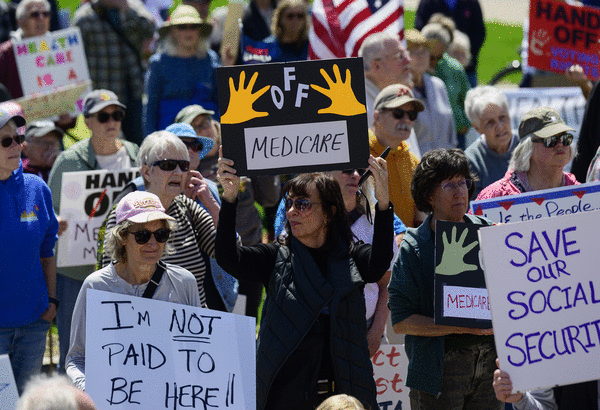
Across the country, candidates are running unapologetically on Medicare for All— and winning.
In just the last several months, three Democratic contenders for U.S. Senate seats clinched primary election wins after making Medicare for All a centerpiece of their campaigns. In Illinois, it was attorney and lieutenant governor Juliana Stratton; in Michigan, it was former public health director Abdul El-Sayed; and in Florida, the nod went to business woman and union organizer Angie Nixon, who, like El-Sayed, identifies as a democratic socialist.
It’s been a long time coming. As a policy and legislative specialist in healthcare reform, I’ve seen the evolution in public opinion and policy shifts up close. For decades, advocates of Medicare for All were told to wait our turn. We were told that single-payer healthcare was politically impossible.
That argument no longer holds true. The country is moving toward the position that physicians and patients have been advancing for years. We must seize this moment to enact real change.
Historically, the fight for universal healthcare in the United States has been defined as much by political skepticism as by policy disagreements. Even as the failures of the private insurance system have gotten harder to ignore, Washington has continued to focus on incremental changes, such as a public option, rather than comprehensive reform. While a public option could expand coverage for some individuals, it would leave the fundamental problems of the system intact.
Now the ground is shifting, and not just in electoral politics. In July, the Congressional Progressive Caucus convened physicians, nurses, patients and policy experts for a shadow hearing on the future of universal healthcare. Even politicians such as Senator Ron Wyden, who spent decades advocating for incremental reforms, now openly acknowledge that America’s healthcare system is not just unaffordable, it’s become a public health crisis — so much so that the senator recently released a comprehensive request for information on healthcare reform.
The nation’s healthcare failures are not solely abstract policy problems. They affect those delivering the care, as well as those receiving it. Physicians are struggling not simply because medicine has become more emotionally, physically or mentally demanding — medicine has always been that way. They are struggling because the system in which they practice is forcing them to choose between what their patients need and what an insurance company will approve.
A recent report by Physicians for a National Health Program found that nearly 70% of physicians “have left or considered leaving a position due to moral injury” — the psychological distress they experience when systemic or profit-driven barriers prevent them from providing optimal care. Those numbers should alarm anyone who has ever struggled to find a doctor, waited for a call back, or been jammed into a 15-minute appointment.
Every prior authorization that delays care. Every insurance denial that blocks a medically necessary procedure. Every patient who cannot afford a prescribed medication. Every physician who spends hours arguing with insurers. These are not isolated frustrations. They are the predictable consequences of a system designed to prioritize profits over patients.
That is where the political and professional movements for healthcare reform converge. Patients are experiencing the consequences of a fragmented system; physicians are asked to make decisions that conflict with their ethical obligations. The same system that makes care unaffordable for patients also makes practicing medicine unsustainable.
Medicare for All is not a cure-all, and transitioning to a single-payer system would require difficult decisions about financing, implementation and the future of the healthcare workforce. These questions of implementation deserve serious debate. But they should not be confused with an argument for maintaining the status quo.
That is why the politics are changing. Americans are reaching the same conclusions that physicians have long understood: When financial incentives dictate medical decisions, patients pay the price. More Americans now recognize that the problems they experience are not isolated inconveniences but symptoms of a system whose incentives do not align with its stated purpose.
Whether that recognition leads to meaningful reform remains to be seen. But for the first time in a generation, the debate is no longer about whether fundamental change is imaginable. It is about whether we have the power to make that change.
____
Rebecca Delay is a health policy and legislative specialist. She holds a master of public policy from the Harris School at the University of Chicago, and a certificate from the Graduate Program in Health Administration and Policy. This column was produced for Progressive Perspectives, a project of The Progressive magazine, and distributed by Tribune News Service.
_____
©2026 Tribune Content Agency, LLC.

















































Comments