Stephen L. Carter: The courts weren't built to keep up with Trump
Published in Op Eds
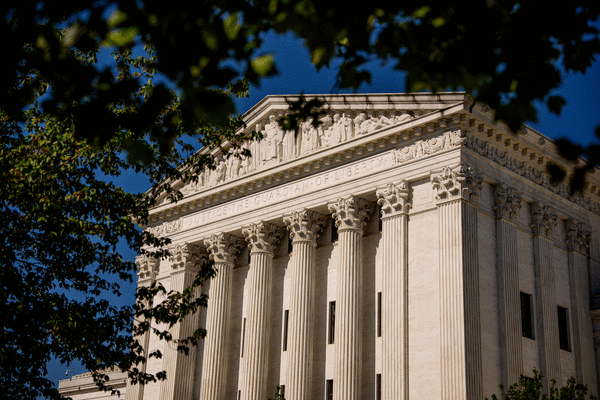
There’s a simple reason that President Donald Trump always seems one step ahead of the courts.
He moves too fast.
Courts, at their best, are magisterial, contemplative, careful to hear both sides. They take the time to cross every t and dot every i before sending forth their decrees.
Trump is a whirligig of ideas, inspirations, occasional idiocies, firing off orders here, defacing beautiful structures there, meeting every court order that stands in his way with vitriol, followed by a sudden sidestep, to try to do in another way what the court just forbade.
Judges, by contrast, can decide only cases properly before them — and, speed aside, even finding a proper plaintiff can be hard enough. Keeping up with the president is harder still.
Echoes of this theme may be found in the Supreme Court’s recent order refusing to allow the U.S. Postal Service’s regulation tightening requirements for mail-in ballots to go into effect. The president ranted against the majority on social media, sounding every bit as adolescent as those on the left who insist that the court must be restructured when it doesn't rule the way they want. But the overlooked dissent provided a cautionary Greek chorus to the contretemps. Here’s Justice Samuel Alito, joined by Justice Clarence Thomas:
Some of the plaintiffs lack standing, while the remainder are pursuing a claim that this Court has recently called a “Hail Mary pass” that “rarely succeeds.”
In other words, said the dissenters, the stay of the Postal Service rule should have been overturned because the plaintiffs are likely to lose in the end.
If they turn out to be right, the reason will be that the executive branch, subject to a single will, can move fast — recklessly fast at times — and judges simply can’t keep up.
Consider the Ultimate Fighting Championship event recently held on the South Lawn of the White House. A lawsuit aimed at stopping it was tossed out of court on standing grounds. The plaintiffs claimed principally an “aesthetic” harm by being forced to be near the “hideous” structures that the event required. Not enough, said the court, and the court was right. I too like my aesthetics traditional, but my unhappiness when the vista changes gives me no right to litigate.
In the absence of standing — a legally cognizable harm — the courts have no jurisdiction. Good luck trying to find a new plaintiff before we’re presented with a fait accompli.
Take the reflecting pool. The administration had painted the pool blue, so that it resembles a swimming pool more than a monument. That’s a hideous idea. If it was done in violation of law, as some allege, that’s worse. But for a court to step in, one would still need a plaintiff suffering a harm beyond a gorge that rises at the thought. To be sure, there’s litigation, but I would bet a No-Prize that the case will be dismissed.
Even what may be the ugliest idea of all — putting Trump’s name on the Kennedy Center — might well wind up a fait accompli. True, at the moment the effort to craft a version that will survive judicial review (“The John F. Kennedy Memorial Center for the Performing Arts renovated and restored by President Donald J. Trump” — no kidding, that’s where we are) is being held back by an injunction, and, so far, the injunction is being obeyed. But the trustees, thwarted in their effort to honor the president for, well, whatever it is, have voted to close up shop for now, and Trump himself insists that if his name isn’t on the building, no renovations will be made, and the structure itself might collapse. A tantrum of such extravagance has no name. Yet it is difficult to imagine how a court might frame (or enforce, or monitor) an order to fix the place up.
Sure, Trump keeps losing, justifiably, on his illegal tariffs, and he has taken big hits, justifiably, on his scarcely more legal immigration policies. When we deal with high policy, the courts have a somewhat easier job, because putting a policy into practice has so many moving parts. But those are the rarer cases.
There’s nothing new in the discovery that executive branch illegalities can be left unchecked because there exists no proper plaintiff. There’s nothing new in the discovery that clear constitutional violations can be left unchecked because there exists no proper plaintiff. We’ve seen it in recent administrations.
What makes Trump different isn't that he’s doing this stuff — we’ve scarcely had an administration that didn’t try to sneak a project or two past the legal bloodhounds — but that he’s doing so much of it, doing it with such alacrity, aswirl with madcap activity, firing off ideas like arrows, some clearly against the law, others arguably so, many more within his authority no matter how many critics deny it. We are seeing the Silicon Valley slogan brought to politics: Move fast and break things.
But here we’d do well to pause. That coinage evolved from phrases tossed around by engineers, and they were talking mainly about software. The idea was to go ahead and run the program even though you know it’s not ready yet. If you crashed the computer (which happened all the time back in the day), you’d go back and try again. No permanent harm was done.
With presidential orders, there can be damage aplenty — as those of us who shudder at the hole in the ground where the East Wing used to be can attest.
_____
This column reflects the personal views of the author and does not necessarily reflect the opinion of the editorial board or Bloomberg LP and its owners.
Stephen L. Carter is a Bloomberg Opinion columnist, a professor of law at Yale University and author of “Invisible: The Story of the Black Woman Lawyer Who Took Down America’s Most Powerful Mobster.”
_____
©2026 Bloomberg L.P. Visit bloomberg.com/opinion. Distributed by Tribune Content Agency, LLC.














































Comments