Commentary: Vladimir Putin's extension of the war beyond Ukraine has European leaders worried
Published in Op Eds
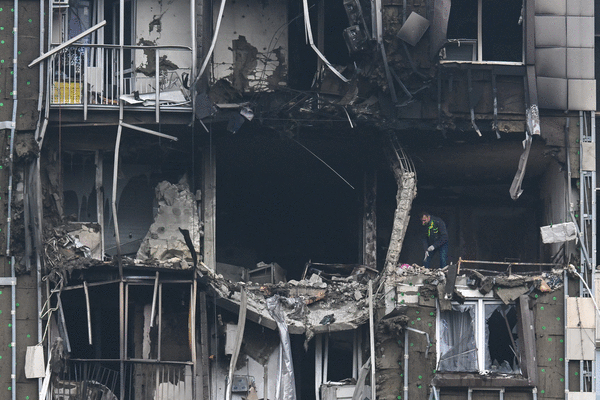
Last weekend, as Russians were heading to the polls to vote in a meaningless parliamentary election stocked with Kremlin-approved candidates, Ukraine unleashed one of its biggest drone attacks to date. According to Russian authorities, approximately 1,600 Ukrainian drones entered Russian airspace in what appeared to be an attempt by Kyiv to disrupt the voting process. The Russians knocked down the vast majority, but some managed to hit their targets. A few struck the oil refinery serving Moscow, an extension of Ukraine’s monthslong deep strike campaign that aims, in part, to exacerbate Russia’s domestic energy shortages.
Kyiv’s latest strike comes at a time when the war, deep into its fifth year, remains at a standstill on the ground. Any advances at the front have been minuscule. The Russian army continues to lose tens of thousands of troops a month, leading some observers to wonder whether Russian President Vladimir Putin will order another mobilization to compensate for the Kremlin’s recruitment struggles. Ukraine and Russia have spent the year terrorizing each other from the air as both use ever more powerful bombs to sap the other’s morale. Ukrainian President Volodymyr Zelenskyy will be at the United Nations in New York this week, no doubt using his meeting with President Donald Trump and the Europeans to press them for more air defense interceptors.
It’s the situation outside Ukraine, however, that’s even more concerning. While Russian destabilization campaigns are nothing new, Europe is increasingly worried about Moscow expanding the war to NATO territory. Polish Prime Minister Donald Tusk warned his parliament last week that Moscow could launch a drone or missile attack on a NATO member state in the next few months. French President Emmanuel Macron echoed Tusk over the weekend and called an emergency meeting with the leading French presidential candidates to talk about the issue. Although other European intelligence agencies have different assessments about the timeline, none of them are ruling out a Russian attack.
We can’t blame these officials for being rattled. In fact, we could make the case that Putin is already taking the war to the Europeans through the so-called gray-zone tactics the Russians are so fond of using. This year has been especially busy on that front. In addition to the usual cyberattacks and assassinations against dissidents the Russian intelligence services have conducted, Moscow is challenging NATO airspace, testing the alliance’s air defense networks and taking aim at the logistical networks assisting the Continent’s weapons distribution to Ukraine. It seems like barely a week goes by without more news of a Russian plot discovered or subverted.
The examples are almost endless. On Aug. 11, two drones, presumably Russian, were found near the Romanian coast. Weeks later, Romania used F-16s to strike another sea drone loitering near a major gas platform in the Black Sea. Later in the month, Lithuania scrambled fighter planes to shoot down drones coming from Belarus, Russia’s only remaining ally in Europe.
The Russian probing has extended into Western Europe as well. The German government attributed the discovery of an armed drone at the Leipzig airport, located near a Ukrainian cargo aircraft, to the Russians. The United Kingdom, meanwhile, has reportedly faced around 340 drone incidents near its military sites since August 2025, at least some of which can likely be traced back to Russia.
What does Putin hope to achieve with all of this activity? His primal goal is to retaliate against NATO, which Putin ultimately views as a party to the war in Ukraine given the alliance’s military and intelligence support to Kyiv. But retaliation is hardly the most important thing on Putin’s mind. The Russian strongman is also trying to determine how far he can push NATO until the alliance responds. In this, the Russians are playing a dangerous game, because as much as Putin likes to poke NATO in the eye, he doesn’t want to instigate a direct conflict with the world’s most powerful alliance (an alliance that also includes three nuclear-armed states).
This is even more true today, when the Russian army remains tied up in a war in Ukraine that has proved to be far more difficult than the Kremlin originally anticipated. Thus far, NATO has sought to downplay the Russian hybrid attacks by taking defensive measures, issuing more sanctions on the Russian economy and, in the case of Germany, closing Russian cultural centers on its soil. Yet if one of these attacks actually kills people in the heart of Europe, there will be an urge by at least some NATO member states to adopt more forceful measures.
If it wasn’t for the military support the United States and Europe provided to the Ukrainian army earlier in the war, it’s likely Kyiv would be in a worse position today. Curbing this support remains a Russian objective. But these acts of sabotage are proving counterproductive. The U.K., Germany, France, the Netherlands, Norway and Ukraine’s other traditional European backers remain steadfast in sending military equipment to Kyiv to ensure they have a fighting chance. If anything, Russian attempts to destabilize Europe are only giving these backers more reason to continue this policy. A growing number of European officials are describing the outcome of the war in Ukraine as not only critical for Ukraine itself but fundamental to Europe’s own security. Putin isn’t doing himself any favors in the end.
How this all affects the war itself is difficult to determine with precision. But we might be wise to bet on more of the same happening. More Russian oil refineries will be blown up. More apartment blocks in Kyiv will be hit. Thousands of additional soldiers will die. And peace will remain an abstraction.
____
Daniel DePetris is a fellow at Defense Priorities and a foreign affairs columnist for the Tribune.
___
©2026 Chicago Tribune. Visit at chicagotribune.com. Distributed by Tribune Content Agency, LLC.

















































Comments