Justin Fox: Noncitizens don't sway elections, even in a pro-Trump tally
Published in Op Eds
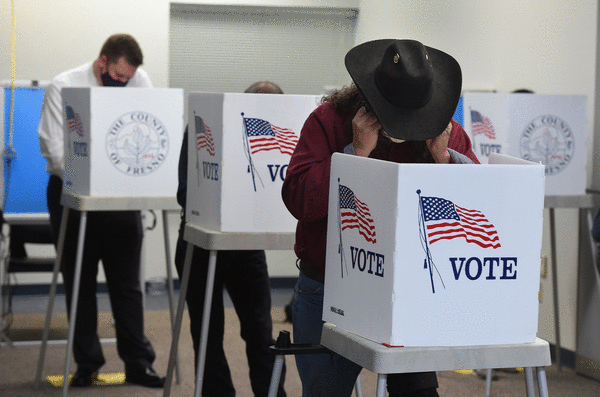
Last month, the Census Bureau published a strange little document claiming that “over 24,000” votes were cast by noncitizens in the 2020 U.S. general election.
The anonymous report has come under fire for its provenance and methods: It was reportedly produced outside of regular Census Bureau channels by political appointees and staffers at a think tank with close ties to President Donald Trump, using an approach that, according to one former high-level bureau official, was likely to turn up far more false positives than actual noncitizen voters.
The fact that partisan researchers using methods that probably overstate the problem found evidence of only 24,000 noncitizen voters in 2020 is worth dwelling on, though. Coupled with the report’s estimates of how noncitizen voters were distributed among the states, it amounts to a clear admission by the administration that noncitizen voters did not affect the outcome of the 2020 presidential election.
That’s not how Trump portrayed it, of course. “I WON THE ELECTION!” he wrote in a Truth Social post about the report. But for those more numerate and less delusional who are nonetheless concerned about noncitizen voting, the report offers reassurance. The president’s fevered efforts to prevent voting by noncitizens are aimed at behavior that even Trump-friendly researchers conclude isn’t widespread.
That still leaves a channel through which noncitizens truly do affect elections — by being counted in the U.S. census for purposes of apportioning representatives — and the Trump administration has taken aim at that, too. Its recently announced plan to count only noncitizens with permanent residency status (aka green cards) in the 2030 census appears to be both unconstitutional and a recipe for less accurate population statistics, but at least it’s not based on a delusion.
The Census Bureau study on noncitizen voters involved checking 128 million voter records in a commercial database against administrative records containing information on citizenship status, with the researchers concluding that 0.019% of the voter records “represented noncitizens” at the time of the 2020 election.
To protect personal information, the comparison was done using anonymized census personal identification keys that, according to a 2014 Census Bureau paper, have an overall false match rate of 0.185%, or nearly 10 times the supposed noncitizen voting rate. This is what prompted John Abowd, an emeritus professor of economics at Cornell University, who was the Census Bureau’s associate director for research and methodology and chief scientist from 2016 to 2022, to write on LinkedIn that “the alleged ‘noncitizen voters’ are therefore much more likely to be data errors than noncitizen voters.”
But let’s just say all 0.019% truly were noncitizen voters and that the rate was the same for the 32 million 2020 votes not yet examined by the researchers. This would add up to 30,000 noncitizen voters, which if concentrated in a few swing states might have been just enough to have some impact on the presidential race. But according to the report, these noncitizen votes were mostly elsewhere, with 10,300 of the 24,000 in the four most populous states — California, Texas, Florida and New York — where victory margins ranged from 371,686 (Trump’s edge in Florida) to 5.1 million (Joe Biden’s in California). Among states with close results, only in Arizona did the estimated number of noncitizen voters top 1,000 — and at 1,100 it was still far short of Biden’s victory margin of 10,457. There’s also no reason to think all of those supposed noncitizen votes would have gone to Biden. Lots of immigrants vote Republican.
You may feel that the appropriate number of noncitizen voters is zero. On the strength of the Census Bureau report alone, it might be, given the false-match problem, but other evidence does point to an amount greater than zero. New Jersey, for example, recently disclosed that it had mistakenly registered 6,600 noncitizens to vote in 2023 and 2024 in the process of granting them driver’s licenses and non-driver identification cards. Of those, the state reported, 340 had actually voted — which indicates both that the number of noncitizen voters isn’t zero and that it is probably minuscule. For the most part, noncitizens living in the U.S. would like to become citizens or, failing that, at least avoid deportation. They are thus wary of doing anything that could get them into trouble, such as voting when it’s not allowed. In New Jersey, the state registered these people to vote and probably sent them multiple mailings urging them to do so, yet only 5% did.
In the 18th and 19th centuries, many U.S. states did allow noncitizens to vote in state and local elections, and some even in federal elections, with the last laws allowing this repealed amid the anti-immigrant fervor of the 1920s. No state has reversed course since, and in 1996 Congress passed a law forbidding noncitizen voting in federal elections, but in recent years a few municipalities have allowed noncitizens to vote in some local elections — in San Francisco, for example, they can vote for the school board. This is arguably in keeping with this country’s founding principle of no taxation without representation, but it adds complexity for election administrators and is certainly confusing for noncitizens.
Any broad crackdown on noncitizen voting, meanwhile, risks preventing far more U.S. citizens from voting than noncitizens. That would almost certainly have been the case with the Safeguard American Voter Eligibility (SAVE) Act championed by Trump, which passed the House but has not been able to garner a filibuster-proof majority in the Senate. By requiring every voter to provide proof of citizenship, the legislation would likely disenfranchise tens of millions of native-born Americans who don’t have passports or ready access to their birth certificates (and marriage certificates in the case of women who have taken their husbands’ surnames), with Republicans probably hit harder than Democrats. Basing your policy priorities on false beliefs can lead to results like that, and Trump is lucky that a minority of Senate Republicans have refused to go along.
As already mentioned, noncitizens do still play a significant role in national elections in the sense that they’re counted in the U.S. census, which is then used to determine how many House districts and Electoral College votes each state gets. Both the first and second Trump administrations have looked for ways to exclude some noncitizens from these counts, most recently with a regulatory proposal unveiled this month that would leave out all noncitizens other than permanent legal residents from 2030 census totals.
The biggest barrier to such a move is the Constitution, which in its original form infamously called for counting enslaved Americans as three-fifths of a person for apportionment purposes, but since the ratification of the 14th Amendment in 1868 has based representation on “the whole number of persons in each State.” Observers also worry that the proposal and other administration actions regarding the census will compromise the quality of the statistics it produces.
Which states benefit electorally from having large numbers of persons who are noncitizens without permanent-resident status? A Pew Research Center estimate based on 2023 census data concluded that the states with the highest percentages of noncitizen residents here either illegally or under some sort of provisional status were Florida (6.9%), Nevada (6.7%), Texas (6.6%) and New Jersey (6.4%).
That’s two red states, one blue state and a swing state. Most of the other states with unauthorized-immigrant population percentages above the 4.1% national rate are reliably Democratic, but overall I wouldn’t be too confident that excluding such people from the census favors one party over the other. Having such large numbers of people living in the U.S. with no prospect of becoming citizens does seem like a problem, though. My favored solution would be to give more of them a path to citizenship; the Trump administration’s is to throw them out of the country. It’s the responsibility of Congress to define some sort of middle ground. Its last significant attempt to do so foundered in the early 2010s, and a new one can’t come soon enough.
_____
This column reflects the personal views of the author and does not necessarily reflect the opinion of the editorial board or Bloomberg LP and its owners.
Justin Fox is a Bloomberg Opinion columnist covering business, economics and other topics involving charts. A former editorial director of the Harvard Business Review, he is author of “The Myth of the Rational Market.”
_____
©2026 Bloomberg L.P. Visit bloomberg.com/opinion. Distributed by Tribune Content Agency, LLC.















































Comments