Commentary: 2001's Authorization for Use of Military Force is being treated like a forever law for forever wars
Published in Op Eds
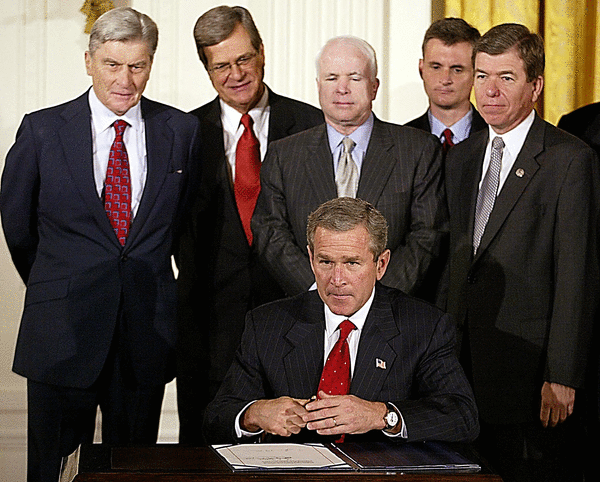
As of last Friday, a quarter century has elapsed since the 2001 Authorization for Use of Military Force (AUMF) became law. When U.S. Sen. Dick Durbin and U.S. Reps. Danny Davis and Jan Schakowsky depart D.C. in January, no Illinois legislator who voted for the AUMF will remain in office. In fact, only 32 lawmakers of the 2001 Congress will remain, or 6% of those who passed the AUMF.
Despite the many years and departures, the AUMF still authorizes the president “to use all necessary and appropriate force against those nations, organizations, or persons he determines planned, authorized, committed, or aided the terrorist attacks that occurred on September 11, 2001 … in order to prevent any future acts of international terrorism against the United States.”
This expansive language served as the “specific statutory authorization” required under the War Powers Resolution. In primary effect, the AUMF was how Congress granted the president the necessary legal justification to use the military in response to the 9/11 attacks. But that was just the start; the AUMF has no end date. Scrambling to react to 9/11, Congress omitted any expiration language in the 2001 AUMF that would cause it to sunset or even periodically surface for renewal.
Consequently, Presidents George W. Bush, Barack Obama, Donald Trump (in his first term) and Joe Biden each cited the 2001 AUMF as the basis for the ongoing “Global War on Terrorism” and related counterterrorism operations in at least 22 countries. All four presidents advanced increasingly aggressive interpretations of the AUMF, allowing our military to target foreign actors “associated” with, or “ancillary” to, the forces that the AUMF might be argued to cover.
Alongside the toll incurred by the rest of the world, America has paid a high price for war on terror, spending $8 trillion so far, according to a 2021 report by Brown University. Moreover, roughly 3 million Americans have served in the war on terror; 15,000 service members and contractors have been killed and 54,000 physically wounded. More than 30,000 veterans and active service members have died by suicide since 9/11.
In such a permissive legal environment, enter Trump in his second term. With a Republican-controlled Congress, the president has used the military without even the courtesy of mentioning the AUMF. Instead, the Trump administration has cited inherent executive authority to order significant publicly named operations, including Rough Rider in Yemen, Midnight Hammer in Iran, Southern Spear in the Caribbean, Absolute Resolve in Venezuela and Epic Fury in Iran.
Not yet halfway through his term, Trump might expand the list further: He has proposed military action against Cuba, Greenland, Panama and Oman, among others.
A fundamental premise of our country’s founding was that no one person — king or president — should alone choose when to fight other countries. The Constitution assigned to Congress the exclusive decision of whether to declare war. There can be reasonable debate about what “declare” means in the context of modern warfare. However, the reasonable interpretation is that no president should be able to initiate military action against a country without approval from Congress.
This enumerated power works only if Congress exerts it, and Congress can restore balance to our government’s war powers in three steps. First, Congress must repeal the 2001 AUMF. Carte blanche authorizations for war amount to quaint vestiges of trusting times between branches and should feature now only in history.
Second, Congress should update the War Powers Resolution framework pertaining to the president’s commitment of troops into hostilities abroad, specifically shortening the current 60-day automatic termination window to 15 days. As demonstrated by the current administration, much can be done in 60 days, especially when an operation is stopped on day 60 and resprung the next day under a new name.
Third, Congress should fuse its war declaration powers to its war funding powers. Each year, Congress passes the National Defense Authorization Act (NDAA), which sets the military’s budget and policy. In this legislation, Congress could insert language requiring that any expenditure of funds pursuant to a named operation greater than 15 days must be attributed to an operation already explicitly declared or otherwise authorized by Congress. The list can be classified, of course, and narrow exceptions can be made for truly exigent circumstances.
Furthermore, Congress could attach criminal penalties similar to those in the Antideficiency Act, such that any political appointee in the Pentagon who approves funds in violation of this new NDAA requirement would face personal consequences. As most political appointees would opt to follow the law to protect their livelihoods, the administration would be forced to come to Congress to seek preapproval of any new operations abroad.
Twenty-five years ago, now mostly ex-legislators voted for the AUMF to equip the president with the tools necessary to meet the national security challenges facing our country at that time. The challenges have since evolved, as has the executive branch. Now Congress needs to not only retire some old tools but also invest in new ones.
The three steps I’ve outlined can do just that — replace forever laws and wars with focused laws for specifically authorized operations.
____
Dan Tully served as a major and a judge advocate in the Army Reserve who deployed to Iraq under a “Global War on Terrorism” operation. He also is a onetime Democratic candidate for Illinois’ 8th Congressional District. Use of military rank and title does not imply endorsement by the U.S. military or the Department of Defense.
___
©2026 Chicago Tribune. Visit at chicagotribune.com. Distributed by Tribune Content Agency, LLC.
















































Comments