Commentary: How President Donald Trump's summit with China's Xi Jinping can yield dividends
Published in Op Eds
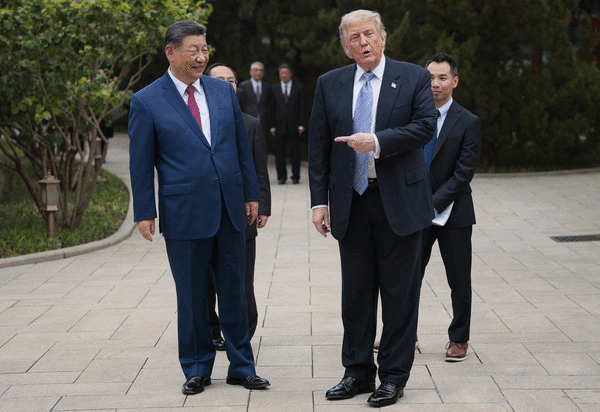
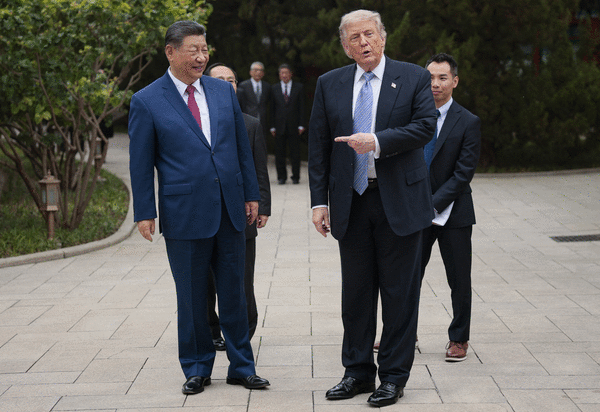
The next U.S.-China summit is scheduled for Sept. 24 in Washington, D.C., and expectations are low. It will be Chinese President Xi Jinping’s first White House visit in more than 10 years and will include a state dinner with all the related pageantry.
President Donald Trump will enter these talks considerably weakened by an Iran war that shows little prospect for resolution. Still, relations with China are somewhat of a bright spot in an otherwise bleak foreign policy landscape.
Despite dire predictions of crisis and even war, the two superpowers have kept their differences in check and even achieved some progress. At the September summit, Trump and Xi should strengthen the framework of “constructive stability” that they agreed to in Beijing in May.
This new formula has proved more promising than the “guardrails” approach favored by Joe Biden as president, whose often-inflated framing of global situations, at one point comparing Taiwan to NATO allies, did not endear himself to Chinese leaders.
By contrast, Trump’s nonideological approach has opened the door to more pragmatic bilateral relations. Take the fentanyl issue. Substantive progress has been made as Chinese authorities move to strictly regulate the export of precursor chemicals to both the U.S. and Mexico. This cooperation has, in part, allowed Trump to claim some success in lowering American deaths from opioids.
Similarly, American farmers are benefiting from a stabilization of the U.S.-China economic relationship. Thus, it was reported in August that Beijing was increasing its purchases of U.S. soybeans. American farmers are being hit hard by high gas and fertilizer prices, but exports to China are helping to soothe a painful situation.
American aviation companies such as Boeing and GE Aerospace are reaping the rewards of this U.S.-China diplomatic engagement, while there have been further breakthroughs in the automotive domain. Even if major economic deals remain elusive, there is ample room for small-scale investments in nonsensitive areas. These cooperative steps are preferable to the economic warfare that roiled U.S.-China relations at the start of Trump’s second term.
There is vitally important work to be done in the security domain too. The Trump administration deserves some credit for lowering temperatures in the western Pacific. Despite momentary flare-ups, Washington has generally forsworn the bluster and peacocking that previously saw the relationship spiral dangerously.
It is true that Xi began the May summit with Trump with a pointed assertion of China’s sovereignty over Taiwan. That could easily have prompted a crisis, but Trump listened to Xi and subsequently criticized Taiwan’s leadership as “dangerous separatists” while opting to deploy arms sales to Taiwan as a bargaining chip in negotiations with Beijing. This made many in the Washington foreign policy commentariat furious, but the result is that the Taiwan Strait is less volatile today than in the recent past.
A breakthrough on the ultrasensitive Taiwan issue is likely too much to ask, but Trump’s advisers could focus their energies on another gravely dangerous situation: North Korea. Ideas on the table include inaugurating four-power talks (China, North Korea, South Korea and the U.S.), a peace treaty to formally end the Korean War and an Arctic initiative that could involve all the countries of Northeast Asia. An even more ambitious negotiation could trade U.S. diplomatic recognition of North Korea for Pyongyang’s agreement to bring home all its troops from Eastern Europe.
Washington is slowly coming around to the realization that it needs China’s diplomatic assistance — and not just in Northeast Asia. If agreements are to be reached with Russia or Iran to settle the Ukraine or Middle East war, respectively, it will help enormously if China can offer these two recalcitrant countries inducements to negotiate in good faith.
This possibility is still remote in our nascent détente with Beijing. Washington needs to walk before it runs in such a sensitive, ultra-high-stakes relationship. Still, U.S.-China relations are clearly moving in the right direction.
Trump can call the September summit a success if he succeeds in reopening the U.S. Consulate in Chengdu and the Chinese Consulate in Houston, which were foolishly closed during the dark days of 2020. In addition, it will be ideal to build on the U.S.-China summitry of 2026 by working with Beijing to ensure that regularized, multiday, annual summits are occurring for the foreseeable future that bring together the leaders of the world’s two most important countries.
Let’s hope Trump can.
____
Lyle Goldstein is director of Asia Engagement at Defense Priorities.
___
©2026 Chicago Tribune. Visit at chicagotribune.com. Distributed by Tribune Content Agency, LLC.

















































Comments