Andreas Kluth: Tactical nukes are a gateway drug to Armageddon
Published in Op Eds
The U.S. is quietly — and largely with a view to a potential war against China — tweaking its nuclear strategy, contemplating a bigger role for so-called tactical nukes. To the uninitiated, the shift may seem arcane. To those in the know, the stakes are nothing less than the risk of atomic Armageddon.
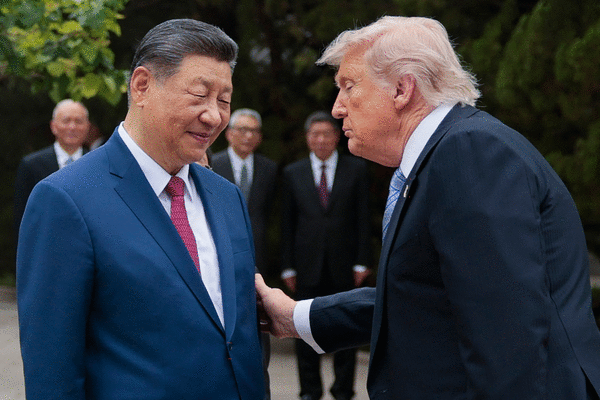
Obscure or not, the topic is so existential that it should top, or at least make, the list when President Donald Trump hosts his Chinese counterpart, Xi Jinping, later this month. If they don’t discuss it, after already avoiding their looming nuclear arms race when they talked in May, they will endanger the whole world.
The adjustment in American nuclear strategy has been communicated in various speeches and comments by administration officials such as Elbridge Colby, a policy thinker in the Pentagon. It’s generally couched in phrases such as giving the president more “options,” with weapons that are “credible” because, as Colby puts it, a potential enemy has “got to believe there’s some sense in which we would use” them.
That language is code for tactical (also called theater or nonstrategic) nukes. The difference between those and strategic nuclear weapons is big but sometimes subtle.
Strategic nukes are typically the most powerful warheads, made to be launched on intercontinental missiles or from long-range bombers or submarines against an enemy’s homeland. Their implied purpose is to annihilate any adversary who dares to initiate a nuclear war, thus deterring a first strike by enemies.
Tactical atomic bombs have more variable yields, ranging from limited blasts — enough to take out an airport, say — to explosions comparable to those at Hiroshima and Nagasaki. (“Limited,” in the radioactive context of nuclear war, is a relative and macabre term.) They’re usually made to be launched at shorter ranges and on more kinds of vehicles, including cruise missiles. As their names imply, their purpose is to win on the battlefield, especially when defeat seems likely in an otherwise “conventional” (non-nuclear) war.
Tactical nukes played a crucial role during the Cold War, starting in the 1960s. The U.S. was committed to defending Western Europe from the Soviet Union but had to accept that Moscow wielded more conventional military might. To compensate, Washington deployed tactical nukes that could have decimated and stopped Soviet invasion forces. Even then, nobody — in Washington, Moscow, Bonn or anywhere — could say whether the U.S. would actually have launched the weapons and whether their use would then have escalated to all-out nuclear Armageddon.
After the Cold War, the role of tactical nukes declined, largely because U.S. presidents starting with George H.W. Bush retired or mothballed most of them: The U.S. stockpile shrank by more than 90%, to an estimated 200 weapons today, some 100 of which are stored at air bases in five allied European countries.
Moscow also reduced its tactical arsenal, but less so. (Arms-control treaties such as New START, which has now expired, covered only strategic weapons.) Russia’s stockpile is now estimated to outnumber that of the U.S. roughly 10-to-1. Worse, Russian leader Vladimir Putin has repeatedly broken taboos by threatening to use such warheads in Ukraine. That’s one reason tactical nukes, after decades of being out of the headlines, are back in the news.
The other reason is China, and its military plans for seizing Taiwan (about which we can only theorize), should Xi ever go for it.
Experts in Washington struggle to read China’s nuclear intentions. On one hand, China remains the only nuclear power that has an explicit doctrine of No First Use.(1) Beijing, which wields huge clout over Moscow, has also warned Putin not even to think about using a nuke against Ukraine, in 2022 and again this year. On the other hand, China is now growing its nuclear arsenal with a goal of reaching parity with the U.S. and Russia while refusing, so far, to enter arms-control negotiations.
In some ways the Taiwan Strait today also resembles the Fulda Gap of yore (through which the Soviets might have crossed from East into West Germany). With shorter supply lines and no global commitments, China could have a regional advantage in conventional military might over the U.S. and its allies. As during the Cold War, this potential asymmetry is making some nuclear hawks in Washington seek to restore deterrence with tactical nukes.
In another scenario, it is China, abandoning its dogma of No First Use, which first launches a tactical nuke in the region by bombing an American base or maybe even just blowing up water as a show of resolve. If the U.S. president lacks tactical nukes in his tool kit, he would then face a conundrum, thinks Victoria Coates, who was deputy national security adviser in Trump’s first term and is now at the Heritage Foundation.
“If Xi fires a tactical nuclear weapon at a U.S. aircraft carrier, or a large vessel in the Pacific, our retaliatory options in the nuclear realm are limited,” Coates told me. “It’s essentially doomsday weapons.”
What she means is that the U.S. would not respond to a Chinese tactical strike causing a few thousand casualties with a retaliatory strategic strike that kills millions (and would draw inevitable strategic retaliation by the Chinese against American cities). This is also why Colby thinks the current U.S. nuclear deterrent is not “credible” and leaves the president with too few options.
That is flawed logic, I heard from other nuclear strategists. Christopher Preble at the Stimson Center, a think tank in Washington, told me that the Pentagon already has plenty of conventional options to retaliate against a Chinese tactical strike, including devastating attacks without nukes against China’s command-and-control nodes.
China also doesn’t want to turn itself into a global pariah by being the first to go nuclear, Preble adds. So the threat of a preemptive tactical strike by China is not credible.
By contrast, the pressure on Beijing to answer an initial tactical strike by the U.S. with a nuclear response would seem imperative. The reason China is expanding its nuclear arsenal in the first place, analysts think, is to protect itself from American atomic blackmail in this kind of scenario. So it’s highly credible that China, during a war, would answer a tactical strike by the U.S. with one or several of its own.
And then? Daryl Kimball, the executive director of the Arms Control Association in Washington, told me that “there’s absolutely no guarantee that each side is going to be able to contain or stop escalation beyond a handful of sub-strategic detonations in that region.”
For a start, each side would face a so-called discrimination dilemma: What’s on those incoming missiles, a conventional or a nuclear warhead? Beijing might see another American volley in the air and fear that it’s an atomic strike to take out its nuclear silos in the western deserts or the leadership compound in Zhongnanhai.
At that point, the distinction between tactical and strategic nukes in effect vanishes, and new calculations — as well as miscalculations — would be made within minutes. “These are the reasons why these war games often lead to World War III,” Kimball told me.
“A nuclear war cannot be won and must never be fought,” Washington and Moscow stipulated toward the end of the Cold War. That insight also prompted the U.S. and others, for a time, to de-emphasize tactical nukes, precisely because they appear more “usable” than the strategic kind, threatening to become gateway drugs to the fatal dose.
It would be disastrous if this understanding got lost again in today’s world of increasing great-power rivalry, disorder and strife. Adding tactical nukes back into the arsenals and war plans of the U.S. or any power, in the Taiwan Strait or anywhere, is the wrong answer to today’s conflicts.
The only way to step back from the brink is to get the leaders of the main nuclear powers — and at a minimum the big three in Washington, Moscow and Beijing — to address the danger openly and cooperate in managing it, with new arms-control talks. Trump and Xi must make a start when they next meet.
_____
(1) India also used to have a policy of No First Use but subsequently suggested that it might retaliate with nuclear weapons against a biological or chemical attack as well as a nuclear one.
This column reflects the personal views of the author and does not necessarily reflect the opinion of the editorial board or Bloomberg LP and its owners.
Andreas Kluth is a Bloomberg Opinion columnist covering US diplomacy, national security and geopolitics. Previously, he was editor-in-chief of Handelsblatt Global and a writer for the Economist.
_____
©2026 Bloomberg L.P. Visit bloomberg.com/opinion. Distributed by Tribune Content Agency, LLC.















































Comments