Commentary: Franklin D. Roosevelt and Dwight D. Eisenhower were models of statesmanship
Published in Op Eds
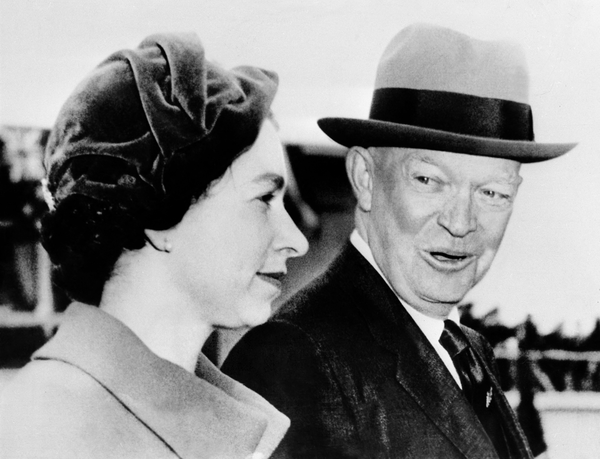
I’ve long been intrigued by the presidencies of Franklin D. Roosevelt and Dwight D. Eisenhower and believe they each offer important and illuminating examples of the kind of statesmanship the United States urgently needs.
Roosevelt was a liberal Democrat and Eisenhower a conservative Republican. Their families, educations, personalities, professional backgrounds, governing styles and political skills could not have been more different. However, each represented the best of his party’s governing philosophy and leadership tradition. Both offer compelling statesmanship lessons.
Roosevelt was from a wealthy New York family. His charmed early life and promising political career were slowed, but not halted, when he was stricken with polio in his late 30s. He refused to be derailed by his partial paralysis, became an effective governor of New York and then was elected four times as president of the United States, serving from 1933 until his death in 1945. He led America through the Depression with an activist and experimental approach to governing.
“It is common sense to take a method and try it,” he said. “If it fails, admit it frankly, and try another. But above all, try something.”
David Kennedy, a Pulitzer Prize-winning historian, recently told me that Roosevelt possessed a genius that approached “political magic.” He understood the mood of his time, with its complex blend of anger, fear and despair. According to Kennedy, Roosevelt had the special ability to “understand historical opportunities in their moment.” Roosevelt offered frightened and dispirited Americans a vision of a secure future. His periodic fireside chats were broadcast on the radio and captivated the nation with their warmth, clarity and resolve.
“Good evening friends,” he began, offering ideas, plans and, most importantly, hope. He exuded confidence.
Roosevelt was both a crisis manager and a structural reformer who fundamentally changed the role of the federal government and the nation’s expectations of the state. On top of that, he also skillfully navigated the United States through one of the most threatening international upheavals imaginable in the late 1930s and early 1940s. Roosevelt and Britain’s Winston Churchill shrewdly and courageously led the West in the epic battle against Nazi Germany and Imperial Japan through World War II. Even in the midst of this global struggle, Roosevelt contemplated the future and envisioned the critical role that a new United Nations might play.
Eisenhower, although a contemporary of Roosevelt, came from another world and displayed a different leadership style. Eisenhower was born into a family of seven boys and grew up in Abilene, Kansas, on what was generally considered the wrong side of the tracks.
He studied at West Point, had superb military mentors, developed extraordinary leadership skills and matured into a five-star general who led the epic D-Day invasion and reconquest of Europe. Gen. George Marshall, his boss who was notoriously parsimonious with praise, told Eisenhower that “you have made history, great history, for the good of mankind, and have stood for all we hope for and admire in an officer of the United States Army.”
Eisenhower possessed iron discipline, sunny self-confidence and a mind that loved organizational challenges. Tackling practical problems, he said, was “my equivalent of crossword puzzles.”
Initially avoiding politics after the war ended, he eventually plunged in. He secured the Republican presidential nomination in 1952 and then won the national election by a landslide that year and in 1956. Not as verbally eloquent as Roosevelt, Eisenhower communicated with a broad smile and a confident demeanor. Americans admired and trusted Ike.
He was a champion of disciplined and effective government. His statesmanship was as a planner, organizer and builder. He oversaw the construction of the St. Lawrence Seaway and the interstate highway system, expanded America’s space program, created NASA, balanced the federal budget and devised a new national security strategy.
Eisenhower’s leadership was based on what he described as “a fair, decent and reasonable dealing with men, a reasonable recognition that views may diverge, a constant seeking for a high and strong ground on which to work together.”
His vision of America’s global role was simple and profound. The United States should“display a spirit of firmness without truculence, conciliation without appeasement, confidence without arrogance.”
Eisenhower’s farewell address was a master class in statesmanship. In addition to his prescient warning about the emerging “military-industrial complex,” he emphasized restraint and stewardship. Americans, he said, should “avoid the impulse to live only for today, plundering, for our own ease and convenience, the precious resources of tomorrow. We cannot mortgage the material assets of our grandchildren without risking the loss also of their political and spiritual heritage.”
Whatever our party affiliation or political views, Americans should appreciate Roosevelt’s ingenuity, determination and confidence and applaud Eisenhower’s competence, planning and stewardship. We need Roosevelt’s flexibility and agility and Ike’s solidity and stamina to successfully tackle immigration reform, deficits and debt, climate change and other challenges.
I urge our current leaders to adopt as their credo the words inscribed on a desk plate on Eisenhower’s Oval Office desk. On one side was Latin: “Suaviter in modo, fortiter in re.” And on the other side was the English translation: “Gently in manner, strongly in deed.”
____
John T. Shaw is a professor at the Les Aspin Center for Government in Washington, D.C. His most recent book is “The Education of a Statesman: How Global Leaders Can Repair a Fractured World.”
___
©2026 Chicago Tribune. Visit at chicagotribune.com. Distributed by Tribune Content Agency, LLC.















































Comments