Commentary: Let's heed the wisdom of Wendell Berry
Published in Op Eds
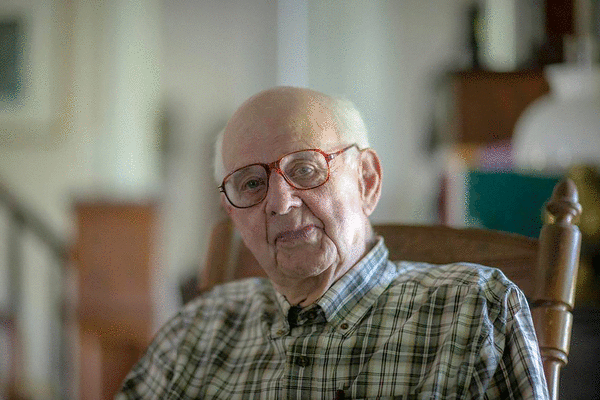
On Aug. 31, the great writer Wendell Berry died “suddenly and peacefully” at his home in Port Royal, Kentucky, where he had lived with his beloved wife, Tanya Berry, for more than six decades.
He was the author of more than 50 books of essays, poetry and fiction, all of which championed an agrarian economy built on a sense of place and a commitment to community, against the predations of corporatism and heedless consumption.
Berry worked continually and until the very end of his life, often making the same points with the same urgency. His most famous book,“ The Unsettling of America,” came out in 1977. It was a clarion call for resistance to the desolation of rural areas and the devastation caused by an overarching commitment to extraction.
A 50th anniversary edition of the book was reissued less than a month before Berry’s death and just days after his 92nd birthday. It included a new foreword in which Berry reflected, as he often has, that the trends he decried back in the mid-1970s have all gotten appreciably worse, as evidenced by the ascension of billionaires including Elon Musk and Donald Trump. “To be successful now,” he wrote, “is to achieve the satisfaction of one’s greed, which of course is enlarged by every additional prospect of satisfaction.”
Today, assessed Berry, “We foresee no practical enactment of the concept of enough, but rather submit to the absolute determinism of progress: progress undirected and inevitable. Progress forbids us to stop when we are satisfied. We must go on, adopting the changes of technology, whatever the cost may be to ourselves and our children.”
Throughout his life, Berry refused to accept the notion that more is better or that what is called progress was actually an improvement on the way things were. As the New York Times noted in its obituary, Berry “plowed his fields behind Belgian draft horses and wrote lyrical poems, novels and essays — mostly in pencil and without electric light.”
He had no use for smartphones or television, which he once memorably described in his 1981 essay collection, “The Gift of Good Land,” as “a vacuum line, pumping life and meaning out of the house,” a constant source of “glibness,” “gleeful idiocy” and “idiotic gravity.” He admired the Amish for their commitment to simplicity.
I met Berry for the first of several times in November 2019 at his Kentucky farmhouse, after which we struck up a spirited and at times contentious correspondence that went on for more than six and a half years and produced dozens of letters about books, our lives and things in the news. A few of his letters were typed, but most were written in pencil by hand on yellow legal paper.
Berry viewed the future with alarm. When my wife and I last visited the Berrys in September 2025, he expressed concern for his family, which now includes five grandchildren and four great grandchildren.
“I don’t know the answer but the question is: ‘How do we keep from killing ourselves?’” he said at one point. He also stated, with gloomy conviction, “I think the world is coming to an end. I don’t know what kind of end. But it’s coming to an end.”
However, Berry was too great a man to give into resignation. In a letter to me just a month before he died, he identified some reasons for despair before quickly sounding an upbeat note: “We’ve got Trump who can be neither believed nor forgotten, we’re burning the poisonous fuels as fast as possible, and so forth. But we Americans have a lot to be thankful for, and we ought to be giving thanks. And we ought to be taking care of our land, grass, and trees, for which we ought also to be giving thanks. And we could give thanks also to have so much to give thanks for.”
Add this to the list of things for which we should be thankful — the courage, wisdom and legacy of Wendell Berry.
____
Bill Lueders is editor-at-large of The Progressive magazine and a writer in Madison, Wisconsin. This column was produced for Progressive Perspectives, a project of The Progressive, and distributed by Tribune News Service.
_____
©2026 Tribune Content Agency, LLC.

















































Comments