Rochelle Olson: Don't let Texas off the hook for releasing ICE agent accused of Minneapolis shooting
Published in Op Eds
The word seems to be out among federal immigration agents: Shoot a civilian, give an account contradicted by the evidence and retreat to a friendly red state, and you may escape prosecution.
That is what appears to be happening with Minnesota’s attempted prosecution of Immigration and Customs Enforcement agent Christian Castro. Castro faces five state charges for allegedly shooting Julio Cesar Sosa-Celis in Minneapolis during Operation Metro Surge in January and then falsely reporting what happened.
The stalling tactics in Texas should alarm anyone who believes federal agents are not above the law, particularly when they use deadly force. It also offers an ominous sign that a reckoning may not come anytime soon for the federal agents who shot and killed Minneapolis residents Renee Good and Alex Pretti.
Word last week was that Castro was about to be charged, but that didn’t happen and it’s unclear if or when it will. The agents involved in the Pretti and Good shootings also have not been charged.
As Twin Cities defense lawyer Fred Goetz, who represents the roommate of Sosa-Celis, who was present at the shooting, said in a statement, “it appears that political considerations have derailed the federal prosecution.”
Political considerations also are impeding Minnesota’s prosecution of Castro.
Republican Texas Gov. Greg Abbott has thus far declined to send Castro to Minnesota. He didn’t formally refuse to send Castro. But he has prolonged an investigation, with no definitive timeline for conclusion, into whether Castro meets the definition of a fugitive.
Don’t be fooled. This is political stonewalling disguised as legal deliberation.
Abbott has said he does not trust Gov. Tim Walz and has tried to link Castro’s extradition to fraud in Minnesota. Distrust of another governor, however, is not among the constitutional grounds for refusing to extradite a fugitive.
Abbott is following President Donald Trump’s governing ethos: Allies receive indulgence, while foes are punished.
The Castro case should test the sincerity of every politician who claims to support “law and order.”
On Jan. 14 during Operation Metro Surge, Castro shot Sosa-Celis, a Venezuelan national, who was legally in the country. Castro claimed Sosa-Celis and his roommate had attacked him with a shovel and broom, so he fired in self-defense. Video and eyewitnesses disproved Castro’s account.
On May 18, Hennepin County Attorney Mary Moriarty filed five criminal charges against Castro. Castro was arrested by Texas Rangers in late May and held in custody for 90 days with Minnesota’s extradition request pending.
Abbott, who has honored other extradition requests from Minnesota, punted on this one. The governor said that he didn’t trust Gov. Tim Walz, an assertion that’s not on the menu of options for denying extradition.
In U.S. District Court in Texas, Abbott’s lawyers argued that Castro might not qualify as a fugitive because ICE ordered him to leave Minnesota, meaning he didn’t flee voluntarily.
Even U.S. District Judge Fernando Rodriguez, Jr., who declined to intervene, expressed doubts about that argument. But the judge said Minnesota’s lawsuit was premature because Abbott had not taken action on the extradition request.
The court also determined there was no deadline for Abbott’s investigation which means the governor can deny extradition with prolonged inaction.
Castro walked out of the Cameron County Detention Center on Thursday. Cameron is the southernmost county in the United States, bordering Mexico.
Moriarty said last week, “If Christian Castro walks out of the door of the jail ... and disappears into Mexico, it will be the fault of one person, Gov. Greg Abbott.”
I don’t put all the blame on Abbott. He made his move with the full confidence that Trump and fellow Republicans would support him either explicitly or with their silence.
Top Minnesota Republicans are fine with what’s unfolded.
House Speaker Lisa Demuth, the GOP nominee for governor, said, “I trust the courts to adjudicate the matter of extradition under the Constitution and related statutes.”
GOP Attorney General candidate Ron Schutz extensively cited the judge’s ruling that noted how Abbott had yet to make a decision because the investigation is ongoing, so legal action against the Texas governor would be premature and unwarranted.
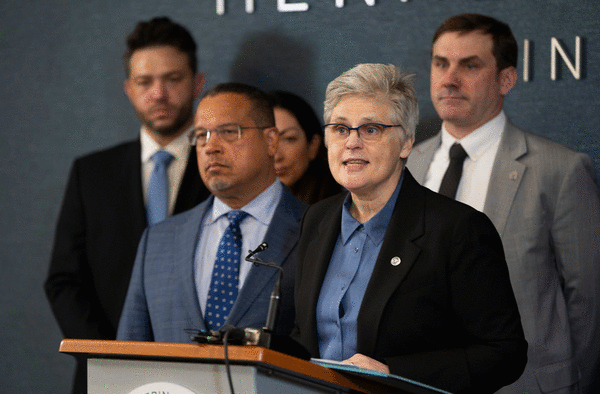
DFLers aren’t forgiving of Abbott’s tactics. U.S. Sen. Amy Klobuchar, who is running for governor, and Attorney General Keith Ellison, who is seeking another term, want accountability.
“If a governor can delay extraditions and cherry-pick cases according to their political tastes, then no state will be able to hold fugitive criminals accountable,” Ellison said last week.
In a statement, Klobuchar said Tuesday: “Minnesota properly sought extradition in this case and Texas should have complied — as a former prosecutor, I will always stand up for Minnesotans and the rule of law.”
But this isn’t merely a partisan divide in a political year; This is about whether the Constitution and the rule of law apply when the accused carries a badge.
Abbott is not merely snubbing a DFL governor. He is testing constitutional limits and duties.
Two acclaimed constitutional law scholars: Michael Stokes Paulsen and Sanford Levinson argue that Abbott should be compelled to act. Stokes Paulsen and Levinson are on the faculty of law schools at, respectively, the University of St. Thomas and the University of Texas.
In a commentary published in the Minnesota Star Tribune last week, the two argued that Abbott should be held in contempt for failing to extradite Castro.
“Greg Abbott should, and must, obey the law. He can be forced to do so, and maybe even criminally prosecuted, if he does not,” they wrote.
Pretti and Good were U.S. citizens. Sosa-Celis was here legally. All deserve justice.
The Constitution was not written for selective application nor can it be discarded by an aspiring authoritarian president and his partisans.
If Abbott’s obstruction and Castro’s alleged conduct are dismissed, ignored or forgotten, the lesson will be clear: Federal agents accused of violence can seek refuge in politically hospitable states.
That is a blueprint for lawlessness and division.
_____
©2026 The Minnesota Star Tribune. Visit startribune.com. Distributed by Tribune Content Agency, LLC















































Comments