Commentary: I worked on Hillary Clinton's 2016 campaign. Abdul El-Sayed is repeating our biggest mistake
Published in Op Eds
“But her emails.”
It’s a callback to a 2016 sticking point during that year’s presidential campaign that refers to the email security practices of Democratic presidential candidate Hillary Clinton, in her previous capacity as the secretary of state. The outcry drew outsized media scrutiny, given all that was at stake in the election and the relative scandals Republican presidential candidate Donald Trump had brought to the table.
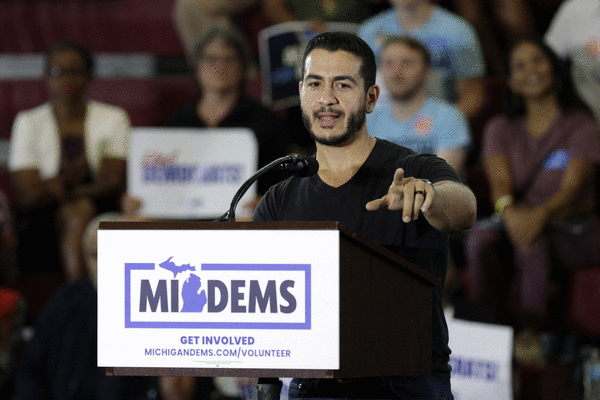
I worked on Clinton’s campaign. Today, as I watch Michigan Democratic U.S. Senate nominee Abdul El-Sayed respond to controversy surrounding leftist streamer Hasan Piker, I see the same mistake being made that our campaign made.
Across that cycle, evening newscasts of the three main networks gave roughly 100 minutes to Clinton’s emails and about 32 minutes combined to the policy positions of every candidate in the race. The Clinton campaign had published 65 policy fact sheets— an entire campaign policy book, which even included a plan for pandemics, and more than 112,000 words on Alzheimer’s research, Wall Street reform, criminal justice and just about everything else a presidential administration might touch on. None of it registered.
There was one unresolved question sucking up all the oxygen: “What about the emails?”
Now, El-Sayed is being dragged down by nonstop media cycles around his previous choice to campaign with Piker, who has made extreme comments. Last week, several Democratic Party leaders and elected officials condemned Piker over comments he made regarding Israel. Despite pleas from many, El-Sayed has yet to explicitly disavow Piker. To El-Sayed’s supporters, this criticism of him is in bad faith at best and a form of Islamophobia at worst.
Clinton was the establishment’s candidate, and El-Sayed is seen as an insurgent of the left, yet both decided on the same instinct: The scandal is illegitimate; engaging with it dignifies it.
When the email story broke in the spring of 2015, Clinton said use of her private server for State Department business was a matter of“convenience” and that it “ would’ve been better” to carry a second phone for her official duties. That August, she said: “These years later it doesn’t look so convenient.” That September, she said: “I am sorry that this has been confusing to people.” Six months after the story broke, she conceded: “That was a mistake. I’m sorry about that. I take responsibility.”
In a book years later, Clinton communications director Jennifer Palmieri wrote that the campaign made a mistake in how it handled the email story and should have addressed it more head-on.
I thought about that flawed calculus again while reading El-Sayed’s recent statement about Piker, which does not mention the streamer by name. It ends this way: “While politicians and pundits try to make this race about a Twitch streamer, we’re going to be talking about gas, groceries, good schools, and healthcare.”
I believe he means it. Clinton meant it too.
Every day a candidate declines to give a clean answer, he or she isn’t starving the story. They are in essence writing the next installment.
This April, El-Sayed was asked whether he would disavow Piker’s views. He said, “I’m not here to disavow people’s views. This whole ‘gotcha’ game, platform policing, cancel culture, I thought we were over it.” In early August, he said:“I’m less focused on folks who are campaigning with me, more focused on the folks I’m campaigning to.” A few days later, on the political show “Meet the Press,” El-Sayed dismissed Piker’s claim that America deserved 9/11 as“a dumb statement”— but he still would not say whether Piker would appear with him again.
Then, after Piker told his audience that if American Jews continue to insist they are singularly invested in Israel, “eventually someone’s going to come around and take action,” El-Sayed’s answer was:“ Nobody speaks for this campaign besides me and my campaign spokespeople.”
In August, a question about why Michigan Democrats Dana Nessel and Hillary Scholten were criticizing El-Sayed inspired this answer from him: “I think the question right now is how do we get together to beat Donald Trump?” He now says he has“no plans” to campaign with Piker. Still, when he recently was questioned about Piker, El-Sayed refused to address the issue directly, instead lambasting reporters for trying to “make this race about a streamer in California.”
Déjà vu.
El-Sayed may even be right that the news media are disproportionately covering the Piker controversy. But being right about a double standard does not shut down the story. It means only that you can be right while you lose.
Scholten, a U.S. representative, said she still hasn’t endorsed her party’s Senate nominee, and“ a lot of it has to do with past associations with Hasan Pike r.” Democratic s tate Sen. Jeremy Moss is still withholding his endorsement. And Debbie Dingell — about as loyal a Michigan Democrat as the state produces — snapped at reporters recently: “I am done! So don’t any reporter ask me again about Hasan Piker.”
That isn’t the story dying. It’s the story expanding and entrenching itself into the remainder of the campaign cycle.
The clear exit here is embarrassingly cheap. El-Sayed should disavow Piker by name and make clear he is not welcome on his campaign or in his orbit. Then, take questions until reporters run out of them. That costs one bad news cycle — instead of an entire election.
We all know how the alternative works out: A scandal you don’t even believe in runs on a loop, occupying the exact space where your substantive campaign was supposed to go.
El-Sayed says nobody speaks for his campaign but him and that a streamer in California is not what this race is about. He’s right on both counts. He is also the only person who can make either one true, and he can do it in a single sentence today.
____
Kaivan Shroff is a politics and culture commentator, attorney and former digital organizer for Hillary Clinton’s 2016 presidential campaign.
___
©2026 Chicago Tribune. Visit at chicagotribune.com. Distributed by Tribune Content Agency, LLC.

















































Comments