Mark Gongloff: For a thirsty American West, it's either cows or humans
Published in Op Eds
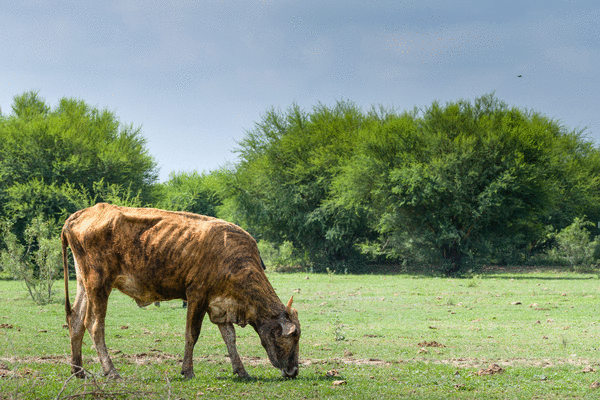
Sustaining communities of millions of thirsty people in a desert is challenging enough. Adding millions more cows, or at least growing the water-intensive food those cows eat, ramps up the difficulty level exponentially. America’s arid Southwest is learning it can’t comfortably have both.
The toxic combination of a 25-year drought and chronic overuse has caused the Colorado River to lose 20% of its flow, major reservoirs Lake Mead and Lake Powell to fall to record-low levels and a Lake Mead’s worth of groundwater to evacuate. The seven states that share the Colorado’s water with several Native American tribes and Mexico have haggled unsuccessfully for years over divvying up this dwindling resource, so the federal government recently offered its own suggestions.
The federal plan calls for steep cuts to California, Arizona and Nevada, the three states that make up the lower Colorado Basin. According to agreements made obsolete long ago by climate change, these states are supposed to get 7.5 million acre-feet (AF) of river water per year. The federal plan would slash that by up to 3 million over the next decade, starting with 1.25 million by 2028. Arizona, with junior rights, would lose 760,000 per year during the first two years and possibly all of its 3 million acre-feet of river allocation in the long run.
One acre-foot of water is enough to flood an acre of land a foot deep, or 325,851 gallons. That should theoretically be enough to supply one average American household for three years. The amount of water the feds want to take from Arizona at first would be enough to serve 2.3 million households each year.
But the bulk of the Colorado River isn’t piped to houses. It’s claimed, in the form of food, by those cows.
Irrigation for alfalfa and other kinds of hay grown to feed cattle take up 32% of the river’s water spent on human endeavors every year, according to a 2024 accounting by a dozen water experts published in the journal Communications Earth & Environment. That’s roughly enough to fill a quarter of Lake Mead. Other farming takes up about 23%. All other human-designed water hogs, from golf courses to dishwashers to factories, use just 25%.
And much of that alfalfa feeds cows in China, Japan and other parts of the world. About 26% of the hay grown in California and Arizona is exported, according to a 2023 University of Arizona study. One top destination is Saudi Arabia, a desert nation that outlawed growing alfalfa specifically to save water. It’s worth asking whether it makes sense to use that same dwindling resource to subsidize the rest of the world’s growing appetite for beef and dairy.
Nevada has sued the federal government over the water plan, and Arizona is thinking of joining the fray. But one way or another, either by court order, federal mandate or the inescapable fact that a hotter climate keeps drying up the Colorado, Southwestern states eventually won’t have enough water to maintain the status quo. Who will lose in that case: the people or the cows? “That is the question of the hour,” Brian Richter, the lead author of the 2024 water accounting and now president of a consultancy called Sustainable Waters, told me.
The answers are far more complicated than just “Don’t grow cow food,” Richter pointed out. For one thing, those cows do eventually make food for people. Even vegetarians often get protein from cheese, yogurt and milk. Farmers, meanwhile, make a lot of money on alfalfa, a crop that is easy to grow and can handle long stretches without water. Those farmers then take that money and support local and national economies.
Helping farmers use water more efficiently often just encourages them to grow even more alfalfa rather than cutting water demand, in a rural version of Jevon’s paradox. Paying farmers to fallow fields or grow less-thirsty crops is an effective fix, but it’s expensive. And anyway, President Donald Trump last year cut off Inflation Reduction Act funds meant for just that purpose.
Those communities of people have already gone a long way toward using water more efficiently, particularly in Arizona. Municipal demand in all of Arizona’s water-management zones, which include major population centers such as Phoenix and Tucson, was 1.5 million AF in 2024, basically the same as in 2006, according to the Arizona Department of Water Resources. During that time, Arizona’s population grew by 27% to 7.6 million people.
That track record will be tested by the recent influx of thirsty data centers into Phoenix, seeking its light regulations, predictable weather and connection to the rest of the country. Given Arizona’s flesh-melting heat, these data centers also need more water to stay cool; one ChatGPT request through an Arizona server farm uses almost twice as much water as the national average, according to a University of California Riverside study last year.
One Microsoft Corp. data center in suburban Phoenix uses as much water as 670 local households, according to a report by APM Research Lab, part of American Public Media. That’s less than 2% of the suburb’s population and far less than any alfalfa farm. But when you’re splitting a rapidly depleting water supply, every drop counts.
In order for people, alfalfa farms and data centers to keep coexisting in a desert, all will have to understand their limits. In a recent blog post, Richter laid out three principles for managing the Colorado’s shrinking water supply, the first of which is setting a hard cap on use and revisiting that cap every five years to make sure it’s still realistic.
The old system for managing the river must also be updated. Having a single water authority, rather than many squabbling states, would help. Robust water markets for buying and selling rights could price this precious asset more efficiently. We could also price beef as the luxury good it really is, rather than importing mystery meat just to placate voters.
We already have some evidence of how Southwestern farms respond to losing water. After Arizona’s Colorado River allocations were slashed by 300,000 AF in 2022, many farmers with junior water rights stopped planting. Many others switched to less water-intensive crops such as barley, which surged by 159% in one irrigation district between 2020 and 2024, while alfalfa production fell 48%, according to an Arizona State University study.
In the struggle between cows and people, we’ve got the opposable thumbs and the advantage.
_____
This column reflects the personal views of the author and does not necessarily reflect the opinion of the editorial board or Bloomberg LP and its owners.
Mark Gongloff is a Bloomberg Opinion editor and columnist covering climate change. He previously worked for Fortune.com, the Huffington Post and the Wall Street Journal.
_____
©2026 Bloomberg L.P. Visit bloomberg.com/opinion. Distributed by Tribune Content Agency, LLC.


















































Comments