Editorial: Venezuela oil deal may be a win, but it shouldn't set a precedent
Published in Op Eds
Eight months ago, American aircraft launched from 20 bases as a special operations team entered Caracas and removed Venezuelan President Nicolás Maduro from a fortified compound. Dozens of Venezuelan and Cuban personnel were killed. Congress never authorized the operation.
On Monday, Americans learned what emerged from it: century-long rights to 17 oil fields containing an estimated 65 billion barrels, a 35% Pentagon ownership stake in a newly created company, and a State Department guarantee to purchase one-fifth of its production at cost.
Two things can be true at once. The way this agreement was obtained should alarm anyone who cares about constitutional government and the limits of presidential war-making. Yet its strategic and economic benefits to the United States may also be substantial.
The president ordered military action against the leader of a foreign government without congressional authorization. He then announced that the U.S. would oversee Venezuela until a transition acceptable to Washington had taken place. Maduro may have been a dictator, and the narcoterrorism indictment against him is serious. But neither fact erases the constitutional question.
The precedent is now unmistakable: A president can use military force to remove a foreign leader and then negotiate a century-long interest in that country’s natural resources with the Pentagon itself holding equity while Congress watches events unfold on television alongside the rest of the country.
That is not how a constitutional republic should decide when to wage war, govern another nation’s transition or acquire a financial interest in the aftermath.
The legitimacy of the Venezuelan signatories presents another serious problem. The interim government granting these concessions is led by Maduro’s former vice president, who assumed power only after the U.S. removed her predecessor. A government formed in the immediate aftermath of a foreign military operation is hardly positioned to refuse the demands of the power responsible for its survival.
Nor is such a government obviously entitled to bind generations of Venezuelans to a 100-year agreement.
Former American energy officials have already identified the most predictable danger: A future government in Caracas or even Washington could challenge or discard the entire arrangement. That risk is not incidental. It flows directly from the questionable manner in which the agreement was secured. The weaker its democratic legitimacy, the more vulnerable it becomes to legal challenges, political upheaval and eventual repudiation.
The White House’s assurances also deserve greater scrutiny. The administration describes the agreement as carrying “zero cost” to the U.S., citing a federal veto over board appointments, an American majority on the board and provisions placing the deal under U.S. law and within U.S. courts.
But “zero cost” is a misleading description of an investment whose value may depend upon a continuing American military presence in the Caribbean. Warships, surveillance, personnel and security guarantees are not free simply because their costs are omitted from an agreement’s fact sheet.
Still, the strategic benefits are real.
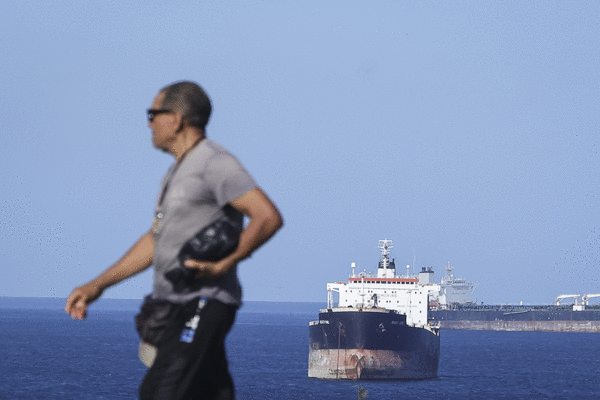
For two decades, Beijing and Moscow exploited Venezuela’s debt, corruption and institutional collapse to establish a foothold in the Western Hemisphere. That foothold has now been sharply diminished. An estimated $100 billion in infrastructure commitments could revive an oil industry left crippled by mismanagement and neglect. A large and potentially stable supply of non-OPEC crude located only days from Gulf Coast refineries could strengthen American energy security, reduce foreign leverage and place downward pressure on prices.
The benefits could be felt beyond Washington.
Here in Maryland, Baltimore residents have just endured a rate case that left many families calculating at the kitchen table whether they could afford to turn up the heat. Energy prices are not determined solely in Annapolis or at BGE headquarters. They are shaped by decisions made in Caracas, Moscow, Beijing and across the global energy marketplaces where Maryland consumers have no vote and little influence.
A reliable supply of crude that is no longer controlled by hostile powers could eventually mean lower costs for families in Hampden, Cherry Hill and communities throughout Maryland. The savings may not appear immediately, and no administration should exaggerate them, but the potential benefit is genuine. Denying that reality merely to deny President Donald Trump a political victory would be intellectually dishonest.
That leaves the country with an uncomfortable but necessary conclusion: A constitutionally troubling process may have produced a strategically defensible outcome.
The outcome, however, cannot be allowed to legitimize the method.
America can recognize the value of removing Russian and Chinese influence from Venezuela. It can welcome greater energy security and the possible economic benefits for American families. But it must not normalize a system in which presidents wage war first, acquire foreign resources second and consult Congress only after the arrangement is complete.
_____
©2026 The Baltimore Sun. Visit at baltimoresun.com. Distributed by Tribune Content Agency, LLC.
















































Comments