Spain's far right party poised for breakthrough in key election
Published in Political News
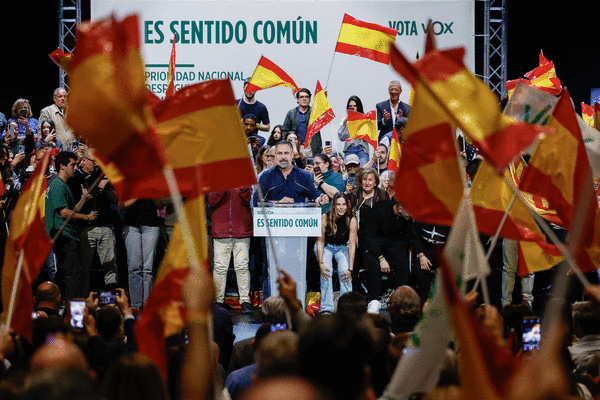
In the febrile days after a horrific train crash killed 69 people on the high-speed line to Ciudad Real, a large crowd is gathering in the Spanish city’s historic center. By lunchtime the medieval main square is packed.
They are all there to greet Santiago Abascal, who is set to take the far-right into government in Spain for the first time since the death of General Francisco Franco. Here, some 120 miles (200 kilometers) south of Madrid, lies the beating heart of Castilla de la Mancha, the setting for Don Quixote. And here the 50-year-old leader of Vox is treated like nothing short of a rockstar.
There are thousands of supporters — seniors, parents with strollers, dog-owners. There’s even a group of girls wearing scarves in the dark green colors of the Civil Guard police.
Most of the fans are young people. They are carrying Spanish flags, wristbands and phone cases in patriotic red and yellow. As they sense his approach they start to chant, “Presidente! Presidente!” Some clamber onto marble benches around the square to catch a better view. Others break through the security cordon and lunge toward him.
“We dare to say it,” Abascal tells his rapt audience from an improvised lectern. “This government’s betrayal kills, this government’s corruption kills, and this government’s ideological fanaticism kills.”
His turbo-charged rhetoric has been the secret to the rise of Vox, which has been polling in third place ahead of the election on Nov. 29 and surveys signal it should be able to form a majority alongside the conservative People’s Party. Most observers expect the two parties to form a coalition to oust Socialist Prime Minister Pedro Sánchez, who has ruled for over eight years.
Sánchez has been juggling a series of domestic crises, including an unprecedented nationwide power blackout, a mass illegal border crossing into the Spanish North African city of Ceuta and two high-speed rail accidents.
“We need change in Spain,” says Melissa Aldaria, 23, a university student at the nearby city of Daimiel. “Vox is the only party that is standing firm and proposing it.”
Abascal’s populist invective is not to everyone’s taste. A lone egg, launched from far back in the crowd, sails toward him and lands nearby.
In 2023 Vox won 12%. On Sunday, it’s projected to largely exceed that result. According to many sociologists, that’s because the protest vote in Spain has shifted from the far left to the far right since the last election. The political winds in Europe have also moved to the right.
Vox has honed in on its anti-immigration message, trying to persuade Spaniards that their traditions are under threat. Abascal’s argument is that he’s seeking to bring Spain into line with other European capitals that have been toughening controls in recent years, drawing inspiration from Giorgia Meloni’s Italy and Marine Le Pen in France.
Vox draws the strongest support from a specific demographic, one that is particularly disgruntled about the cost-of-living crisis. It is the preferred party among men aged 18 to 44, according to an October survey by the publicly funded pollster CIS.
“Young people are desperate because they can see the future looking increasingly bleak,” says José María Montoya, 22, who is pursuing degrees in Agricultural Engineering and Business Administration. “We’re exhausted from seeing people our age, people who share our ambitions, finding it more and more difficult to start a business and get ahead.”
The PP’s leader, Alberto Núñez Feijóo, may become the next prime minister. But over the long term he faces a challenge to fend off Vox, which is tapping into a sense of frustration with the dominance of the PP and the Socialists, who have alternated in power for more than 40 years.
“The PP has become far too comfortable,” said Fernando Sánchez-Mejías Parias, 30, a former PP voter from Seville who’s switched his allegiance to Vox. “When one party is in government, it never really fixes things the other party did wrong. Then, when the other party comes back, it does the same.”
Spain has for years been Europe’s fastest-growing major economy but much of that growth has been driven by waves of immigration that have dramatically increased the size of the workforce. At the start of the century Spain had a population of just over 40 million. Now it’s almost 50 million.
Sánchez encouraged that trend, granting residency to as many as a million undocumented migrants through a special process this year and adding 3.2 million people in total to the census since he took office in 2018.
One of the policies that Vox wants to implement is to start expelling people who it considers shouldn’t be living in Spain.
“The question is no longer who else can come in, because there is no room for anyone else,” Abascal said on Nov. 17 at a campaign event in Lanzarote. “We need to start thinking about how many people to get rid of.”
Under the slogan “It’s Common Sense,” the party’s election manifesto promises to start sending migrants back to their countries of origin, and to deport even Spanish citizens who’ve been convicted of certain crimes or who promote more severe forms of Islam. They also want to ensure that Spanish citizens have preferential access to public services and benefits.
Vox wasn’t always this hardline.
When it was formed as a breakaway from the PP in 2013, the party was initially more nuanced in its views. Its founders included former officials and prominent public figures, some of them aristocrats, and their main focus was on pushing for more free-market economics.
But since the last election in 2023, and especially with the resurgence of Donald Trump’s MAGA movement in the U.S., those economic liberals have been purged and the party has switched its focus to defending what it calls Spain’s traditional values.
Opposition to immigration and the fight against Islam have become Vox’s main concerns, alongside hostility toward Sánchez, whom Abascal openly calls a “dictator.”
The party has attacked the nationalist movements in Catalonia and the Basque region, where Abascal grew up, and subscribes to the standard culture wars views of far-right groups across Europe on climate policies and support for LGBTQ+ communities.
Vox has yet to clarify what role it wants in the next government and depending on how well it does, could play hardball tactics with the PP. If the party outperforms its polls and Abascal feels he has a strong hand, he might demand strategic ministries such as defense, interior or foreign affairs.
Another option would be to support Feijóo without joining the government to avoid becoming too closely associated with the PP.
Despite their clear differences, Abascal and Feijóo have been trying to avoid disagreements on the campaign trail. Both know that, if the polls are right, they will need each other after the election.
The risk for Feijóo though is that Abascal ultimately doesn’t want to complement the PP, but to replace it.
©2026 Bloomberg L.P. Visit bloomberg.com. Distributed by Tribune Content Agency, LLC.












































Comments